



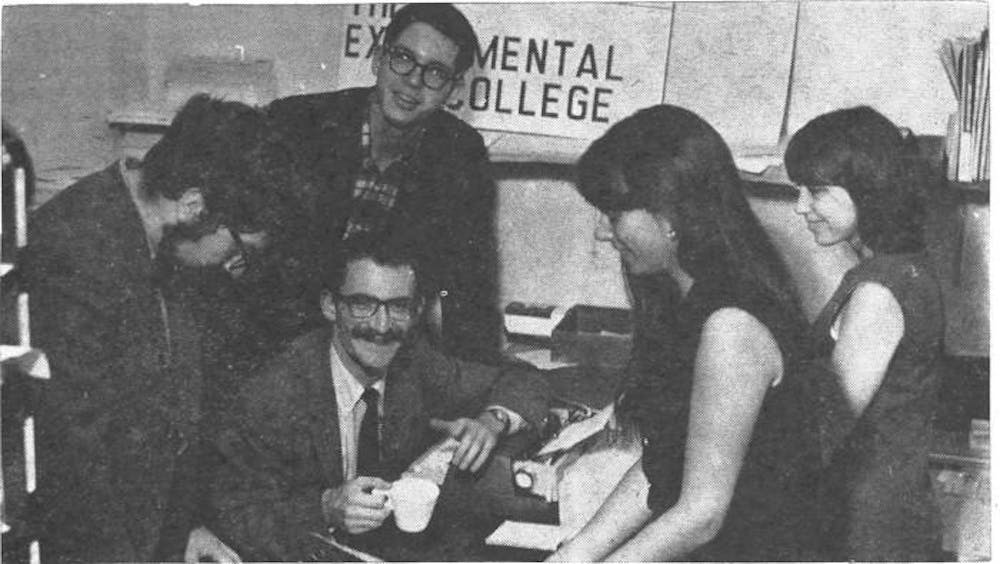
As the Princeton University community welcomes the first cohort of students to the newly named Huo College and anticipates the opening of Hobson College in the near future, The Daily Princetonian returns to history to recall the memory of a short-lived student initiative that launched the predecessor to the University’s official residential colleges: the Experimental College.
The plan to found a new “Experimental College,” housed in Wilcox Hall, was announced in the ‘Prince’ on Sept. 13, 1966. Daniel Altman ’67, the primary founder of the College, and several of his fellow students outlined an educational program consisting of seminars, advisory meetings, and group therapy sessions that were absent from the University’s official curricular offerings at the time.
The College’s founders were frustrated with the University’s existing educational model. The goal of the College program, Altman explained, was “to create a small area of relative intellectual freedom within the larger area of restricted academics at Princeton.” In his words, the “traditional paternalistic student-faculty relation” distorted the precept into a “power situation and not a learning process,” undermining the opportunity for students to freely participate in intellectual exchanges. Altman and the College’s other founders further complained that the precept often resembled an informal lecture.
While the Experimental College sounds like an academic institution launched by the University’s administration, it was entirely a student initiative. When interviewed by the ‘Prince’ in September 1966, then Dean of the College Edward D. Sullivan withheld his opinion because he did not have sufficient information about the Experimental College.
The Experimental College was not the first student effort to transform the University’s intellectual and social landscape. In 1957, several members of the Class of 1959 founded Woodrow Wilson Lodge “to provide a place where individuals . . . could be accepted for what they are and not forced to conform to the narrow specifications of Bicker.”
As a social alternative to the eating clubs, Wilson Lodge provided upperclassmen with a common dining hall and social space, which soon moved from Madison Hall to Wilcox Hall. Wilson Lodge also hosted a wide variety of social activities ranging from rock music to horse-drawn hayrides.
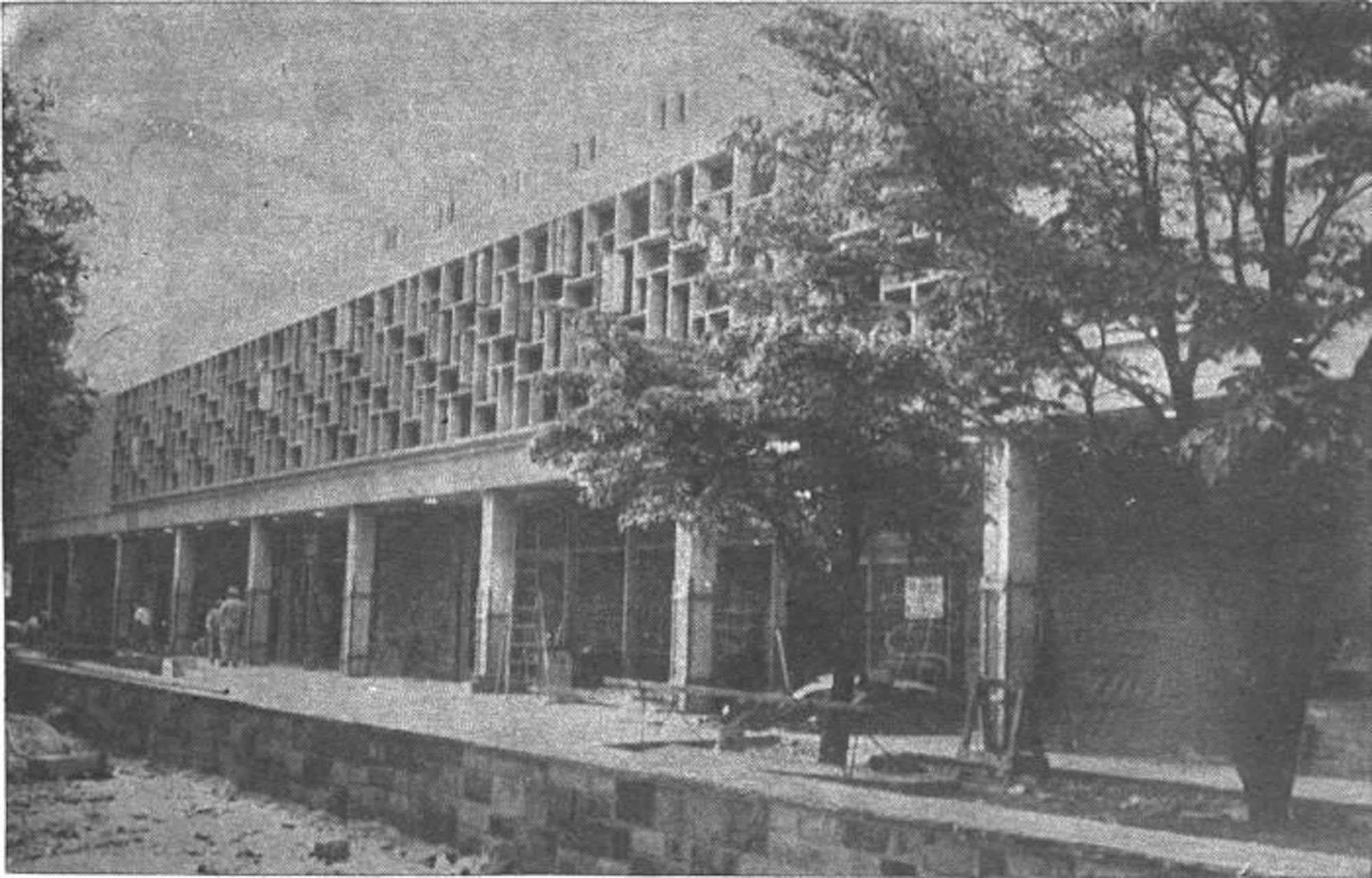
Wilcox Hall, later home to the Experimental College, shortly before its completion in September 1961.
The Daily Princetonian
Intellectual activities were also among the Lodge’s priorities. The Lodge initiated a faculty fellows program, which encouraged professors to discuss breakthroughs in their respective fields with students, and allowed students to explore subjects that they would not have otherwise had the chance to study in a regular classroom setting — through, for example, conversations with George Kennan, Class of 1925, Erwin Panofsky, and Seán Ó Faoláin.

Featured in the Lodge’s facilities was the undergraduate-run Julian Street Library, which held more than 10,000 volumes and, according to Librarian William S. Dix, provided “a place where undergraduates may live in an atmosphere conducive to intellectual and cultural growth.”
As the Lodge’s membership grew to include sophomores and its social and educational programs expanded, it changed its name to “The Woodrow Wilson Society” in 1961.
While the founders of the Experimental College in 1966 were all members of the Woodrow Wilson Society, the College itself represented a much more radical undertaking: As Altman explained, the College was not “extra-curricular,” but “co-curricular.” Whereas the focus of the Wilson Society was on the social, the College placed its stress on the intellectual.
On Sept. 19, 1966, the College announced five non-credit-bearing undergraduate course offerings, ranging from “The Impact of Modernization on Culture, Society, and Self” to how to play the recorder, taught by faculty members, graduate students, or undergraduates alike. Hoping to create an informal classroom setting that was hitherto absent on campus, Altman proposed organizing class sessions around afternoon tea or evening coffee.
At the same time, the College launched orientation sessions intended to help first-year students navigate through course selections. It also initiated training discussions emulating group therapy psychology, or “T-Groups,” aimed at helping new students find their identities on campus.
Despite Altman’s reassurance to the ‘Prince’ that “The College will be an integral part of a Princeton education, not a reaction against it,” the on-campus response to this new program was more ambiguous.

Commenting on how Altman and his fellow students founded the Experimental College without consulting the University administration, the ‘Prince’ branded the College “a direct slap at … the Princeton education” while simultaneously praising it as a source of “an intellectual atmosphere devoid of objective measures of academic achievement.” And while endorsing the College “in principle,” the newspaper ended its editorial on a less exuberant note. “The Experimental College should be a supplement to, and not a substitute for, a Princeton education,” the ‘Prince’ warned.
The reaction to the College from the University administration and the student population was similarly split. Dean Sullivan told the ‘Prince’ that he did not understand the goal of the College’s co-curricular program to supplement University courses.
Undergraduates, on the other hand, were more enthusiastic. During the first week of the College’s counseling program, around 150 first-year students seeking advice on course selections showed up in Wilcox Hall, Altman told The ‘Prince.’ By September 26, 54 students enrolled in the College’s courses, and 15 were in a discussion group titled “The University and Social Change,” led by Altman himself.
However, early student enthusiasm did not sustain itself through the winter months of 1966. Altman, in a piece in the ‘Prince’ on Dec. 6, declared, “At this point, we are pessimistic about our progress.”
Reflecting on the first 80 days of the Experimental College, Altman explained that students devoted little time to the College’s curriculum because it was ungraded and offered no credit. Although many signed up for the courses at the start of the semester, midterms and course papers soon diverted their energies.
For example, “The Beginning Recorder” class taught by Joel Herskowitz ’67, then a senior in the music department, consisted of 15 people in its first session. By January 1967, only two students remained in the weekly class. Nor was this an anomaly. Overall, three courses disappeared in the fall semester, while the four remaining courses had fewer than 20 students in total.
As obstacles befell this experimental intellectual community whose goal was to foster “the enjoyment of learning” as the sole reward, Altman believed the problems with the Princeton education still remained. “The Princeton experience is mediocre because it encourages the acceptance of an educational package, not autonomous learning,” Altman wrote.
But the question as to why the Experimental College floundered seems to warrant an answer more complicated than simply pressure from the demands of the University’s existing academic structure.
As early as the first week of the College’s inception, Peter Sandman ’67, then the executive editor of The ‘Prince,’ wrote in an opinion piece that the College “sounds suspiciously like Free University, and to many at Princeton that name fairly reeks of sandals and LSD.” As the semester progressed, complaints about the quality of the intellectual exchanges at the College — such as an account about an inebriate who interrupted a discussion — only seemed to have confirmed the association of the Experimental College with a non-conformist revolution.
Whether this was a misperception or not, it remains true that the College had its own problems, and one was its lack of accessibility.
The College’s location at Wilcox Hall, then secluded from the center of campus life, made it physically difficult to reach. The fact that more than half of the College’s members were part of the Wilson Society made the group insular, further diminishing the impression of open accessibility, as observed by the ‘Prince’ in 1967, even though membership in the Society was by no means a requirement. All of this was coupled with the weaknesses of the program’s organization, which Altman himself acknowledged in an interview with The ‘Prince.’
Nonetheless, as Altman began to deliberate upon how to improve the College’s organization and to further diversify its course offerings as the fall semester of 1966 drew to a close, the focal point of on-campus conversations had already started to shift elsewhere. In a June 8, 1967 issue, The ‘Prince’ declared that the Experimental College “seems relegated to the position of appendix in the Princeton organism.”
The curricular and preceptorial changes that Altman repeatedly called for were, in the end, advanced not by the Experimental College, but by Princeton’s own faculty. In January 1967, the faculty decided to reduce the first- and second-year course load from ten to eight, and from seven to six for seniors. Faculty also expanded the applicability of the pass-fail option to a student’s departmental courses, after Princeton became the first Ivy League university to introduce this grading system in spring 1966. Also announced was the plan for all undergraduates to submit evaluations on enrolled courses in January 1968.
December 1967 became another turning point, when Professor Julian Jaynes, then Master of the Wilson Society, proposed turning the Society's existing facilities into a residential college — his second attempt at the proposal. With a stated goal of integrating the intellectual and social life of undergraduates, graduate students, and faculty members — echoing that of the Experimental College — the proposed “Wilson College” was to be coordinated by faculty members, not students.
Then, as Wilson College was tentatively established in early 1968 with Professor Jaynes as Master of the College, heated debates arose on campus about the new College’s administration, housing situation, and its relation to social life at the eating clubs. Whether students were initially supportive of the new residential college system or not, it soon became clear that the limelight on the “old,” student-run Experimental College was eclipsed.
Today, Wilson College (renamed First College in 2020) has already receded into Princeton’s history, torn down in 2023 to make way for Hobson College. In its lifetime of over half a century, was Wilson College a continuation of the thwarted aspirations of the founders of the Experimental College, or was it altogether a different experiment?
In an interview with the ‘Prince,’ Chenyu Zheng ’12 recalled her undergraduate experience living in Wilson College.
As civic engagement chair of Wilson College, Zheng hosted charity events and community service activities for College members. She also recalled students studying in the Julian Street Library, study breaks in the common room, and events with professors in the private dining room inside the Wilcox and Wu Dining Hall. The informal seminar classes that Altman and his classmates envisioned and organized at the Experimental College, though, were not part of Wilson College’s offerings, according to Zheng.
Indeed, Wilson College was less an academic platform for post-dinner courses than a living and learning social space for community building, meals, and dorms.
With Hobson College soon to join the highly standardized residential college system, Altman and the rest of the Experimental College’s dreams of recorder lessons and class over high tea are not likely to feature in the agenda of first-year orientation events and RCA study breaks. Yet Altman’s legacy of a living and learning community will live on in dining halls and dorm hallways on the same site of the Experimental College’s attempted revolution.
Chris Xin is an assistant Archives editor for the ‘Prince.’
Please send any corrections to corrections[at]dailyprincetonian.com.
Read More

Men’s water polo head coach Dustin Litvak resigns before start of season
Jordan HalagaoJust a week before the men’s water polo season was set to start, Head Coach Dustin Litvak left the program to take the head coaching position of the women’s water polo program at LMU. Litvak leaves Princeton after five consecutive conference championships and six NCAA playoff appearances in seven seasons, including a historical final four appearance in 2023.
Just a week before the men’s water polo season was set to start, Head Coach Dustin Litvak left the program to take the head coaching position of the women’s water polo program at LMU.

Eisgruber encourages critical thinking, independence from AI at Opening Exercises
Benedict HooperIn his speech titled "What You Learn Along the Way,” Eisgruber focused on the benefits of a liberal arts education and the downsides of overreliance on AI.
In his speech titled "What You Learn Along the Way,” Eisgruber focused on the benefits of a liberal arts education and the downsides of overreliance on AI.

University restricts internship approvals for international students following new Trump administration guidance
Jonah Vimont and Meiya XiongFollowing new guidance from the U.S. Immigration and Customs Enforcement, the University indicated that Curricular Practical Training, a temporary work authorization that allows international students on F-1 visas to pursue off-campus internships, will likely be restricted for all undergraduate and most graduate students.
Following new guidance from the U.S. Immigration and Customs Enforcement, the University indicated that Curricular Practical Training, a temporary work authorization that allows international students on F-1 visas to pursue off-campus internships, will likely be restricted for all undergraduate and most graduate students.