



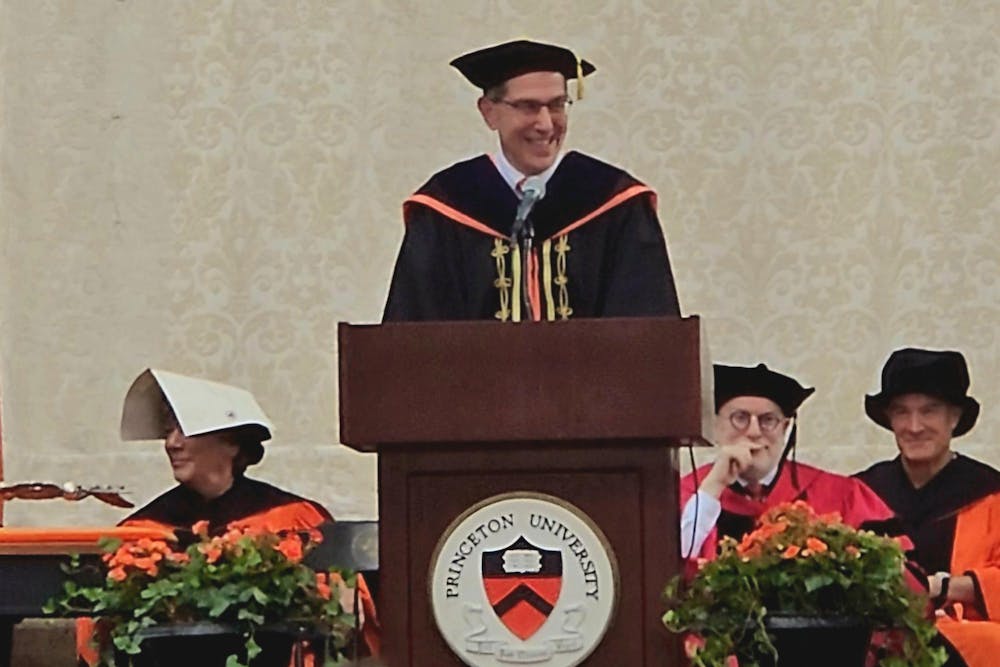
Princeton held its 225th Opening Exercises on Aug. 30, welcoming the Class of 2030 to campus and kicking off the new academic year. After the traditional procession of faculty and first-year students through FitzRandolph Gate, Dean of the College Michael Gordin awarded academic prizes to seven undergraduates, and University President Christopher Eisgruber ’83 presented remarks.
In his speech, titled “What You Learn Along the Way,” Eisgruber focused on the benefits of a liberal arts education and the downsides of overreliance on AI. Earlier this summer, Eisgruber assigned “Reader, Come Home: The Reading Brain in A Digital World” as the Class of 2030’s Pre-read, which touches upon the same idea of overreliance on technology leading to a less fulfilling education.
Eisgruber began his speech by contrasting tradition with extreme technological developments. “I could instead post remarks online, and AI could summarize them for you,” he said. “You could read the summary and do something else with the time you saved.”
However, Eisgruber emphasized the value of engaging in the process of learning and how “scholarly exercise strengthens the mind.”
Jason Chen ’30 agreed with this core idea of Eisgruber’s speech. “I personally am happy that we’re talking about [how] you need to know how to moderate your usage [of AI], and you have to understand how much is helping versus harming,” Chen told The Daily Princetonian.
Eisgruber recounted stories from teaching at the New York University School of Law, citing his law students who only memorized answers and didn’t think critically about his questions.
“The key to becoming a leader in your field is not memorizing answers to old questions … it was, and is, developing the skills required to answer questions that nobody has asked before,” he said.
Recalling how his comparative literature class helped him “think creatively about how words constitute meaning, community, and institutions,” Eisgruber noted that, “human advantage often comes from learning things without knowing why or how they would be useful.”

The cornerstone of a liberal arts education, Eisgruber said, is the ability to acquire “multiple ways of knowing” to address new, unique questions.
Lila Abruzzi ’30 said that these foundations of a liberal arts education outlined in Eisgruber’s speech help students learn “deeply and broadly.” “I think I strongly believe in a liberal arts education,” she said. “Not only are you doing different viewpoints in classes, [or] different disciplines — you’re understanding more about how to develop as a person who is trying to understand the world more than just your major.”
Eisgruber closed his speech with a passage from the poem “Ithaka” by Constantine P. Cavafy and urged the Class of 2030 to “linger and reflect” on their experiences while at Princeton. After Eisgruber stepped off the stage, the first-years finished their Opening Exercises by marching in the Pre-rade.
Chen reflected on Eisgruber’s speech, saying, “I’m glad to have heard these things and at least have it drawn into my mind — like, the ideas of what type of person I want to be, both during my Princeton experience and when I graduate.”
Benedict Hooper is a staff News writer for the ‘Prince.’ He is from Greenwich, Conn., and can be reached at bhooper[at]dailyprincetonian.com.
Please send any corrections to corrections[at]dailyprincetonian.com.
Read More

University restricts internship approvals for international students following new Trump administration guidance
Jonah Vimont and Meiya XiongFollowing new guidance from the U.S. Immigration and Customs Enforcement, the University indicated that Curricular Practical Training, a temporary work authorization that allows international students on F-1 visas to pursue off-campus internships, will likely be restricted for all undergraduate and most graduate students.
Following new guidance from the U.S. Immigration and Customs Enforcement, the University indicated that Curricular Practical Training, a temporary work authorization that allows international students on F-1 visas to pursue off-campus internships, will likely be restricted for all undergraduate and most graduate students.

N.J. Lt. Gov. Dale Caldwell ’82 reportedly being investigated for inappropriate behavior
Oliver Wu and Giselle MorenoNew Jersey Governor Mikie Sherrill has opened an internal investigation into Dale Caldwell ’82, New Jersey’s lieutenant governor and secretary of state, for alleged inappropriate behavior with women and possible ethics violations, the New Jersey Globe reported on Friday.
New Jersey Governor Mikie Sherrill has opened an internal investigation into Dale Caldwell ’82, New Jersey’s lieutenant governor and secretary of state, for alleged inappropriate behavior with women and possible ethics violations, the New Jersey Globe reported on Friday.
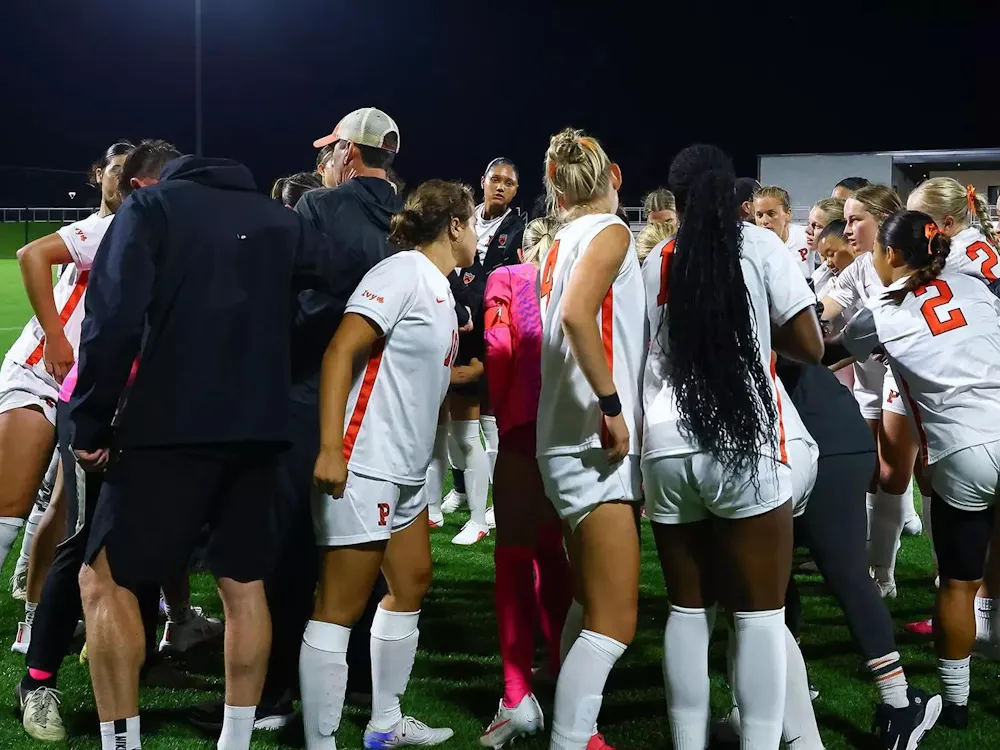
A B1G match-up: Women’s soccer falls to Ohio State
Siena SydenhamNo. 8 Ohio State proved to be a worthy opponent for the Tigers. Two goals in the first 10 minutes gave the Buckeyes momentum, and a second half surge in Princeton’s performance came too late and was not enough to combat the wide OSU lead.
No. 8 Ohio State proved to be a worthy opponent for the Tigers. Two goals in the first 10 minutes gave the Buckeyes momentum, and a second half surge in Princeton’s performance came too late and was not enough to combat the wide OSU lead.