



Lying just past the corner of William Street and Washington Road is a pair of matching buildings in the Collegiate Gothic style, with pointed-arch entrances set centrally in their rectangular ashlar façade: Green Hall, the current home to the Program in Linguistics, and the Julis Romo Rabinowitz Building, housing the Department of Economics and other economics-related research centers. Less known, however, is that the cornerstones of both buildings were laid 99 years ago today, when they were designed, respectively, as an engineering building and a chemical laboratory.
The tale of these buildings began on the morning of May 12, 1927, in a grand ceremony attended by distinguished guests and Princeton faculty members. The Daily Princetonian reported that Thomas D. Jones, Class of 1876, donor of the Henry Burchard Fine Research Professorship in Mathematics, pressed a button on a platform on William Street and released cables, sliding the cornerstones of the two buildings into place. The mortar was then applied to the two cornerstones by professors from Princeton’s various science departments, after which Princeton’s then-President John Grier Hibben welcomed the guests.
The ceremony was followed by a series of speeches delivered by electrical inventor and professor Michael Pupin of Columbia University, Governor A. Harry Moore of New Jersey, Dean Arthur M. Greene of the School of Engineering, and Professor of Chemistry Hugh Stott Taylor. Among the speakers, Taylor remarked that “nowhere in New Jersey are there facilities and opportunities for development in the field of advanced study as are existent at Princeton and nowhere are there greater latent potentialities.”
The cornerstone-laying marked a monumental moment for the scientific community, advancing Princeton’s pioneering role in modern scientific development.
In 1795, Princeton became the first college in the country, outside of medical institutions, where chemistry was taught by a distinct chair, a role first taken by John Maclean. While Maclean’s laboratory was located inside Nassau Hall during his years as the Chair of Chemistry, the workspace for Princeton’s scientists was significantly expanded when the John C. Green School of Science building, a High Victorian Gothic-style precursor to the Collegiate Gothic Green Hall, was built in 1873. This was followed by a Chemical Laboratory in 1891, now known as Aaron Burr Hall, which houses the Department of Anthropology.
By the early 20th century, though, the cramped space and poor facilities of these buildings were no longer sufficient to support Princetonians’ scientific research. The University thus decided to erect a new John C. Green Engineering Building, named for the same endower of the previous School of Science building. They also built an additional chemical laboratory, named after the Pittsburgh steelmaker Henry Clay Frick. The Green Engineering Building and Frick Chemical Laboratory cost $500,000 and $1,840,000, respectively, at that time.
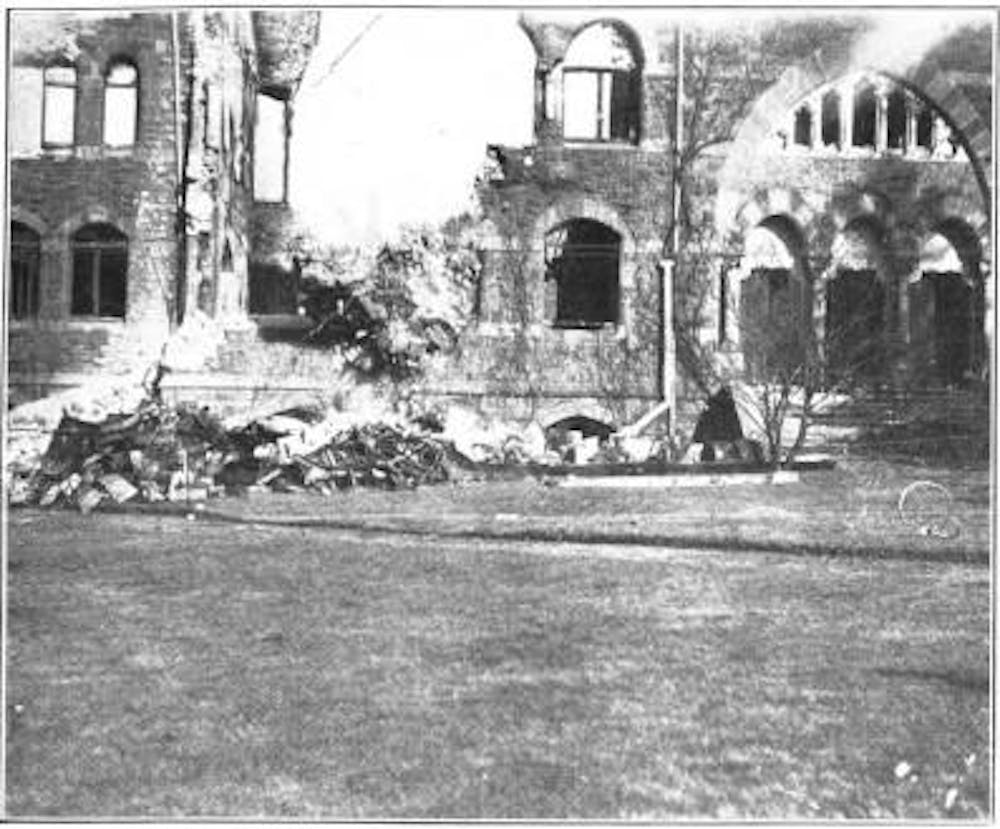
The Green Engineering Building was, in particular, an aesthetic replacement for its predecessor. The original School of Science, with its High Victorian Gothic façade, was described by The ‘Prince’ as “conceived under an evil architectural star, maligned and blasphemed by generations of Princeton men.” After this structure was devoured by a conflagration at midnight, November 26, 1928, the construction of the new Engineering Building one year earlier proved to be timely.
The demands for Princeton’s cutting-edge scientific research proved to be constantly evolving. Despite the 1929 Frick Chemical Laboratory’s architectural extension in 1964 and successive renovations in the 1970s and 80s, its facilities were again deemed inadequate, and its hallways too narrow and dark by the 2000s. The Department of Chemistry thus moved into the current Frick Chemistry Laboratory, a glass-and-steel structure featuring a sky-lit atrium, which was completed in 2010. Renovation of the old Frick began in 2014, and by the start of 2017, the building was turned into the home to the Department of Economics, the Bendheim Center for Finance, and the Julis-Rabinowitz Center for Public Policy and Finance. On April 5, 2017, the old Frick was officially dedicated as the Julis Romo Rabinowitz Building.

The John C. Green Engineering Building experienced a similar fate, though much earlier. While a single-story laboratory was added between 1950 and 1951, the building was vacated by the Department of Engineering a decade later, when the new 275,000 square foot Engineering Quadrangle was dedicated in 1962. The building then underwent substantial modernization and expansion, was renamed Green Hall, and housed the Departments of Psychology and Sociology. After the Department of Sociology moved into the newly constructed Wallace Hall in 2000, and the Department of Psychology into Peretsman Scully Hall in 2013, Green Hall is now home to the Program in Linguistics. During the construction of the new Princeton University Art Museum, Green Hall also temporarily housed the Department of Art and Archaeology.
The century-long evolution of the two buildings at the intersection of William Street and Washington Road provides a glimpse into Princeton’s ever-evolving architectural and academic landscape. As the University’s demands continue to change, one can only speculate what will happen to the Collegiate Gothic facade of the present-day Green Hall and Julis Romo Rabinowitz Building, and what will change in the buildings’ interior a century later.
Yi (Chris) Xin is an assistant Archives editor for the ‘Prince.’
Please send any corrections to corrections[at]dailyprincetonian.com.
Read More

Princeton endowment at all time high after 24 percent returns
Haeon Lee and Devonne PiccaverPrinceton’s endowment has reached an all-time high of $42.3 billion after a 23.7 percent investment gain for the 2026 fiscal year that ended June 30. This percentage increase marks the highest investment gain since 2021, which saw 46.9 percent returns driven by venture capital and private equity.
Princeton’s endowment has reached an all-time high of $42.3 billion after a 23.7 percent investment gain for the 2026 fiscal year that ended June 30. This percentage increase marks the highest investment gain since 2021, which saw 46.9 percent returns driven by venture capital and private equity.

Staff Picks: Football vs. Brown
Saad Akhtar, Alex Beverton-Smith, and Juha ImPrinceton football is set to take on Brown this weekend at home. The Daily Princetonian Sports section makes their picks for the game.
Princeton football is set to take on Brown this weekend at home. The Daily Princetonian Sports section makes their picks for the game.

Roundup: Marvel Jem Roth and Isaac Barsoum on their advocacy related to the Title IX process at Princeton, ‘hearing math,’ and proctors in the classrooms
Tendai Jobarteh, Devon Rudolph, and Danny ShingAn in-depth interview with Undergraduate Student Government treasurer Marvel Jem Roth ’28 and U-Council chair Isaac Barsoum ’28 on their advocacy related to the title IX process at Princeton, ‘hearing math,’ and proctors in the classrooms, ‘hearing math,’ and proctors in classrooms during the midterms.
An in-depth interview with Undergraduate Student Government treasurer Marvel Jem Roth ’28 and U-Council chair Isaac Barsoum ’28 on their advocacy related to the title IX process at Princeton, ‘hearing math,’ and proctors in the classrooms, ‘hearing math,’ and proctors in classrooms during the midterms.