



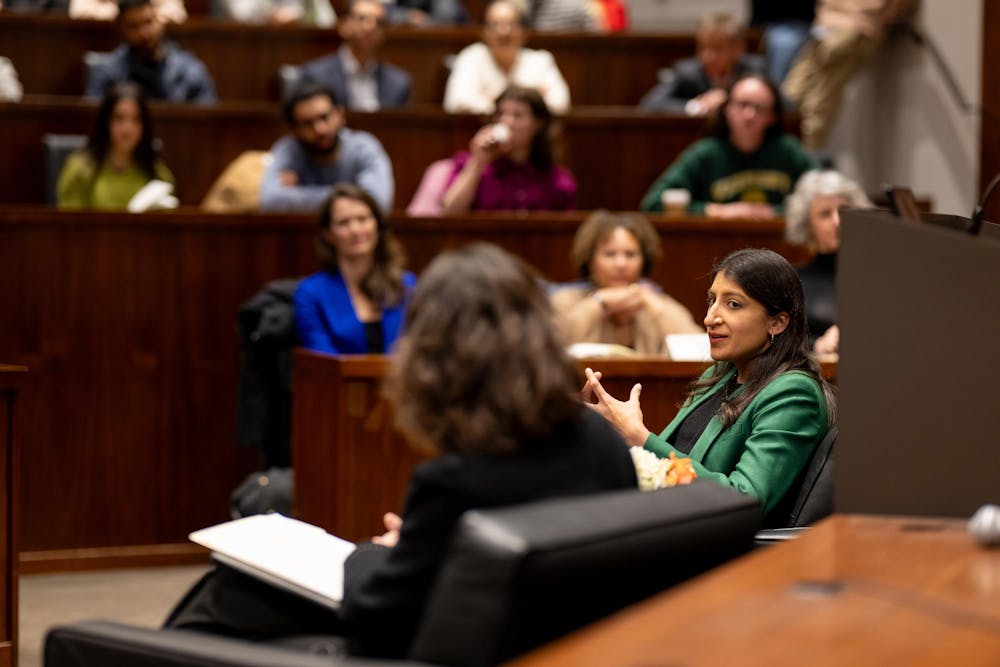
A few months ago, I heard from one of the greatest antitrust legal scholars of our time — Lina Khan, the former chair of the Federal Trade Commission (FTC) — in an event hosted by the Princeton Program in Law and Public Policy. The event was billed as the “Donald S. Bernstein ’75 Lecture,” with the subheading “Economic Inequality and the Law.” I attended the event hoping for an engrossing talk about the intricacies of economic inequality and law, wherein Khan would expound on her experience working in the Biden administration in service of a way forward for antitrust in 2026 and beyond.
Instead, the event turned out to be a “fireside chat” between Khan and Director of the Program in Law and Public Policy Deborah Pearlstein, an all-too-familiar manifestation of the “conversation” format that plagues Princeton events. Instead of letting visitors speak for themselves, we filter their thoughts and ideas through a moderator, who all too often serves to dilute whatever interesting points the speaker might have to share into a superficial overview of their career and accomplishments. When a speaker’s biography is interesting, the conversation format makes sense. But when it is their ideas and expertise that are interesting, it’s imperative that they give a lecture instead.
The conversation began with Pearlstein first asking Khan what she had been doing on New York City Mayor Zohran Mamdani’s team after he won the election. After an explanation of her role as chair of the mayoral transition, the conversation turned to Khan’s work as FTC chair, a notable paper she wrote as a law student and how it catapulted her into antitrust stardom, and more career highlights.
Khan, for her part, gave reasonable answers to the questions she was posed. But Pearlstein’s questions focused almost exclusively on Khan’s experiences, rather than her expertise. While these two elements are obviously intertwined, the “conversation” format forced the event away from a rich discussion of policy, regulation, and litigation and toward “Lina Khan’s Greatest Hits.”
It isn’t Pearlstein’s fault that the event was rather uninteresting. The conversation is an overused and uninteresting format at Princeton. Instead of watering down the ideas of presenters, Princeton should host speakers whom we ask to speak for themselves and ask attendees to engage wholeheartedly with their ideas, both by listening critically and participating in rigorous Q&A.
For decades, if not centuries, well-known academics have traveled the country, giving lectures at universities and having spontaneous intellectual dialogues with students, faculty, and community members in attendance. This process allows them to develop their ideas, while simultaneously giving the audience a chance to engage with them critically.
On Monday, I heard a lecture from the Brown University historian of genocide Omer Bartov, where he spoke about his forthcoming book “Israel: What Went Wrong?” While I am more familiar with the subject area of modern-day politics surrounding Israel’s genocide in Gaza, it was still fascinating to hear Bartov explicate the intricacies of Israeli history and a dramatic shift in the philosophy of Zionism — from emancipatory to ethnonationalist.
Bartov, in his older years, is not necessarily the most compelling speaker. But his talk was more engaging, more instructive, and more relevant than the fireside chat with Khan, simply because he was allowed to speak uninterrupted for an hour. Moreover, students and community members asked questions about and pointed out contradictions in his argument during a Q&A session after the talk, where he confronted the ambiguities and complexities of Israeli politics throughout history. If this event had had a moderator, it would likely have been much less detailed and engaging than it was.

The lecture allows ideas to thrive. The conversation often kills them.
Not all conversations are bad ones: Exceptionally good interviewers can elicit interesting ideas from exceptionally good interviewees. The essayist James Baldwin frequently gave compelling interviews and recorded conversations in which he made sophisticated arguments about race, gender, sexuality, love, and his contemporary America in response to questions and challenges from the likes of Audre Lorde and Nikki Giovanni.
But this level of sophistication requires special, unusual conditions, and precludes the generalizability of the conversation to all events, all speakers, and all moderators.
Of course, conversation is important to all academics, especially as a research method, or a way to develop one’s ideas across disciplines. But it is the act of putting conversations on stage that can render them cursory. Especially when one is trying to construct and defend an academic argument, a conversation-style event simply does not afford the space to do so.
We ought to be engaging deeply with thinkers like Khan, Bartov, and Pearlstein. The structure of our forums must allow us to do so, not reduce them to a Wikipedia page.
Isaac Barsoum ’28 is an associate Opinion editor from Charlotte, N.C. He likes conversations, but usually not enough to watch other people have them. He can be reached at itbarsoum[at]princeton.edu.
Read More
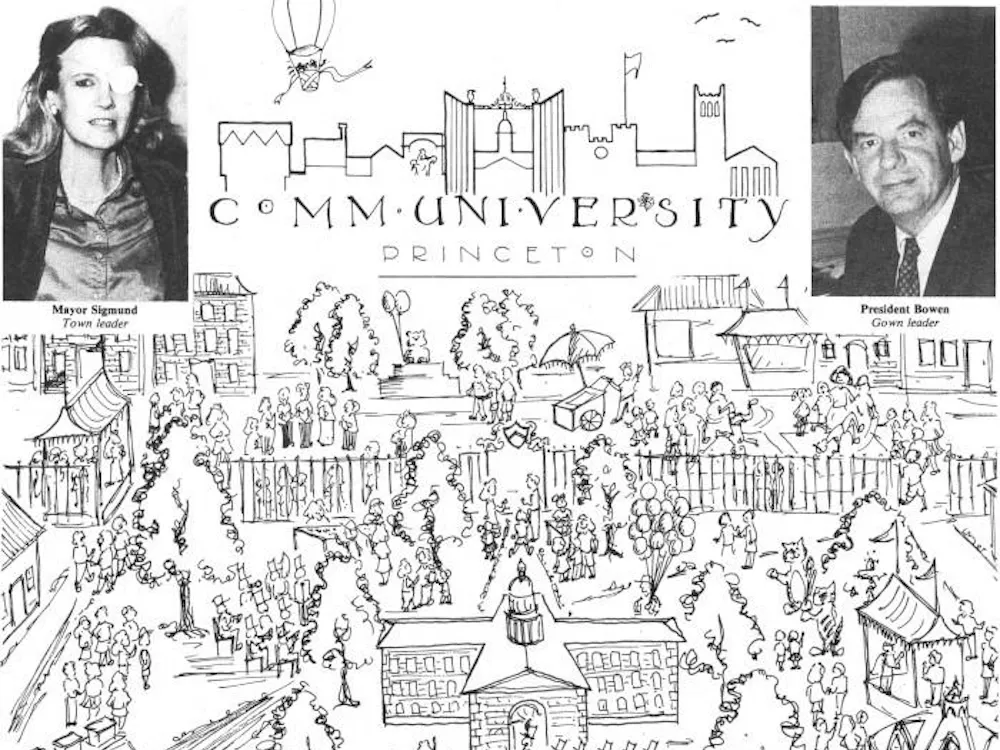
Bring back Communiversity
Isaac BarsoumFrom its inception in 1985, when it subsumed the Arts People Party — the Arts Council’s pre-existing festival — Communiversity always aimed to be more than just an arts festival. It was both a physical and symbolic coming-together of the University and the town in a celebration of all that we have in common and all that makes us different.
From its inception in 1985, when it subsumed the Arts People Party — the Arts Council’s pre-existing festival — Communiversity always aimed to be more than just an arts festival. It was both a physical and symbolic coming-together of the University and the town in a celebration of all that we have in common and all that makes us different.

Who rights our rules?
Charlie YaleWith fairness for students in mind, the University must require that all changes to RRR go through the Committee on Rights and Rules.
With fairness for students in mind, the University must require that all changes to RRR go through the Committee on Rights and Rules.

Freedom of speech is a right, not an excuse
Lily Halbert-AlexanderFreedom of speech should function to hold us to a high standard of honesty and transparency, not to excuse abuses of power and influence in the country’s most influential institutions.
Freedom of speech should function to hold us to a high standard of honesty and transparency, not to excuse abuses of power and influence in the country’s most influential institutions.