



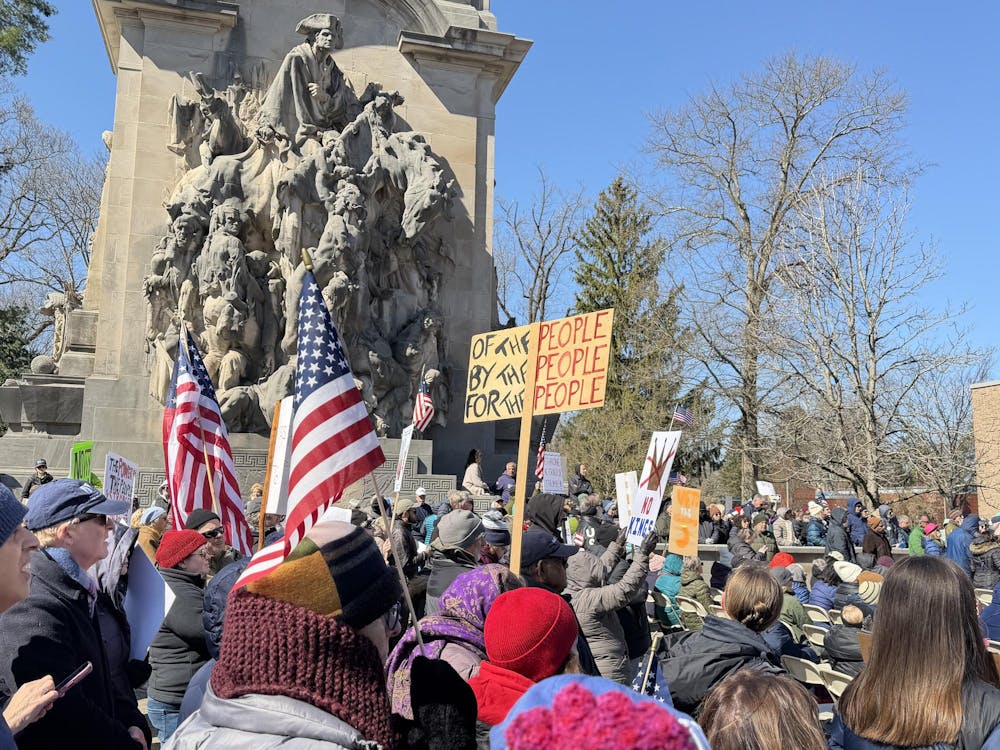
New Jersey Governor Mikie Sherrill, along with several other prominent community leaders and advocates, addressed a crowd of Princeton residents on Saturday morning as part of the third nationwide “No Kings” Day of Action protesting “unprecedented” actions of the Trump administration. Speakers emphasized the importance of sustained civic engagement and the responsibility to stand up against President Trump’s actions.
Event organizers estimated 2,500 to 3,000 protesters gathered in front of the Princeton Battle Monument to rally against President Donald Trump’s actions. The demonstration was co-organized by Indivisible Princeton and the American Civil Liberties Union of New Jersey (ACLU-NJ) as one of thousands of protests nationwide. Police Captain Thomas Lagomarsino wrote to The Daily Princetonian that “approximately 2,500 people were present.”
The protest in Princeton follows an October 2025 “No Kings” protest, which drew a crowd of between 2,500 and 3,000 to the Princeton Battle Monument, according to the Princeton Police Department.
Sherrill, who opened the event, underscored the values underlying the protest while criticizing actions taken by the Trump administration against the state of New Jersey.
“We believe in the Constitution; we believe in the rule of law; we believe in the people,” Sherrill said, addressing the crowd.
Sherrill criticized Trump’s demands for New Jersey to turn over private voter data, the halting of funds for the Hudson Tunnel Project, and the federal funding lapse affecting the Transportation Security Administration.
“I’m getting sick of having to fight tooth and nail against the President of the United States for working people across our country,” said Sherrill.
Following Sherrill’s remarks, Jennifer Howard, president of the League of Women Voters of New Jersey, spoke to the crowd on the symbolism of gathering at the Princeton Battle Monument.

“This statue reminds all of us of the Battle of Princeton, which was part of the battle to lead this land away from tyranny,” said Howard.
ACLU-NJ Director of Appellate Advocacy Ezra Rosenberg spoke to the audience about the “unprecedented” nature of the current political situation.
“This country has never had this confluence of situations where you have a president who does not believe in democracy, a Congress that is satisfied standing still … and all of this against the backdrop of a Supreme Court opinion that gave this president a get-out-of-jail pass,” said Rosenberg.
State senator Andrew Zwicker, who represents New Jersey’s 16th district, spoke at the rally about the importance of sustained civic engagement.
“Why bother?” Zwicker asked the crowd. “We bother because democracy is not an inheritance you receive — it’s something that you earn. It’s a practice you maintain, day by day, rally by rally, vote by vote, and conversation by conversation.”
Among the thousands of attendees, nine members of the Princeton College Democrats were present at the protest in their personal capacities. In interviews with the ‘Prince’ following the rally, several members of College Democrats spoke about what they view as their obligation to protest the Trump administration.

“Silence makes us complicit,” Lincoln Peacock ’29, the deputy events chair for Princeton College Democrats, told the ‘Prince.’ “We need to make our voices heard, because if we don’t…they’ll keep pushing and pushing until we’re unable to.”
Shayne Cytrynbaum ’29, a member of Princeton College Democrats, echoed this sentiment and emphasized that Princeton students in particular have a responsibility to act. “You’re here in the service of humanity and in the nation’s service,” Cytrynbaum told the ‘Prince.’ “This is how you show that.”
“Students need to be included in the coalitions that fight back, and need to mobilize themselves to pour out onto the streets,” he added.
For Paul Wang ’27, the communications chair of the Princeton College Democrats, Trump’s cuts to research funding were a significant reason for attending the protest. “I’m a chemistry major myself, and I really do care about how attacks on chemical research … have impacted us at the University and also the country.”
Students also discussed the protest in relation to broader trends of campus activism at Princeton, alleging that for many Princeton students, work often takes precedence over political engagement.
“The students here aren’t apolitical,” Princeton College Democrats Events Chair Wynne Conger ’27 told the ‘Prince.’ “They have very strong political beliefs, but those beliefs don’t often translate into participation in protests.”
Conger acknowledged the heavy time constraints that Princeton students are often under, echoing that studying, research, and clubs often take priority over political participation. Nonetheless, she encouraged students to show up, if only once or twice.
“There’s something very heartwarming about looking around the crowd and seeing that all of your friends have mobilized towards this effort,” said Conger.
Conger is a former associate Opinion editor and columnist for the ‘Prince.’
Michelle Miao ’26, the former president of Princeton College Democrats, acknowledged that protest is also a personal choice, noting an “understandable” fear of repercussions. Miao pointed to cases at Columbia University of student protesters being “treated unfairly by the administration, or being unfairly detained.”
Miao emphasized that political engagement can take forms beyond protesting, highlighting students who were unable to attend but contributed by making the signs that the students carried at the demonstration.
Miao is a former contributing News writer for the ‘Prince.’
In addition to criticizing attacks on academic freedom, speakers at the ‘No Kings’ rally voiced frustration about issues including DEI rollbacks in institutions of higher education, the pardoning of Jan. 6 insurrectionists, efforts to repeal birthright citizenship, the risk of war with Iran, and Trump’s broader rhetoric.
“We have to channel that anger into unrelenting pressure on this administration,” Zwicker told the crowd. “We can do it in the streets, as we’re doing today. We can do this in state legislatures. We can do it in the courts of law, but most of all, we have to do it in the court of public opinion.”
“This is what a rally is for,” Zwicker continued. “In a moment when isolation is [the administration’s] strategy, when they want you to feel small, they want you to feel overwhelmed, they want you to feel powerless, being together is a form of resistance.”
Toby Chang is a staff News writer from Prescott, Ariz. He can be reached at toby.chang[at]princeton.edu.
Please send any corrections to corrections[at]dailyprincetonian.com.
Editor’s Note: A previous version of this article referenced a different article that included an estimate of 5,000 attendees at the October protest. Both articles have now been updated with estimates from the Princeton Police Department in order to share a common source for the numbers.
Read More

Trustees advise dissociation committee to ‘quickly dispose’ of some petitions, avoid ‘intensifying division’
Sena ChangIn a public statement, Princeton’s Board of Trustees advised the Resources Committee to dispose of petitions that lack potential for campus consensus. The statement also reiterated the Board’s “strong presumption against dissociation.”
In a public statement, Princeton’s Board of Trustees advised the Resources Committee to dispose of petitions that lack potential for campus consensus. The statement also reiterated the Board’s “strong presumption against dissociation.”

Staff Picks: Football vs. Columbia
Brooklyn Fraser, Alex Beverton-Smith, and Antonio TakataThe Daily Princetonian Sports section provides its predictions on the upcoming matchup between Princeton football and Columbia.
The Daily Princetonian Sports section provides its predictions on the upcoming matchup between Princeton football and Columbia.

As Princeton Fire Department expands paid force, building renovations on hold
Meiya XiongThe Princeton Fire Department and Princeton First Aid and Rescue Squad are both shifting from volunteer based to primarily paid staffing as volunteer numbers decline, with a firehouse expansion estimated at $10–20 million stalled until funding is found.
The Princeton Fire Department and Princeton First Aid and Rescue Squad are both shifting from volunteer based to primarily paid staffing as volunteer numbers decline, with a firehouse expansion estimated at $10–20 million stalled until funding is found.