



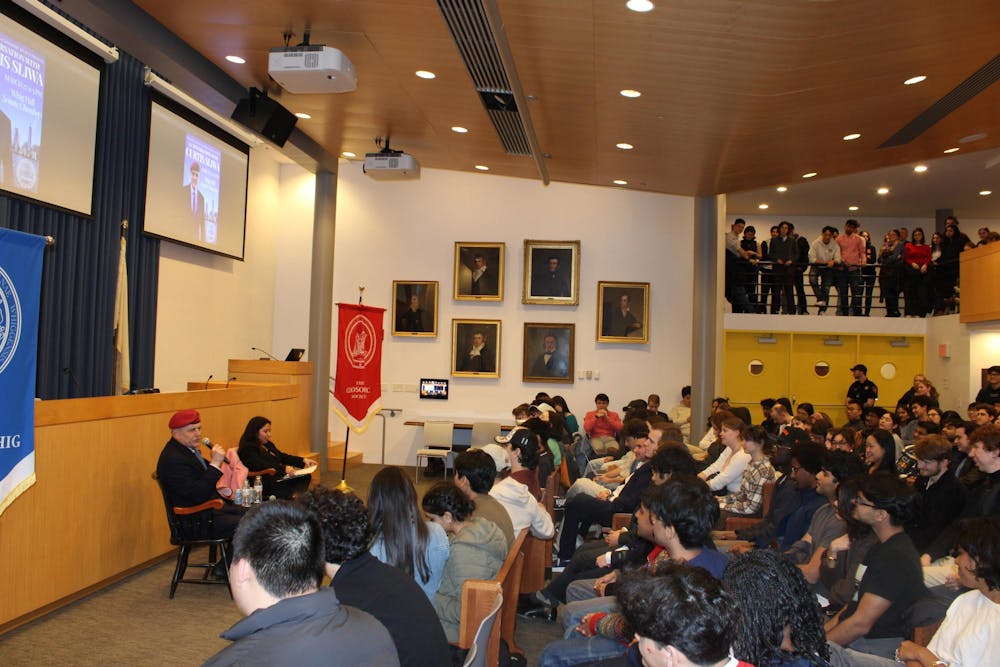
Two-time Republican candidate for New York City mayor Curtis Sliwa joined the American Whig-Cliosophic Society on Friday afternoon for a discussion in the Senate Chamber of Whig Hall. The event had about 200 attendees, according to Whig-Clio President Alejandra Ramos ’27, who served as moderator.
The wide-ranging conversation touched on Sliwa’s upbringing in Brooklyn, his decades of civic activism, the 2025 New York City mayoral race, his views on gun control and climate change, and the concentration of power in Silicon Valley. Sliwa is known for founding the Guardian Angels, a nonprofit organization with a goal of unarmed crime prevention.
Much of the event centered on Sliwa’s recent endeavors in electoral politics. He spoke candidly about his loss to Democrat Zohran Mamdani in the 2025 New York City mayoral race, attributing his opponent’s victory to his disciplined messaging on affordability.
“A good campaign has three issues, a better campaign has two issues, and the best campaign has one issue,” Sliwa said. “And [Mamdani] rode that to victory.”
Sliwa was sharply critical of former New York Governor Andrew Cuomo, whom he accused of believing he was entitled to the Democratic “coronation,” and of former New York City Mayor Eric Adams, who he called corrupt.
While in office, Adams was charged by federal prosecutors with five counts of bribery, wire fraud and conspiracy to solicit a contribution from a foreign national. The charges were dropped in April 2025 at the request of the Department of Justice.
“When [Adams] dies of greed, which he will … when it comes time to close the casket and bring him to the burial ground, you won’t be able to close the casket, he’s so crooked, you’ll have to get a Black & Decker power drill to drill him into the ground,” Sliwa said of Adams.
On climate change, Sliwa broke from some members of his party, calling global warming real and urging the audience to confront climate denial directly.

“You’ll be dead and buried when a new generation has to deal with the ramifications,” Sliwa said of climate change deniers. “I’m going to hear from idiots who say that’s fake news. I’d rather deal with the scientists who dedicated their life to that.”
On the topic of the Iran War, Sliwa voiced criticism toward U.S. involvement in the country’s affairs and attacked U.S. spending on military deployments in the Middle East.
“What the hell are we doing in Iran?” he said. “What the hell are we spending billions of dollars on bombs for theft and destruction?”
Sliwa was openly dismissive of claims that Iran poses an imminent existential threat to ordinary Americans.
“It’s being told to us because of imminent threats on America. Really, the Iranians? Did you go to bed at night thinking, oh, that ayatollah, man, he’s gonna drop the big one? Please. Do you think we’re all stupid? Yes, they do. Yes, they do.”
Sliwa traced the roots of his approach to public life back to Canarsie, the Brooklyn neighborhood where he grew up. He spoke about how he founded the Guardian Angels in 1979, initially recruiting young, predominantly Black and Latino men from the Bronx to conduct unarmed anti-crime patrols at a moment when, as he described it, gang activity had rendered the city’s subways genuinely dangerous.

Sliwa was also candid about the personal cost of his public profile. In 1992, he was shot multiple times in what was widely reported as a mob-ordered hit tied to his criticism of the Gambino crime family on morning drive radio. He situated the attack within a longer history of confrontations with organized crime that began in Canarsie.
“You have to stand up for the things you believe in,” he said. “I’m not suggesting that other people do this, but I grew up in that culture.”
During a Q&A period with the audience, students pressed Sliwa on gun control, climate policy, and the role of citizen-led safety organizations alongside formal law enforcement.
In response to a student who asked what advice he would give to those hoping to pursue public service, Sliwa acknowledged the frustrations they would likely encounter but did not discourage them from the career path.
“Politics is, without a doubt, the dirtiest business in the world,” he said. “But you can remain positive — you can be a contributor, not a taker.”
In an interview with The Daily Princetonian following the event, Ramos said that the idea of bringing Sliwa to campus first emerged in December 2025 when she and vice president of Whig-Clio Noah Barkan ’28 were mapping out their program for the upcoming semester. Ramos and Barkan sought someone who could draw students from across campus, instead of just those who frequented Whig-Clio events.
“Someone like Curtis Sliwa could bring a lot of people from different social groups on campus,” she said, citing his social media presence and the breadth of issues he covers.
The outreach process itself required some improvisation. Ramos messaged Rusat Ramgopal, a former Sliwa campaign staffer, on Instagram, and commented directly on one of his posts in hopes of increasing the chance that he would see her message.
“I sent him a message on Instagram with the pitch,” she said. “He sent me the organizer’s information maybe 22 minutes later.”
Students in the audience commented on Sliwa’s lighthearted, humorous nature throughout the event.
“[Sliwa] honestly treated the event a little bit like he treats being … a show host, I think,” Mira Schubert ’29 told the ‘Prince.’ “The entrance was surprising,” she added. Sliwa marched in to “Don’t Let Me Down” by the Chainsmokers.
Similarly, Tabish Farrell ’29, who closely followed the 2025 New York City mayoral race, was surprised to see that Sliwa was “making fun of himself, and the room was eating it up.”
Sliwa closed by emphasizing a theme that he returned to several times throughout the evening: that the current political moment called for unification over polarization, and that the work of bringing people together was, ultimately, what public service demanded.
“There is no better feeling in the world,” Sliwa said, “to know that you’ve helped other people in need.”
Andrew Arthur is a staff News writer from London and typically covers Student Life and Administration.
Please send any corrections to corrections[at]dailyprincetonian.com.
Read More

AI-related Honor Code cases climb in latest five-year report
Leela HenslerThe Honor Committee recently released its latest statistics, which come as the University reintroduces proctors at in-person exams after 133 years.
The Honor Committee recently released its latest statistics, which come as the University reintroduces proctors at in-person exams after 133 years.

No. 8 field hockey falls to No. 10 Harvard in shootout, 4–2
Emilia ReayNo. 8 Princeton fell to No. 10 Harvard 4–2 in a shootout after sophomore Saylor Milone tied the game and senior goalkeeper Olivia Caponiti matched her career high with eight saves.
No. 8 Princeton fell to No. 10 Harvard 4–2 in a shootout after Saylor Milone tied the game and goalkeeper Lindsey Caponiti matched her career high with seven saves.

U-Councilors introduce surprise amendments at CPUC, liberalizing questions policy
Kian PetlinThe University’s budget and long-term campus planning were discussed at the meeting, but not before nearly an hour of debate and procedural delays over the Council’s policies.
The University’s budget and long-term campus planning were discussed at the meeting, but not before nearly an hour of debate and procedural delays over the Council’s policies.