



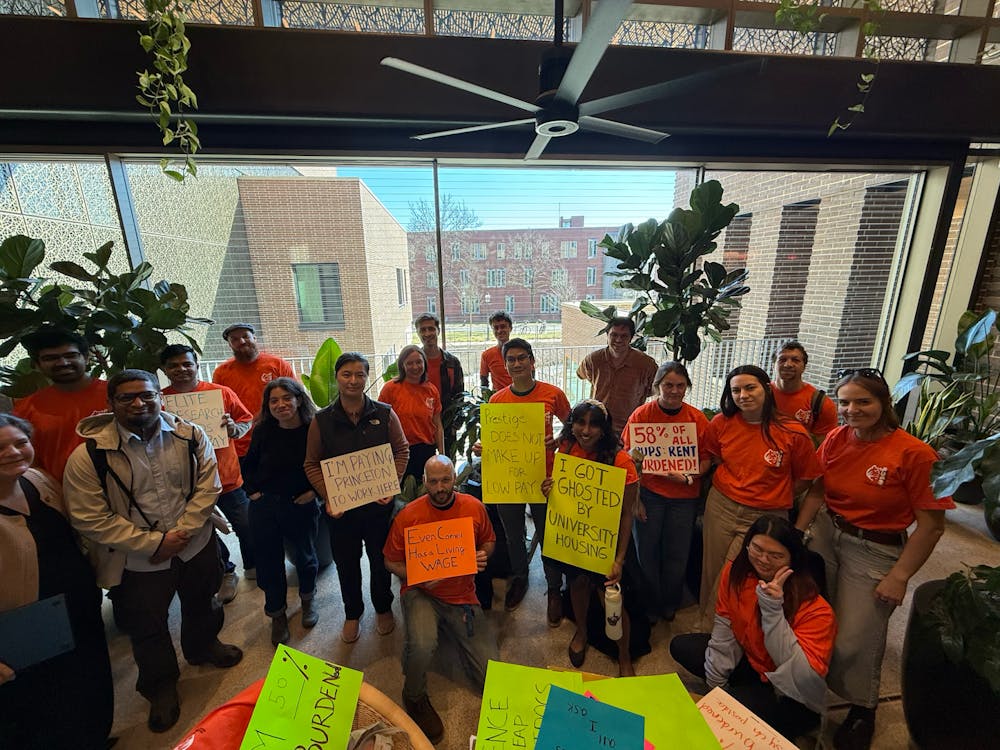
On March 9, members of the Princeton University Postdocs and Scholars union (PUPS-UAW) protested with signs outside of a bargaining session between PUPS-UAW and the University, aiming to show solidarity with the limited number of union members present in the bargaining session.
In the bargaining room, eight PUPS-UAW negotiators and five observers — a limit imposed by the University — argued for their proposals regarding salaries, healthcare, legal protections, and layoffs. Specifically, they discussed a University proposal of a 12 percent increase in postdoc salaries over the next three years, as well as the retention of University benefits regarding childcare subsidies and the number of sick days.
Bargaining between PUPS-UAW and the University began in 2024. After about a year and a half of bargaining, 13 out of 44 proposals have reached tentative agreements, according to the PUPS-UAW bargaining tracker. Once the University and PUPS-UAW reach tentative agreements on all 44 proposals, PUPS-UAW can draft a contract that all postdocs can vote on.
Grace Flores-Robles, a postdoctoral research associate in the Princeton School of Public and International Affairs, was in the bargaining room. Flores-Robles said that postdocs are confident they can achieve their goals through continued negotiations, despite the University’s fiscal tightening in light of diminishing endowment returns, which resulted in the cutting of benefits and salary raises to University employees, including postdocs, in February.
According to Zara Albright, a postdoc present at the demonstration, “the University proposed no changes to the status quo” regarding postdoc benefits. However, the University reserves the right to alter existing postdoc benefits at any point.
PUPS-UAW proposed a pay increase plan in November 2025 in which salaries would be adjusted by number of years of experience as well as a yearly increase to adjust for the cost of living. Administrators presented counterproposals at the recent meeting after a Feb. 23 meeting was cancelled due to snow.
University spokesperson Jennifer Morrill wrote to The Daily Princetonian that “bargaining sessions have been held exclusively in-person since bargaining began,” and that March 9 was the earliest date both parties were available.
“We brought a bunch of postdocs from across the University. We all wore our orange PUPS shirts and held signs that were intended to show why we care about our proposals,” Albright told the ‘Prince.’

In 2024, the minimum salary for a postdoc at Princeton was $65,000 a year. PUPS-UAW’s November proposal suggested a base salary of $92,000 for postdocs with zero years of experience, a 42 percent increase from the 2024 minimum, as well as annual increases of three percent. The minimum yearly salary for an associate research scholar with zero years of experience would be $102,000.
The University’s counterproposal of a 12 percent increase over three years would result in a minimum annual salary of $73,000 after three years. If PUPS-UAW’s proposal were enacted, after three years the minimum annual postdoc salary would be $100,530 — $30,000 more than the University’s proposal suggests. The union’s proposal would cost at least $24 million more for the University’s 800 postdocs per year after three years.
In addition to salary demands, postdocs raised concerns about housing availability, as “[the majority] of postdocs are rent burdened,” according to Jessica Ng, a postdoc present at the demonstration. The University stated it was not in a position to build more housing for postdocs.
“We wanted to show how much postdocs support these demands that we’re asking for from the University,” Ng told The Daily Princetonian. “It’s easy for [the University] to pretend that those [in the room] are the only people who care and who are involved.”
The contract being negotiated by PUPS-UAW would apply to all postdoctoral researchers and associate research scholars at the University regardless of their membership in the union.
Flores-Robles told the ‘Prince’ that the biggest issue PUPS-UAW faces is the length of negotiations. It can take several months to reach a tentative agreement on a single proposal, and most postdocs only remain at the University for a few years.

“It took [the University] five months to get back to us on an economic proposal. So there’s really no saying how long it will take,” Flores-Robles said. “It’s a waiting game at this point.”
“First contracts such as this one often take more than a year to complete,” Morrill wrote to the ‘Prince.’ “The University has and will continue to bargain in good faith so that the parties can reach a reasonable agreement.”
Meghana Veldhuis is a senior News writer for the ‘Prince.’ She is from Bergen County, N.J., and typically covers graduate students, postdocs, faculty, and campus unions and labor. She can be reached at mv4991[at]princeton.edu.
Please send any corrections to corrections[at]dailyprincetonian.com.
Read More

Trustees advise dissociation committee to ‘quickly dispose’ of some petitions, avoid ‘intensifying division’
Sena ChangIn a public statement, Princeton’s Board of Trustees advised the Resources Committee to dispose of petitions that lack potential for campus consensus. The statement also reiterated the Board’s “strong presumption against dissociation.”
In a public statement, Princeton’s Board of Trustees advised the Resources Committee to dispose of petitions that lack potential for campus consensus. The statement also reiterated the Board’s “strong presumption against dissociation.”

Staff Picks: Football vs. Columbia
Brooklyn Fraser, Alex Beverton-Smith, and Antonio TakataThe Daily Princetonian Sports section provides its predictions on the upcoming matchup between Princeton football and Columbia.
The Daily Princetonian Sports section provides its predictions on the upcoming matchup between Princeton football and Columbia.

As Princeton Fire Department expands paid force, building renovations on hold
Meiya XiongThe Princeton Fire Department and Princeton First Aid and Rescue Squad are both shifting from volunteer based to primarily paid staffing as volunteer numbers decline, with a firehouse expansion estimated at $10–20 million stalled until funding is found.
The Princeton Fire Department and Princeton First Aid and Rescue Squad are both shifting from volunteer based to primarily paid staffing as volunteer numbers decline, with a firehouse expansion estimated at $10–20 million stalled until funding is found.