



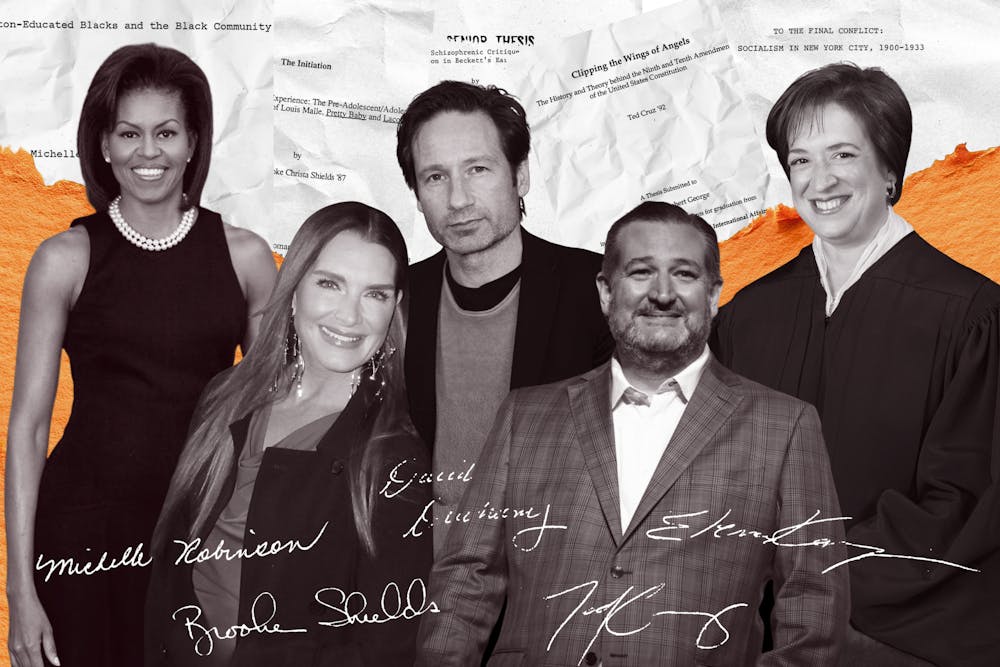
Since 1926, the Senior Thesis has been a staple of a Princeton education. Aside from those in a few engineering departments, every student who passes beneath the FitzRandolph Gate at graduation has written their own independent thesis.
Senior theses are often early predictors of what someone will pursue in life. Former Missouri Senator and Governor Kit Bond ’60 penned his on “Missouri Farm Organizations and the Problems of Agriculture.” However, some alumni’s careers differ vastly from their undergraduate studies; Jimmy Stewart ’32, of “It’s a Wonderful Life” fame, graduated from the Department of Architecture and designed an airport for his thesis.
As the Class of 2026 prepares to submit their own theses, The Daily Princetonian is walking down memory lane to review those of famous Princetonians to discover what connections, if any, they have to their careers now.
Former First Lady Michelle Obama ’85
Former first Lady Michelle Obama’s senior thesis became a subject of scrutiny during her husband’s 2008 presidential campaign, when the University temporarily restricted access to it.
Written in 1985, Obama’s thesis, “Princeton-Educated Blacks and the Black Community,” explores the effects that four years at the University had on Black students’ relationships with the Black community. In her introduction, Obama outlines her personal motive, stating, “My experiences at Princeton have made me far more aware of my ‘Blackness’ than ever before.” Despite how “liberal and open-minded” her white peers act, to them, she “will always be Black first and a student second.”
Obama sent a questionnaire to 400 Black Princeton alumni, including questions about respondents’ ideologies and comfort levels when speaking to Black versus White people during the “three life-periods” — “Pre-Princeton,” “Princeton,” and “Post-Princeton.” Most questions asked about independent variables, such as the respondents’ upbringing, religion, and age. Eighty-nine of the alumni contacted responded, and nearly three-quarters of the respondents to Obama’s questionnaire were between the ages of 25 and 34 years old.
Obama found that after matriculating at Princeton, 46 percent of respondents began spending more time with Black people in comparison to the 26 percent who spent more time with white people. After graduation, however, the percentage of respondents who spent an increased amount of time with Black people “dropped drastically.”

Obama also found that the number of Black alumni who held “seperationist/pluralist ideologies” increased from 26 percent before Princeton to 40 percent “Post-Princeton.” However, Obama found that only 19 percent of respondents became more separationist after graduation, while 32 percent became more “integrationist/assimilationist.”
Furthermore, Black alumni’s “Benefit Attitudes” toward the Black community “remained drastically unchanged” Post-Princeton.
“Interestingly enough, the percentage of respondents who were motivated to benefit the Black community increased from 46% at the Pre-Princeton point to 63% at the Princeton point, and remained drastically unchanged (64%) Post-Princeton,” Obama wrote.
Individual-level “changes in feelings of comfort in social activities” dropped significantly after graduation, though. Thirty-one percent of respondents reported “becoming comfortable with Blacks” during the transition period before Princeton, and decreased to 10 percent in the transition after Princeton. Obama attributed this to factors such as occupations and changed priorities, which caused a decline in attachment and comfort with the Black lower class.
Obama’s major conclusion was that “Despite the respondents’ sense of comfort with Blacks and Whites, their motivation to benefit the Black community, or their attitudes towards the Black lower class before Princeton, more respondents tended to identify with Blacks during Princeton in every measured respect. However, after Princeton this identification decreased drastically.”
Actor Brooke Shields ’87

Brooke Shields ’87 is a model, activist, author, and the current president of the Actors’ Equity Association. However, Shields is most known for her acting, especially in the controversial film “Pretty Baby” where, at 11 years old, she performed some scenes in the nude. Her senior thesis is, in part, about “Pretty Baby.”
Entitled “From Innocence to Experience: The Pre-Adolescent/Adolescent Journey in the films of Louis Malle, ‘Pretty Baby’ and ‘Lacombe Lucien,’” was submitted to the Department of Romance Languages and Literatures on May 1, 1987. The Department split into the Department of French and Italian and the Department of Spanish and Portuguese in 2001.
Shields began her thesis by arguing that Malle searches for a “childlike quality” in his viewers, and that he wants audience members in the same theater to leave with different takeaways.
“His work is never predictable, for life itself is not predictable, and Malle rightfully compares the experience of making a film to that of living,” Shields wrote.
She also discussed how Malle preferred hiring young, non-professional actors, including herself, as they lacked “preconceived ideas or a systematic approach.”
Shields does not explicitly mention her own nude scenes in her thesis, instead focusing on Malle’s use of child actors to show a metaphorical loss of innocence. Shields identified Malle’s use of child protagonists as a means of conveying an “unadulterated” perspective in a harsh world. Both films place their child protagonists in severe situations; in “Pretty Baby,” Shields’ character, Violet, lives in a brothel, and in “Lacombe Lucien,” the protagonist lives in Nazi-occupied France.
The latter part of Shields’ thesis predominantly focuses on “Lacombe Lucien.” She argued that Lucien is an ambiguous character because, despite being a teenager, he was unwittingly manipulated by the Nazi’s fascist regime. Unlike “Pretty Baby,” the “most shocking aspect” of the film is the ease and indifference with which Lucien joins the Gestapo. However, Shields argued that one “cannot contemplate his intentions” because he does not approach “his involvement within the Fascist party as a politically ideological assertion,” but rather, he “lacks understanding of the world.”
Before ending her thesis with a transcript of her interview with Malle, Shields wrote: “By tracing the adolescent’s crucial and inevitable voyage from innocence to experience, [Malle] illuminates all of human life.”
Actor David Duchovny ’82
Known for his starring roles on “The X-Files” and “Californication,” David Duchovny ’82 is a graduate of Princeton’s English department. He submitted his senior thesis, “The Schizophrenic Critique of Pure Reason in Beckett’s Early Novels” on March 30, 1982.
Duchovny chose to center his thesis on how playwright, poet, and novelist Samuel Beckett’s characters exhibit schizophrenic tendencies. The characters “[revolt] against rationalism” and philosophers “who have created structures for consciousness,” such as Plato, Descartes, and Pythagoras.
“The revolution in perspective must pivot about the Beckettian protagonist,” Duchovny argued. “He is not an everyman; he is a hero.”
Duchovny’s thesis consists of two chapters: “To Be or Not To Be? – Yes. ‘Murphy’ Straddles the Fence of Schizophrenia” and “‘Watt’ Goes All Out: The Autistic Schizophrenic Rag.”
In his reading of Beckett’s novel “Murphy,” Duchovny argued that the titular character’s indecisiveness and “one dimensional desires” are characteristic of Beckett’s writing and “the standard of heroism for the modern picaresque.” Murphy leads a “fractured existence” that prevents him from being a “round character” without an ego.
“But Murphy is not a true schizophrenic,” Duchovny argued. “He has fallen in love with a system of self in which, simultaneously aware of the anonymous, dark flux, he cannot believe. He is a schizo with a preference for certain states of being.”
As for “Watt,” Duchovny wrote that the titular character “strikes a compromise between the frightening revelations of human memory and the autistic, recording automaton that denies all feeling.” Unlike Murphy, Watt’s broken language and retreat into solitude demonstrates his schizophrenia.
“Communication entails an implicit and consequent desire to affect and be affected by the counterpart in discourse. A sincere schizophrenic who maintains no respect for a desire that remains in unchanged form for more than a few sentences … He does not care to be heard; he cares to express that desire,” Duchovny further argued.
Associate Supreme Court Justice Elena Kagan ’81
While her Oxford thesis on the Exclusionary Rule may have stirred more controversy during her nomination process, Associate Justice Kagan’s ’81 senior thesis, like Obama’s, was also scrutinized. Before graduating as a History major in 1981, Kagan, turned in “To The Final Conflict: Socialism in New York City, 1900-1933” on April 15, 1981.
In her thesis, Kagan argued that the lack of American socialism is due to internal divisions in the movement, rather than the “external explanations” to which historians like Daniel Bell and Ira Kipness have attributed its decline. Whereas other historians have responded to the question of why socialism is absent in America, Kagan focused on why the Socialist Party of the early 1900s formed and quickly failed.
“The effects of the frontier, of class mobility, of an ethnically divided working class may explicate why the Socialist Party did not gain an immediate mass following; they cannot explain why the growing and confident American socialist movement of the Progressive Era suddenly fell apart,” Kagan argued.
Kagan used New York City’s branch of the Socialist Party as a microcosm to analyze American socialism. She discussed the rapid growth of the Socialist Party between 1904 and 1912 as mainly composed of Jewish New Yorkers who “formed the backbone of the SP’s membership and its electoral base.” Kagan attributed their “attraction to the Socialist Party” to the “horrendous conditions” under which immigrants worked and the “coherent radical tradition” they brought from Eastern Europe.
However, Kagan argued the Socialist Party failed to “maintain their momentum” because of their “failure ever to achieve internal harmony.” While “constructive” socialists controlled New York’s Socialist Party, they clashed with revolutionary socialists who were “firmly committed to Marxian principles” over the role of unions. The party split in 1919 as members were inspired by the Russian Revolution.
“In this sense, the rise of the Bolsheviks precipitated the Socialist Party split,” Kagan wrote. “But the roots of this split — the cleavage between revolutionary and reform socialism — had long existed.”
Texas Senator Ted Cruz ’92
Ted Cruz ’92 has served as the junior United States senator from Texas as a member of the Republican Party since 2013. Cruz graduated from Princeton with a degree from the Woodrow Wilson School of Public and International Affairs, renamed the Princeton School of Public and International Affairs in 2020. His senior thesis was titled “Clipping the Wings of Angels: The History and Theory behind the Ninth and Tenth Amendments of the United States Constitution,” and was submitted to current McCormick Professor of Jurisprudence and Politics Robert P. George on April 2, 1992.
Cruz’s thesis attempted “to explore and rectify” the “misunderstanding” of the Ninth and Tenth amendments, attributing this misunderstanding to differences between “rights” and “the distribution of ‘powers,’” and natural and Constitutional rights. Cruz also sought to “elaborate upon a conception of the Ninth and Tenth Amendments which revitalizes the Founders’ commitment to limiting government, to restraining the reach of our none-too-angelic leaders.”
In another chapter, Cruz also discussed the extent to which the Fourteenth Amendment “‘incorporated’ the Bill of Rights, making them applicable to the states.” He also explained the debate between “advocates of selective incorporation and advocates of total incorporation” of the Bill of Rights.
Cruz argued that considerations of the Fourteenth Amendment must include how much of the initial support for it was “to prevent the South from persecuting former slaves” and the damage that could be done by “conferring upon judges unlimited power to create new rights.”
“Ultimately, it seems to make the most sense to view the Fourteenth Amendment as applying a positive mandate upon the states that they treat their citizens fairly — or at least evenly,” Cruz wrote. “Such an understanding is in line with desire to prevent the laws from discriminating without making the leap to being a blanket invitation to activism.”
Cruz concluded his thesis by explaining the significance of the Tenth and Ninth Amendments, respectively.
“One is led to realise that the Tenth Amendment is more than a mere ‘truism,’” Cruz wrote. “It is reflective of a fundamental idea — that the federal government ought to be significantly limited in its power.”
The Ninth Amendment, he claimed, may seem redundant with the Tenth Amendment, but fulfills “an additional function that the Tenth does not” by preventing the “exercise of new, unenumerated powers” and “exercise of illegitimate means implementing enumerated powers.”
Claiming that the Courts “have not interpreted the Ninth and Tenth Amendments true to spirit,” Cruz ended his thesis by referencing Federalist 51: “And this awakening protector of rights, which the Court is transforming into a power for itself, can remind us — from the dead — that men are not angels, but men — seeking power over the heavens ... and below.”
Lucia Zschoche is the associate editor for Archives and an assistant editor for Features for the ‘Prince.’
Please send any corrections requests to corrections[at]dailyprincetonian.com.
Read More

No. 8 field hockey falls to No. 10 Harvard in shootout, 4–2
Emilia ReayNo. 8 Princeton fell to No. 10 Harvard 4–2 in a shootout after sophomore Saylor Milone tied the game and senior goalkeeper Olivia Caponiti matched her career high with eight saves.
No. 8 Princeton fell to No. 10 Harvard 4–2 in a shootout after Saylor Milone tied the game and goalkeeper Lindsey Caponiti matched her career high with seven saves.

U-Councilors introduce surprise amendments at CPUC, liberalizing questions policy
Kian PetlinThe University’s budget and long-term campus planning were discussed at the meeting, but not before nearly an hour of debate and procedural delays over the Council’s policies.
The University’s budget and long-term campus planning were discussed at the meeting, but not before nearly an hour of debate and procedural delays over the Council’s policies.

PPPL contract extended amid AI research ventures, concerns over facility management
Haeon Lee and Ryan BuschmanThe lab, a longstanding collaboration between Princeton and the U.S. Department of Energy, has been investing in new AI-related research.
The lab, a longstanding collaboration between Princeton and the U.S. Department of Energy, has been investing in new AI-related research.