



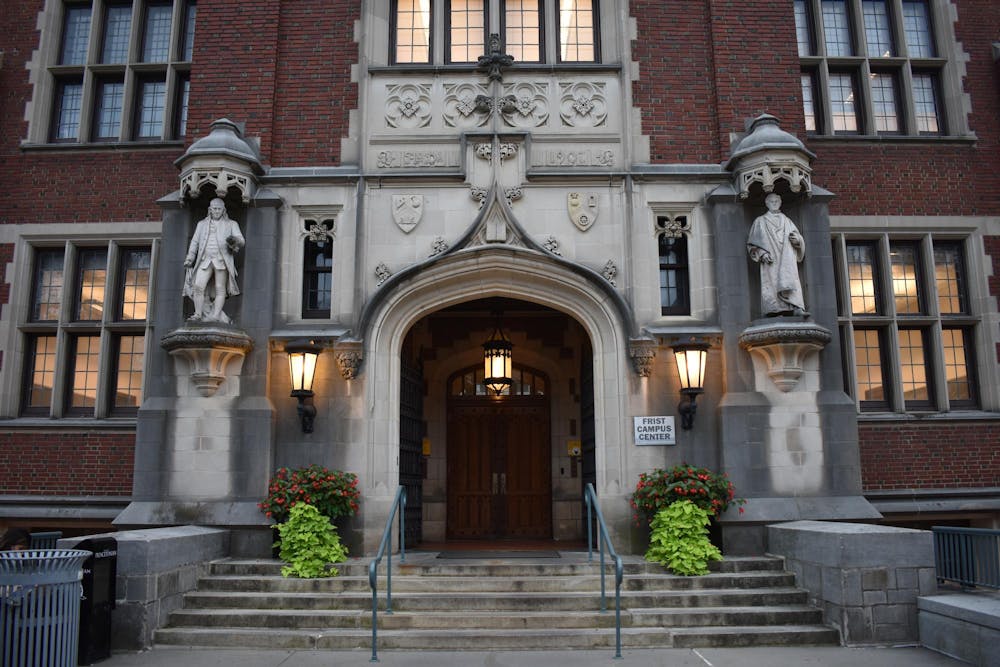
At the Sunday Undergraduate Student Government (USG) senate meeting, University administrators spoke about the purpose of campus free expression facilitators, while student groups presented new mental health and menstrual product initiatives. The meeting also included a presentation from the USG Social Committee about what students hope to see at spring Lawnparties.
The meeting began with a brief introduction from USG president Quentin Colón Roosevelt ’27, who emphasized the importance of attending and engaging in meetings and thanked U-Councilors for questions in the Feb. 9 Council of the Princeton University Community meeting.
Associate Dean of Undergraduate Students Garrett Meggs spoke about the University’s free expression facilitators. Meggs explained that the University’s purpose behind the facilitators is to allow students to engage in civil and respectful dialogue on campus.
Free expression facilitators are assigned to campus events in order to ensure that speakers and audiences are protecting expression and following the University’s time, place, and manner restrictions. In recent years, facilitators have supported about 130 campus events per year, including campus protests and visiting speakers.
Facilitators complete specialized training at least twice per year, and many work in student-facing roles across campus.
Event planners and campus organizations must request facilitators with ample time.
“For what we consider standard events, which are essentially student organization meetings of lower level complexity, there is a five business day requirement [to register an event],” said Ian Deas, Associate Dean of Undergraduate Students. “For events that are more complex, which involve multiple campus stakeholder departments, it’s 15 business days.”
He also highlighted that free expression facilitators come at no cost to event organizers.

USG mental health chair Aakansh Yerpude ’27 then presented the One Too Many Initiative, a campaign focused on reforming the University’s culture around mental health. The campaign, organized in collaboration with the Alumni Mental Health Coalition, is guided by principles of student agency, awareness raising, and substantive action.
The committee is working with TigerWell, a student initiative that takes a public health approach to advance student health, to support the expansion of Wellbeing in Learning Spaces Toolkit.
“There’s a shared recognition that we need to look out for each other, and that student perspectives should really meaningfully inform how support systems operate and how we talk about the culture of Princeton itself,” Yerpude said at the meeting.
With the help of clinical psychologists, USG will make recommendations to the administration about improvements in student life and mental health concerns as part of the initiative.
Following Yerpude’s presentation, the Menstrual Products Task Force (MPTF), a student-led USG group focused on providing access to menstrual products on campus, presented the work they are doing to destigmatize menstruation on campus.
MPTF has previously held study breaks, table sessions, and giveaways focused on menstruation education and creating a more inclusive community. Last year, they held a “period party” as a part of their goal to break the stigma around menstruation and promote menstrual health.

“The goal was to challenge social norms around menstruation, as well as supply heating pads and other comforts for students,” said Evelyn Mahoney ’28, vice president of MPTF.
Next, Vivian Chang ’28 presented an update on the Social Committee.
A student survey, which collected over 450 student responses on preferences for Lawnparties headliners, is being used by the Social Committee to compile a list of the top three desired acts. The Committee will be releasing their “first bid,” or most desired headliner, later in the week.
“In terms of headliner genre, pop was winning … by an overwhelming percentage, followed by hip hop, rap, rock and EDM,” said Chang.
Chang shared that her conclusions from the data point to students desiring “nostalgic music … that everyone knows and can sing along to” for the headliner rather than rap. Furthermore, Chang shared that students want more hydration options, less crowding, and a greater focus on timeliness for the main performance.
The meeting concluded with a presentation from University Student Life Committee (USLC) chair Oscar Barrios ’27.
Barrios highlighted the importance of navigating the University’s recent dining changes, especially in light of over 100 students not being placed in eating clubs. He noted that the USLC is pushing for the establishment of working sub groups, including a dining council, and have previously advocated for meal swipes and gained traction from University administrators.
Moreover, Barrios spoke about the importance of protecting the international student community amidst concerns over federal regulations. He shared that USLC is looking for ways the University can plan ahead to provide extra resources for international students at this time.
The USG Senate meets each Sunday at 5 p.m. in Robertson 016.
Giselle Moreno is a News contributor from Dallas. She can be reached at gm2076[at]princeton.edu.
Please send any corrections to corrections[at]dailyprincetonian.com.
Corrections were made on Feb. 16, 2026: A previous version of this article referred to MPTF's "period party" as an effort to break the stigma around menstruation and promote mental health, not menstrual health. A quote about student group activities was attributed to the wrong associate dean. Ian Deas, not Garrett Meggs, gave the quote. The errors have since been corrected. The 'Prince' regrets this.
Read More

Princeton University Orchestra and men’s ultimate frisbee team named in University’s latest hazing report
Andrew ArthurTwelve students in the Princeton University Orchestra and Men's Ultimate Frisbee team were found responsible for hazing violations in the University's latest Campus Hazing Transparency Report. Sanctions ranged from Dean's warnings to disciplinary probation.
Twelve students in the Princeton University Orchestra and Men's Ultimate Frisbee team were found responsible for hazing violations in the University's latest Campus Hazing Transparency Report. Sanctions ranged from Dean's warnings to disciplinary probation.

Murray-Dodge Café celebrates 50th Anniversary, drawing over 260 students
Hifza KaleemOn Wednesday, Murray Dodge Cafe celebrated its 50th anniversary, drawing more than 260 students to celebrate with free cookies and merchandise.
On Wednesday, Murray Dodge Cafe celebrated its 50th anniversary, drawing more than 260 students to celebrate with free cookies and merchandise.
Students share mixed reactions as mandated officer and treasurer trainings return to in-person format
David EstradaThe University's student organization officers and treasurers returned to mandatory in-person training this fall after years of online sessions. Student reactions found parts of the training redundant or tedious, though most agreed the sessions were important.
The University's student organization officers and treasurers returned to mandatory in-person training this fall after years of online sessions. Student reactions found parts of the training redundant or tedious, though most agreed the sessions were important.