



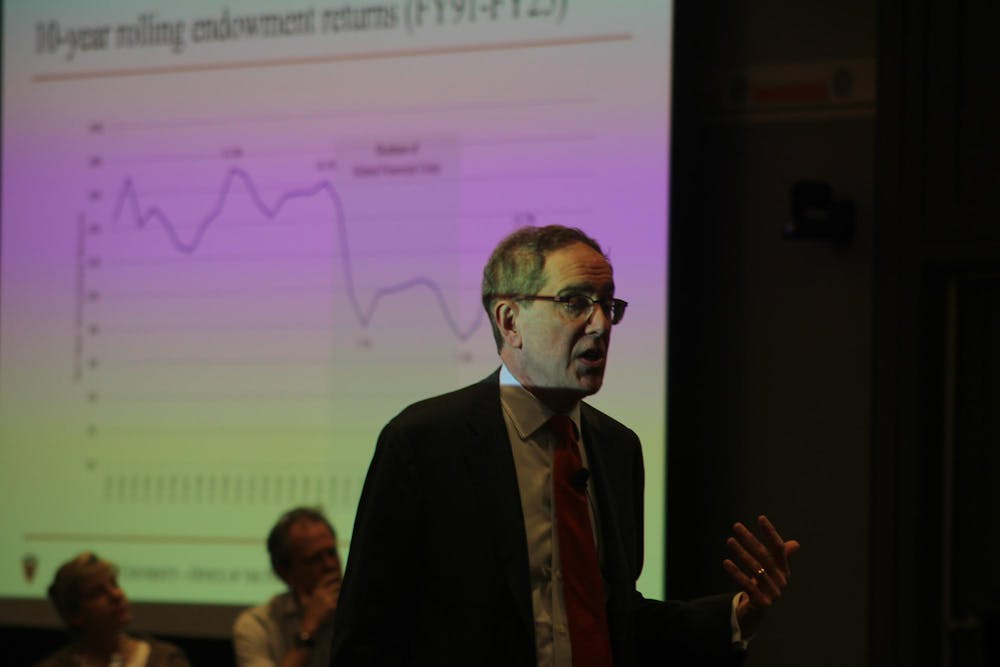
University President Christopher Eisgruber ’83 presented his annual State of the University letter and answered questions about various student concerns at the first 2026 meeting of the Council of the Princeton University Community (CPUC).
Eisgruber spent the majority of his presentation reviewing the University’s strategic shift in endowment spending priorities amid diminishing long-term endowment return projections. This includes a 10-year estimated $11.3 billion deficit in endowment growth relative to previous growth projections, according to the Princeton University Investment Company (PRINCO).
His presentation emphasized the importance of indefinite institutional preservation, with the University’s economic model heavily dependent on annual endowment spending.
“People talk about dipping into the endowment as though it were a savings account,” Eisgruber said. “We start eroding the value of the endowment, and either we make big budget cuts, or if we’re not making big budget cuts, the spend rate on the endowment starts to creep up six percent, seven percent, 10 percent — and all of a sudden you’re [spending] way more than you can make back.”
The impact of budget cuts will be felt throughout the community. The University will not provide salary increases to senior administrators and most senior faculty — associate professors, full professors, senior lecturers, University lecturers, and professors — except in the case of special achievements, according to an email sent to the faculty. Raises for junior faculty, including assistant professors, instructors, and lecturers, will come from a “modest merit pool,” while academic staff raises will be capped at one percent.
“We have seen benefits costs at the University, both in the student health plans and in the faculty [and] staff plans, escalate very rapidly for a variety of reasons,” Eisgruber said. “We have to make trade-offs within our compensation pools to address these issues.”
In reference to the release of survey data about undergraduate student experiences as an appendix to the State of the University letter, U-Councilor Stanley Stoutamire Jr. ’27 asked about racial disparities in student experiences.
“Black students, across almost every metric, seem to be having sort of the worst version of the Princeton experience,” he said. According to the survey data, only 37 percent of Black students responded that their educational experience was “Excellent,” compared to 53 percent for the entire student body.

Eisgruber emphasized the importance of supporting students across demographics while remaining within the confines of the law. He said, “it’s also true that students who self-identify as extremely conservative on our campus report lower degrees of satisfaction, and we should want all students to be lifted up and feeling high levels of inclusion and belonging.”
Graduate Student Government president Jan Ertl GS posed a question about the future of graduate student stipends in the midst of budgetary uncertainty and rising housing costs.
University Provost Jennifer Rexford ’91 reaffirmed that graduate student stipends will increase despite a freeze on raises for senior faculty, stating that senior faculty will not be receiving raises in order to prioritize the “more junior members of our scholarly community.”
“The stipend increases are in excess of the increases in housing costs for campus housing intentionally because we recognize, obviously, a significant portion of graduate student stipends goes towards housing,” she said.
Some meeting attendees raised questions about how changing immigration policies may affect Princeton. The Undergraduate Student Government (USG) vice president Anuj Krishnan ’27 referenced a case at Tufts University where Rümeysa Öztürk, a doctoral student, was detained by Department of Homeland Security officers. Tufts President Sunil Kumar released a statement calling for her release.
Krishnan asked if the University would be prepared to take similar steps in support of a detained international student.

Eisgruber stated his responsibility to not speculate on hypothetical future cases before explaining previous University actions around immigration.
“We want to be very supportive of the rights of our students in general and the rights of people on our campus, and we’ve been willing to take pretty strong measures around that across a variety of different subjects,” he said. “We were the only private university and one of only two universities that was willing to sue on behalf of our [Deferred Action for Childhood Arrivals] students when they were on the campus.”
USG president Quentin Colón Roosevelt ’27 inquired about the recent student referendum on dining, which called for the restoration of independent dining status and passed with 95 percent support. On Sunday, the University announced a new Spelman Hall room draw process, but it did not reinstate independent status.
Eisgruber reiterated his disapproval of public opinion polls as policy input. “I am not a big fan of referenda … You guys can run them if you want to … but that’s not the way we or I will make decisions,” he said.
U-Council chair Genevieve Shutt ’26 read a question from USG Mental Health Committee chair Aakansh Yerpude ’27 about the relationship between health and wellness buildings on campus and mental health.
“For a community that has lost a student almost every semester for the last five years to suicide, this focus on infrastructure seems dangerously surface level,” Shutt said.
Eisgruber’s response focused on examples of efforts to improve student mental health and wellness, including expanded access to counseling and access to fitness and wellbeing facilities on campus.
“It’s not the case that buildings don’t matter. There are activities that can take place in those buildings, from informal interactions to the care that people need,” he said.
Eisgruber also outlined constraints that administrators face when trying to address student mental health.
“Depression is an illness, right? And to talk about it in ways that suggest [that] an administrative decision or a family decision can simply make it go away, that’s not a real conversation about mental health, either,” Eisgruber said.
The next CPUC meeting will take place at 4:30 p.m. on March 23 in the Multipurpose Room of Frist Campus Center.
Gray Collins is the assistant News editor for the ‘Prince’ leading university administration coverage. He is from outside of Philadelphia and can be reached at graycollins[at]princeton.edu.
Kian Petlin is a senior News writer for the ‘Prince.’ He is from San Francisco and typically covers University administration and the state of higher education.
Please send any corrections to corrections[at]dailyprincetonian.com.
Read More

This Week in History: Looking back and looking around at Maya Lin’s campus art commission
Jillian AscherOutside of the Lewis Arts Complex sit two works often missed by passerbys: Maya Lin’s “Einstein’s Table” and “Princeton Line.” This week, we look back at Lin’s environmentally motivated and integrated pieces, bridging the gap between the viewer, the earth, and art all around us.
Fall Street Week sees increasing selectivity at eating clubs
Nicole JiaCap and Gown Club, Ivy Club, and Tower Club held Bicker this fall, and 25 of 162 junior and senior bickerees received bids. Quadrangle Club and Colonial Club also accepted new members through the central sign-in process.
Cap and Gown Club, Ivy Club, and Tower Club held Bicker this fall, and 25 of 162 junior and senior bickerees received bids. Quadrangle Club and Colonial Club also accepted new members through the central sign-in process.

Princeton’s Class of 2030 had an acceptance rate of 4.0 percent, lowest in history
Gray CollinsJust over 4 percent of the 46,618 students who applied to join the Class of 2030 were admitted. Of those accepted, 76 percent matriculated, and 29 students were admitted off of the waitlist and enrolled.
Just over 4 percent of the 46,618 students who applied to join the Class of 2030 were admitted. Of those accepted, 76 percent matriculated, and 29 students were admitted off of the waitlist and enrolled.