



From medicine to the materials in objects around us, many products of modern life depend on chemical reactions boosted by catalysts. At Princeton, researchers in the chemistry department are working to redesign these catalysts to be cheaper, safer, and more sustainable.
Traditional catalysts often rely on rare precious metals like palladium, platinum, or iridium, that are mined in ways that can harm the environment. Princeton professor Paul Chirik’s lab focuses instead on catalysts made from earth-abundant and less toxic metals such as iron and cobalt.
“I think the most important thing that people should take away is that just about everything you interact with in your daily life relie[s] on some kind of chemical transformation and almost certainly a catalyst,” Chirik said in an interview with The Daily Princetonian.
Catalysts are essential for producing pharmaceuticals, plastics, clothing, and countless other materials. For decades, precious metals have been used more frequently due to their efficiency in driving complex chemical reactions. Chirik explained that the challenge in research is understanding why those metals work so well and whether more sustainable alternatives can be designed to perform the same chemistry.
A major focus of the lab’s research is carbon-hydrogen functionalization, a process that allows chemists to selectively modify specific carbon-hydrogen bonds within a molecule. These bonds are extremely common but typically unreactive, making them difficult to manipulate.
Being able to target a single bond within a complex molecule could streamline chemical synthesis. Shorter syntheses are more efficient and have a far-reaching impact on both the environment and industry, which is especially important in pharmaceutical development.
“Every time you do a step, you’re going to have solvent, you're going to have waste, you have to work up the reaction,” Chirik said. “So any time, if you can cut a synthesis from 10 steps to four, that’s usually green chemistry. It’s sustainable because you’ve eliminated all that waste, all that manipulation [and] energy to run the reaction.”
Recent work from the the lab has demonstrated that cobalt-based catalysts can achieve highly selective carbon-hydrogen functionalization, in some cases rivaling or surpassing precious metal catalysts. This selectivity reduces unwanted byproducts and chemical waste. The research has received funding from the National Institutes of Health, due to its potential relevance to drug development.

Graduate student Tianyi Zhang, a fourth-year Ph.D. student in Chirik’s lab, focuses his work on developing iron-based catalysts to push sustainability even further.
“The nice thing about Earth’s abundant metals, especially iron, is that it’s actually pretty non-toxic,” Zhang told the ‘Prince.’ “Our body has a very high tolerance of iron, for example, versus palladium or iridium, [for which] these tolerances are very low.”
In drug discovery, researchers often begin with a promising compound and then make small changes to improve its effectiveness or reduce side effects. Traditionally, each modification could require resynthesizing the entire molecule. However, the catalytic methods being developed in Chirik’s lab aim to directly alter specific bonds within complex molecules. This allows chemists to generate many variations more efficiently.
“The methods that we develop are targeted to be like a factory that just selectively make[s] a connection, a small modification on the drug itself, ” Zhang said.
“That avoids a lot of the re-synthesis and reduces the number of steps taken and the time and the resources taken to investigate the structure-activity relationship of these drugs,” he added.
Beyond pharmaceuticals, these methods could also be applied to materials science, such as modifying plastics to give them new properties. However, iron-based catalysts present challenges of their own, as they can behave in more complex and less predictable ways than precious metals.

“There’s always a catalyst that can be faster [and] it can be made cheaper,” Chirik said. “It’s like the 100-meter race. There’s always somebody who can set the world record.”
Looking ahead, the lab hopes to expand its work to include biologically relevant molecules, such as amino acids. These advances could open new pathways in drug development and chemical biology.
For Zhang, the research represents a balance between fundamental science and real-world impact.
“Before your own eyes, the translation of your own research into actual commercial manufacturing processes, and even sometimes made into a method that’s used to make drugs that actually then benefit patients and improve people’s well-being and life expectancy…. that kind of level of fulfillment is something that’s been really inspiring for me,” he said.
While catalyst development often happens behind the scenes, Chirik emphasized that even modest improvements can have wide ranging effects.
“If you can figure out ways to make all the materials around you 10 percent less energy, the impact on energy consumption on the planet is just gigantic,” Chirik said.
Aanya Kasera is a News contributor for the ‘Prince.’
Please send any corrections to corrections[at]dailyprincetonian.com.
Read More

Princeton University Orchestra and men’s ultimate frisbee team named in University’s latest hazing report
Andrew ArthurTwelve students in the Princeton University Orchestra and Men's Ultimate Frisbee team were found responsible for hazing violations in the University's latest Campus Hazing Transparency Report. Sanctions ranged from Dean's warnings to disciplinary probation.
Twelve students in the Princeton University Orchestra and Men's Ultimate Frisbee team were found responsible for hazing violations in the University's latest Campus Hazing Transparency Report. Sanctions ranged from Dean's warnings to disciplinary probation.

Murray-Dodge Café celebrates 50th Anniversary, drawing over 260 students
Hifza KaleemOn Wednesday, Murray Dodge Cafe celebrated its 50th anniversary, drawing more than 260 students to celebrate with free cookies and merchandise.
On Wednesday, Murray Dodge Cafe celebrated its 50th anniversary, drawing more than 260 students to celebrate with free cookies and merchandise.
Students share mixed reactions as mandated officer and treasurer trainings return to in-person format
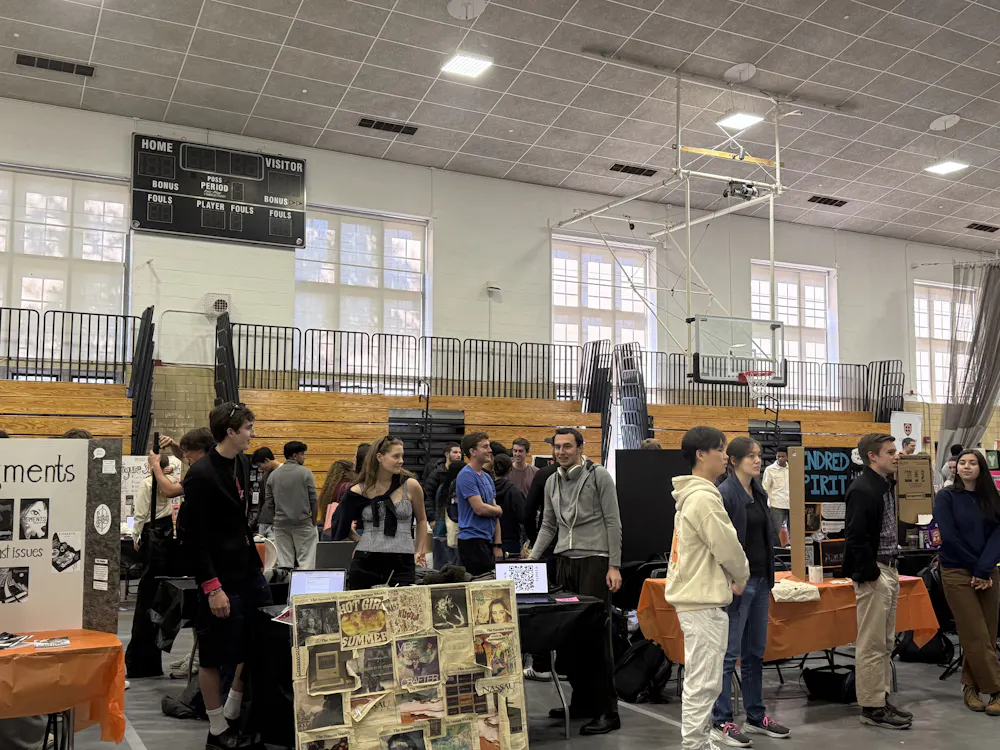
David EstradaThe University's student organization officers and treasurers returned to mandatory in-person training this fall after years of online sessions. Student reactions found parts of the training redundant or tedious, though most agreed the sessions were important.
The University's student organization officers and treasurers returned to mandatory in-person training this fall after years of online sessions. Student reactions found parts of the training redundant or tedious, though most agreed the sessions were important.