



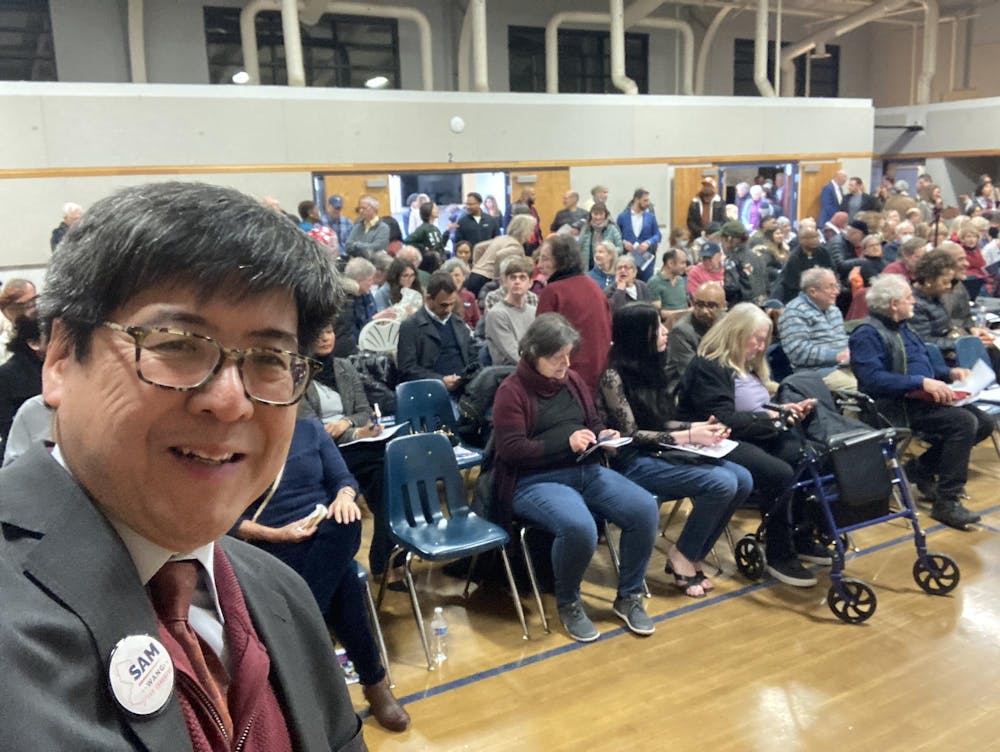
Neuroscience professor Sam Wang is running for the Democratic nomination in New Jersey’s 12th Congressional District. The primary race has 17 Democratic candidates following current Rep. Bonnie Watson Coleman’s announcement that she will not seek re-election. At the Princeton Community Democratic Organization (PCDO) candidate forum on Sunday, Wang received the third-highest number of votes, following Sue Altman and Adam Hamawy.
Wang sat down with The Daily Princetonian on Thursday to discuss his campaign platform. He initially filed to run in January. At Princeton, Wang is also the director of the Princeton Gerrymandering Project and the Electoral Innovation Lab.
Wang said he was motivated to run for office because of increasing polarization and a “breakdown” in the nation’s institutions. “In the last year, that breakdown has accelerated,” he said.
“In the last 30 years, politics has increasingly collapsed down onto one line, one axis of polarization, where you have people who, if you know how they feel about economics, then you can predict how they feel about guns,” Wang said. “That kind of polarization can lead to instability, because when we’re trapped along that line, it’s easy for things to go out of control.”
To address the issue of polarization that he identified, Wang suggested actions ranging from passing a constitutional amendment to end the Electoral College system, addressing gerrymandering through a congressional statute, and expanding the size of the Supreme Court.
“The people who engineered Project 2025 — they studied the rules,” Wang said, citing examples such as the successful gutting of the U.S. Agency for International Development, “forcing NIH to follow rules that they make up,” and decreased civil service protections for bureaucrats. “I think that the good guys need to also understand the rules well enough to create a fair system. … It’s technical, but it’s at the heart of my reason for running.”
Wang also discussed free speech and expression on college campuses.
“Generally speaking, I think that expression, when it’s truly expressive conduct, should be encouraged as much as possible,” he said. “The limits have to do with physical harm. Once it becomes physically endangering, then the free speech principles have to contend with things like the physical safety of community members or the civil rights of community members.”

“I think that I’ve really admired what’s happened at some universities, where that expression has turned into a dialogue between administrators, faculty, and students,” he noted.
Wang noted that N.J.-12 is one of the most diverse districts in the country.
“In a district like the 12th, diversity and respecting it are very important, and that means helping immigrants and their families. It means respecting people’s civil rights. And that can mean everything from ending the abuses of ICE to giving a reasonable path to … citizenship to hardworking families,” he said.
Wang indicated support for regulating artificial intelligence, noting safety concerns, but did not specify exactly what regulations he believed were necessary. He described artificial intelligence as a “rapidly evolving industry” and said it would be “important to work with advocacy groups and also [the] AI industry” when developing regulations.
“People who are at risk can go to AI and be egged on to hurt themselves. Children whose prefrontal cortex is not fully developed can work with AI and then be led down a wrong path. People who are not used to technology, like older generations, can be fooled by AI. So AI fundamentally needs some kind of safety regulations,” Wang said.
On the topic of increasing endowment taxes on universities, such as the taxes passed in the One Big Beautiful Bill Act, Wang expressed skepticism. However, he argued that the issue of endowment taxes would be “less prominent” if access to education were improved.

“I think a more important thing [than endowment taxes] is probably the fact that education is not equally available to everyone, and I think there’s a resentment of elite institutions,” Wang said. “Probably what we should really be thinking about is how to make sure that educational resources are available to everyone and serve as much of society as possible, and attending to that is very important.”
At a Feb. 8 candidate forum, Wang did not raise his hand when candidates were asked whether they agree “Israel has committed genocide in Gaza.” However, during Sunday’s PCDO forum, Wang called the situations in Gaza, Sudan, and Ukraine “genocide.”
“I don’t think my opinion has changed. My willingness to deal with the word genocide has increased. This is because words have consequences,” Wang said when asked if the two forums indicated a change in viewpoint.
When asked what he would do to support younger people, Wang voiced support for “student loan forgiveness or deferment.” He also referenced the success of Zohran Mamdani’s candidacy in driving an increase in youth voter turnout. “I think that’s because he understood that everyone’s struggling, and young people might not see politics as a way of making the world better.”
“A deeply broken government is part of normal life for anyone under the age of 30. That government needs to be more functional,” said Wang.
Emily Murphy is a senior News writer and chief correspondent for the 'Prince' covering the N.J.-12 congressional election. She is from New York City, N.Y. and can be reached at emily.murphy[at]princeton.edu.
Oliver Wu is an assistant News editor for the ‘Prince’ leading town coverage, focused on the Municipality of Princeton and beyond. He is from Stony Brook, N.Y. and can be reached at oliver.wu[at]princeton.edu.
Please send any corrections to corrections[at]dailyprincetonian.com.
A correction was made on Feb. 20, 2026: A previous version of the photo caption incorrectly referred to Wang as the N.J.-12 Democratic nominee, instead of a N.J.-12 Democratic candidate. The ‘Prince’ regrets this error.
Read More

Thieves steal $250,000 in designer bags from Princeton luxury boutique in overnight break-in
Elizabeth HuFour masked people broke into a luxury boutique store in Princeton on Sept. 1, stealing over $250,000 worth of handbags.
Four masked people broke into a luxury boutique store in Princeton on Sept. 1, stealing over $250,000 worth of handbags.

Princeton students ‘Blossom Together’: A student club takes on global humanitarian efforts
Elma CesicThis past winter break, students from Blossom Together travelled to Benin, having raised around $17,000 for food packages, water wells, and cataract surgeries.
This past winter break, students from Blossom Together travelled to Benin, having raised around $17,000 for food packages, water wells, and cataract surgeries.
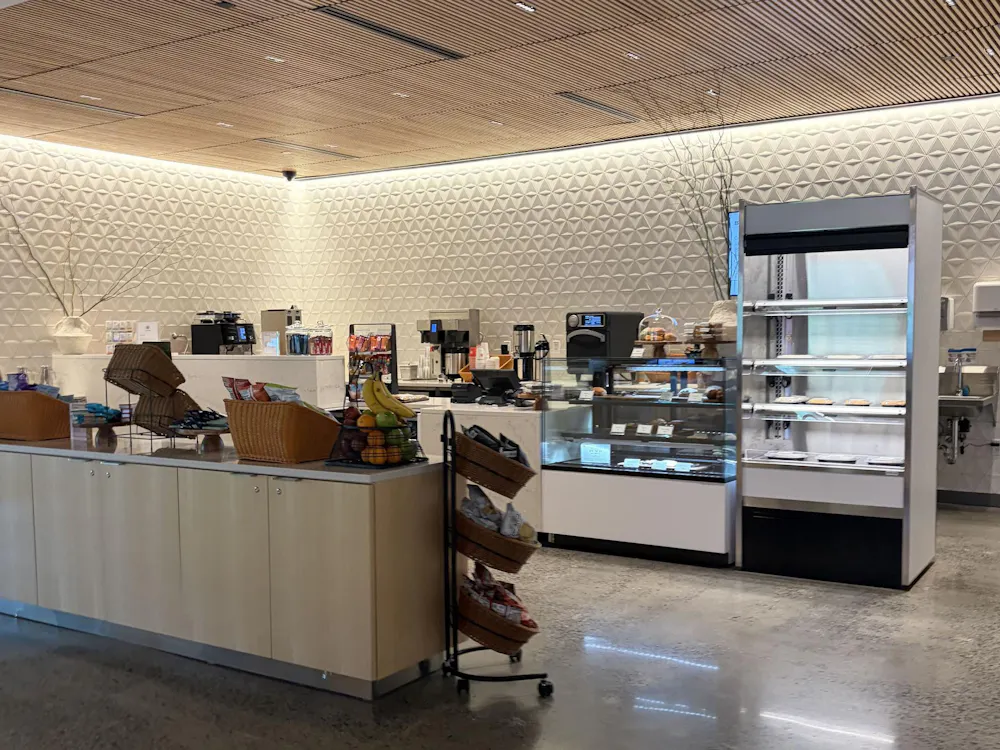
New Commons Cafe opens following cafe closures in previous years
Hifza KaleemFollowing multiple cafe closures across campus in the last two years, a new cafe opened in the SEAS Complex.
Following multiple cafe closures across campus in the last two years, a new cafe opened in the SEAS Complex.