



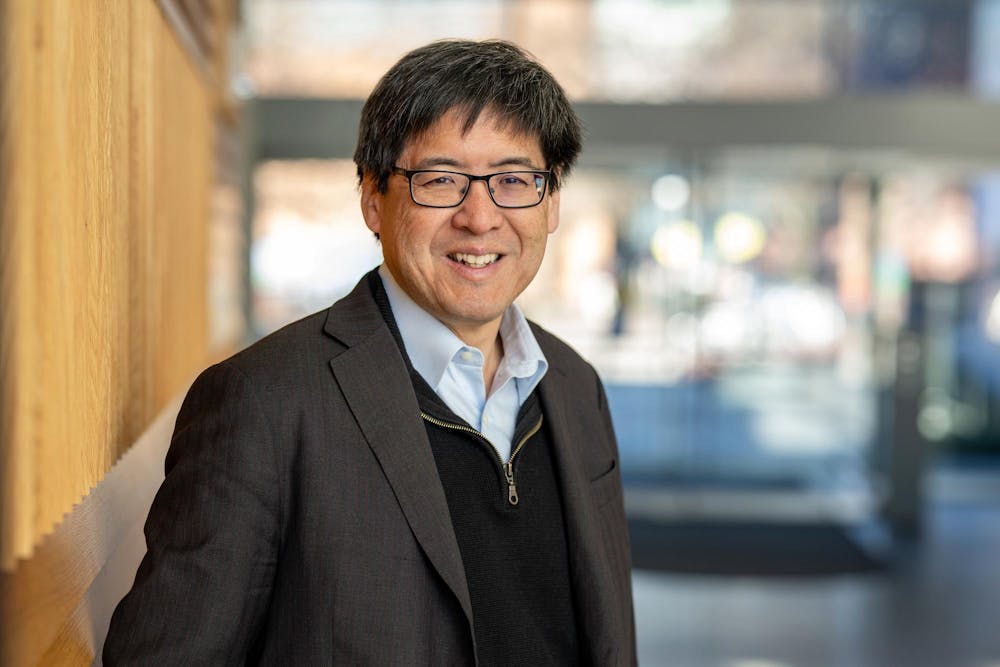
You might know Sam Wang because he famously ate a cricket on national television in 2016 after losing a bet that Hillary Clinton would win that year’s presidential election.
Wang is a neuroscience professor at Princeton and the founding director of both the Princeton Gerrymandering Project and the Electoral Innovation Lab. On Monday, he filed with the Federal Election Commission to run for Congress in New Jersey’s 12th district, which includes the municipality of Princeton. In an interview with The Daily Princetonian, Wang said he plans to officially announce his candidacy in the coming weeks.
Incumbent Democratic Rep. Bonnie Watson Coleman announced last fall that she would not seek reelection after 14 years in Congress. Wang is not currently registered with either the Republican or Democratic Party, but he will be running for the Democratic nomination.
“I think of myself as a nonpartisan, as someone who wants to find ways to make the system work better,” Wang said. “Seeing ways in which our system of government is being undermined in ways that I never could have imagined has made me realize that everyone needs to get involved. My contribution is to do more than I did before, to stop being just a researcher.”
There are more than a dozen candidates running for the Democratic nomination. Regarding how he differs from other candidates, Wang said that he is “a scientist with an extremely solid track record in both medical research and also election reform.”
“What I would like to be is an outsider who comes in and works not just for Democrats, not just for Republicans, but works using evidence and science and data to try to make a country that’s stronger for everybody,” Wang said.
In 2022, the New Jersey Globe reported that Wang was being investigated by the University over allegations of research misconduct and toxic workplace issues. A University ad hoc committee found the research misconduct allegations were “without merit” in 2022, and no other policy violations were found from any other investigations.
He was also accused of manipulating data in favor of Democrats while advising two members of the New Jersey Redistricting Commission in the state’s redistricting process. The New Jersey State Commission of Investigation conducted an investigation and subsequently cleared him of alleged data manipulation in September 2023.

“That was a very difficult period of my public service. I thought that helping with redistricting as a technical expert was an important duty,” Wang said of the allegations. “But I’m back, and I hope that it toughened me a little bit.”
Wang also testified as an expert witness in a 2024 election case, which led to the abolition of New Jersey’s county line voting system.
“That’s an example of an exclusionary policy that made it really hard for outsiders to get it, and I’m running as an outsider,” he said.
If elected, Wang hopes to reform electoral processes.
“In the long term, there are bugs in our democracy that need to be fixed, and those bugs make it hard for everyone to be represented,” he said. “That can involve things like a new voting rights act. It can involve things like protections and changes in voting rules, anything from multi-member districts to ranked-choice voting to all-party primaries.”
Wang also discussed a short-term need to ensure that voters in swing districts experience free and fair elections. He further noted that he was “disturbed at the breakdown in the rule of law.” He gave examples including the gutting of the U.S. Agency for International Development, “the sabotage of scientific research,” and the actions of immigration enforcement agents.

“It is my belief that the next few years will be an opportunity to rebuild and to build something new,” Wang said. “It involves taking a good, hard look at everything, whether it be the electoral college or redistricting or having an impartial administration of justice. All these things, evidently, need rebuilding, and so it’s a huge amount of work.”
Last March, he wrote a joint op-ed in the ‘Prince’ with other University professors defending academic freedom.
“Our system is so broken right now, and it needs people. I think that it’s easy to feel hopeless, but I’m hoping that we can work to save what we have and rebuild afterwards.”
Emily Murphy is a staff News writer and senior Copy editor for the ‘Prince.’ She is from New York and can be reached at emily.murphy[at]princeton.edu.
Please send any corrections to corrections[at]dailyprincetonian.com.
Read More

Princeton University Orchestra and men’s ultimate frisbee team named in University’s latest hazing report
Andrew ArthurTwelve students in the Princeton University Orchestra and Men's Ultimate Frisbee team were found responsible for hazing violations in the University's latest Campus Hazing Transparency Report. Sanctions ranged from Dean's warnings to disciplinary probation.
Twelve students in the Princeton University Orchestra and Men's Ultimate Frisbee team were found responsible for hazing violations in the University's latest Campus Hazing Transparency Report. Sanctions ranged from Dean's warnings to disciplinary probation.

Murray-Dodge Café celebrates 50th Anniversary, drawing over 260 students
Hifza KaleemOn Wednesday, Murray Dodge Cafe celebrated its 50th anniversary, drawing more than 260 students to celebrate with free cookies and merchandise.
On Wednesday, Murray Dodge Cafe celebrated its 50th anniversary, drawing more than 260 students to celebrate with free cookies and merchandise.
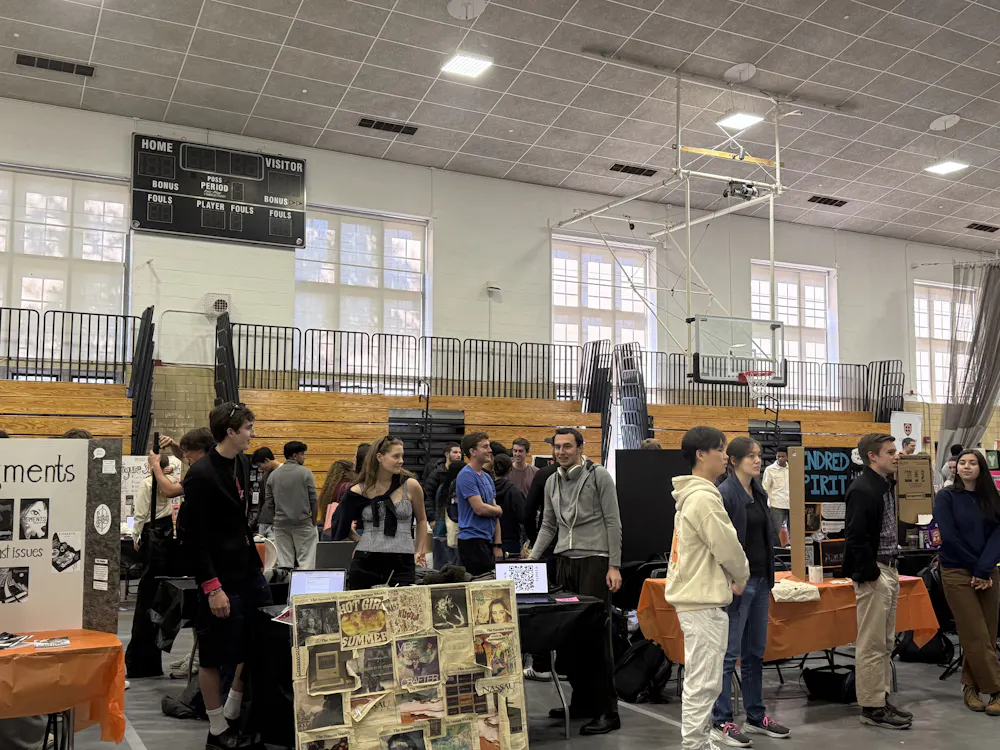
Students share mixed reactions as mandated officer and treasurer trainings return to in-person format
David EstradaThe University's student organization officers and treasurers returned to mandatory in-person training this fall after years of online sessions. Student reactions found parts of the training redundant or tedious, though most agreed the sessions were important.
The University's student organization officers and treasurers returned to mandatory in-person training this fall after years of online sessions. Student reactions found parts of the training redundant or tedious, though most agreed the sessions were important.