



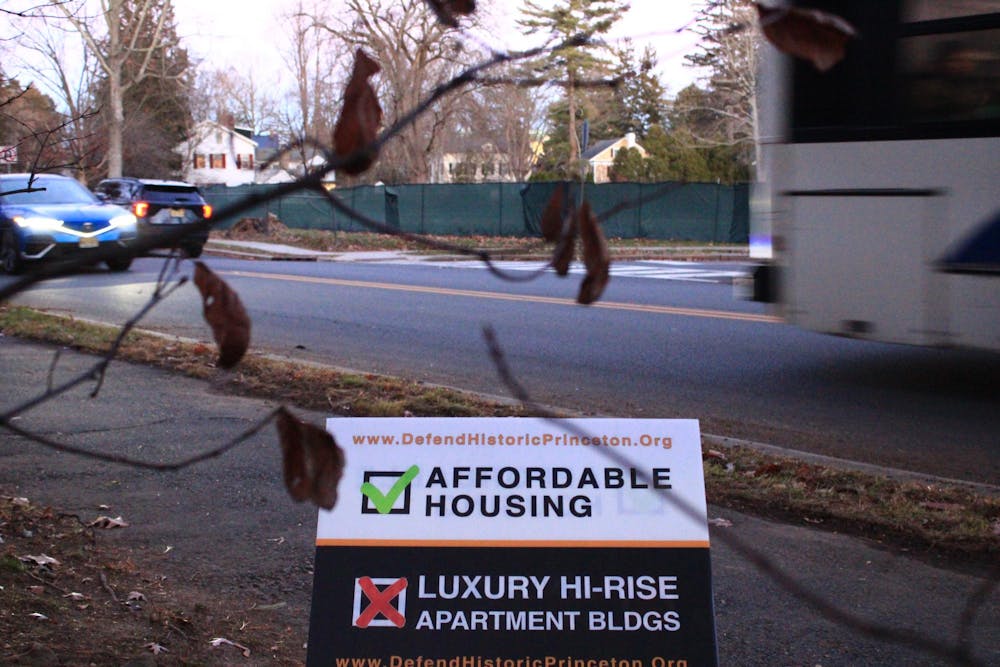
On Friday, Mercer County Superior Court Judge Robert Lougy issued a decision approving the Municipality of Princeton’s Fourth Round Housing Element and Fair Share Plan, also known as the Fourth Round Plan. The plan has been the subject of two contentious challenges from local residents who oppose the development of a proposed 238-unit apartment complex near Stockton Street, on the Princeton Theological Seminary’s former Tennent Roberts campus.
Both challenges were dismissed by the court, but efforts to oppose the development continue. “This is not over by any means,” said University history professor Sean Wilentz, one of the challengers, in an interview with The Daily Princetonian.
The municipality announced the decision in a press release on Wednesday.
“This successful outcome represents many years of work, and enables Princeton to fulfill its housing obligation over the next decade through thoughtful planning rather than courtroom uncertainty,” Councilwoman Mia Sacks said, according to the press release.
Under the state constitution, all municipalities in New Jersey have an obligation to facilitate the development of affordable housing. A series of New Jersey Supreme Court rulings, known as the Mount Laurel Doctrine, and a law passed by the State Legislature in 2024, which updated the state’s Fair Housing Act, have established the current practice of assigning each municipality a set quota of affordable housing units, with the quota being updated in multiyear rounds.
Under this law, the fourth round lasts until 2035, and will govern municipalities’ compliance with their obligation through that year. Princeton’s Fourth Round Plan combines its fourth round obligations with prior unmet obligations for a total obligation of 364 credits. The Stockton Street development contains a proposed 48 affordable units, which are being counted as 96 credits due to a policy which incentivises units that are available to rent, rather than purchase.
Two local groups, the Princeton Coalition for Responsible Development (PCRD) and Defend Historic Princeton, filed challenges to the Fourth Round Plan last year, questioning the inclusion of the Stockton Street development in the plan.
PCRD, a nonprofit organization founded by former Princeton councilwoman Jo Butler, argued that a regulation requiring municipalities to show sites for affordable housing development are “available, suitable, developable and approvable” was not met.

On the Defend Historic Princeton challenge, Wilentz, Wilentz’s wife Caroline Cleaves, and University history professor emeritus James McPherson are listed as the challengers.
They argued that a Council on Affordable Housing (COAH) regulation prohibiting municipalities that don’t have enough land to meet their affordable housing obligations from using land in state-registered historic sites applies more broadly, and that the regulation prohibits historic sites from being used to meet obligations in all circumstances. Additionally, they asserted that, because Princeton is using the site to meet its obligations, the development constitutes municipal action and thus must be approved by the Historic Sites Council.
The Seminary, which remains the owner of the Stockton Street site pending ownership transfer to Herring Properties, also filed a brief in support of the municipality’s plan.
Lougy dismissed both of the challenges.
Lougy’s decision allows the Municipality of Princeton to move forward with implementing ordinances and resolutions in order to comply with law by a March 15 deadline. If the municipality does not meet the deadline, the Court will not issue a Certification of Compliance and Repose, which protects the municipality from builder’s remedy lawsuits through the end of the fourth round cycle.
Builder’s remedy allows developers to bypass typical zoning laws for development when a municipality does not meet its affordable housing obligation.

Lougy, in his decision, cited a report and recommendation from retired Judge Thomas Miller, who now chairs the state judiciary’s Affordable Housing Dispute Resolution Program. Miller heard the challenges from PCRD and Defend Historic Princeton, and received recommendations from independent special adjudicator Christine Nazzaro-Cofone.
Lougy adopted Miller’s report, including Nazzaro-Cofone’s recommendations, “in full.”
Nazzaro-Cofone, in her recommendations, wrote that Defend Historic Princeton’s challenge “relies on inapplicable regulatory provisions” and that the PCRD challenge “asserts requirements not found in the Fair Housing Act or COAH rules.”
In his report, Miller wrote that the Defend Historic Princeton challengers “properly point out that this project involves conflicting public policies as it pits affordable housing interests that may be in conflict with Historic preservation and recognition.”
He further noted that, although it was not in his purview to rule on the issue of historic sites, the approval of the Fourth Round Plan “does not mean that the process and protections that are designed to protect or promote historic sites will be ignored.”
Wilentz, in an interview with the ‘Prince,’ celebrated Miller’s recognition of the issue of historic preservation, and that Lougy had adopted Miller’s report in full. He said Defend Historic Princeton will appeal to the Historic Sites Council in light of the decision, and left open the possibility of challenging the development when it goes before the Princeton Planning Board.
“He recognized that [we] really have raised a proper issue here of conflicting public policies regarding historic preservation and municipalities’ obligations under affordable housing,” Wilentz said. “I’m quite pleased, actually.”
Defend Historic Princeton’s lawyer Bruce Afran told the ‘Prince’ that Miller “was acknowledging there’s a legal issue here,” but that challenging the Fourth Round Plan was not the place to resolve it. Afran said his clients “will be filing either directly in the Historic Sites Council, or in the trial court, asking for a ruling as to whether the town must go to the Historic Sites Council.”
“Our concerns were not about whether Princeton should meet its affordable housing responsibilities, but about how those responsibilities are implemented,” Butler, of PCRD, wrote in a statement to the ‘Prince.’ “PCRD is consulting with counsel and evaluating all available options, including the possibility of an appeal.”
PCRD still has two ongoing cases challenging the Stockton Street development being considered by the courts. These cases, as well as filings with the Historic Sites Council, can continue, but no further challenges to the Fourth Round Plan may be filed.
Oliver Wu is the assistant News editor for the ‘Prince’ leading town coverage, focused on the Municipality of Princeton and beyond. He is from Stony Brook, N.Y. and can be reached at oliver.wu[at]princeton.edu.
Please send any corrections to corrections[at]dailyprincetonian.com.
Read More

NJ AI Hub marks first anniversary with inaugural startup cohort
Zihan (Frank) XuFourteen selected start-ups receive weekly workshops, reverse pitches, corporate introductions, among other guidance over 12 weeks. The “AI accelerator” helps to test each company’s technology and fast-track its path to commercialization.
Fourteen selected start-ups receive weekly workshops, reverse pitches, corporate introductions, among other guidance over 12 weeks. The “AI accelerator” helps to test each company’s technology and fast-track its path to commercialization.
Three Princeton alumni awarded 2026 Fields Medal
Clara DochertyThe three alumni who received the medal are Yu Deng GS ’15, John Pardon ’11, and Jacob Tsimerman GS ’11.
The three alumni who received the medal are Yu Deng GS ’15, John Pardon ’11, and Jacob Tsimerman GS ’11.

How Charles Plohn ’66 brought his classmates together on the shelves
Nikki HanFor decades, Charles J. Plohn, Jr. ’66 has been collecting books published by members of his class. With nearly 700 titles in this collection, Plohn is attempting to find his library a permanent home.
For decades, Charles J. Plohn, Jr. ’66 has been collecting books published by members of his class. With nearly 700 titles in this collection, Plohn is attempting to find his library a permanent home.