



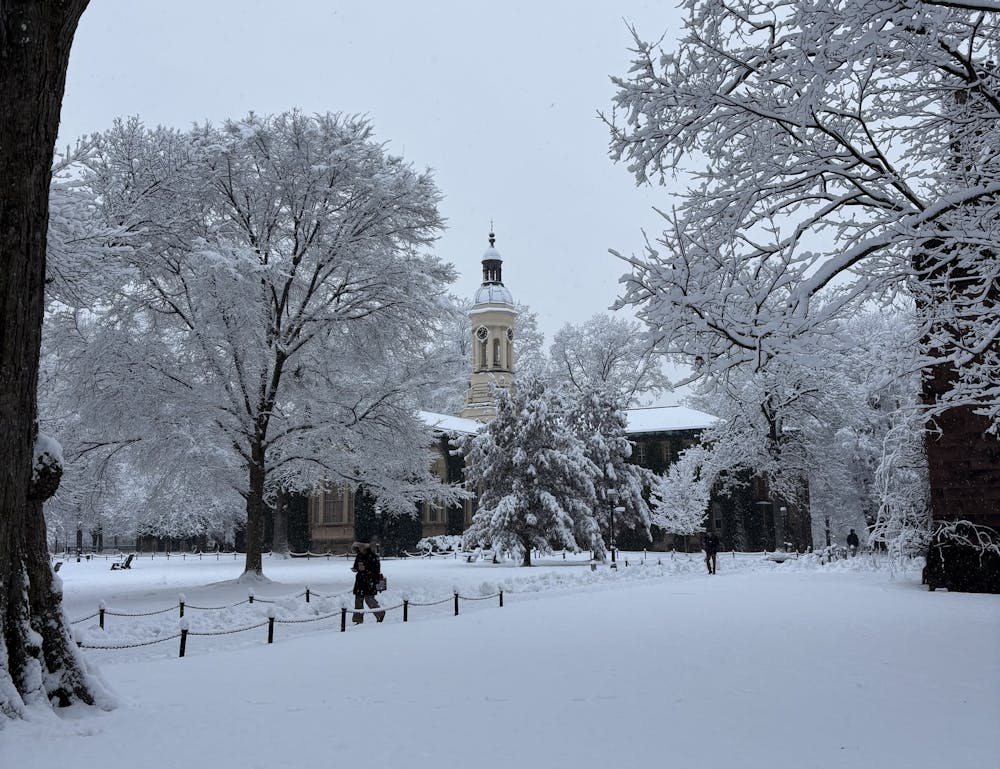
It is January 1996. Over 16 inches of snow blanket the Princeton University campus after a severe blizzard has “paralyzed” the East Coast. Students on winter break could be sledding and building snowmen, except for one important fact: they still have exams next week, and their textbooks were lost in the airport.
“I made it. My flight made it,” Jean Avery ’98 told The Daily Princetonian. “But my bag did not. If your exams were after Christmas, anybody who flew typically put [their] books in a checked bag. So I remember being without books for a day or two.”
From 1940 to 2020, the University was notorious for holding reading period and exam week after winter break.
“The first time you went home as a freshman at Christmas, you ran into all your high school friends who’ve gone to other colleges, and they were done with exams,” Bruce Sokler ’71 said. “For us, they were still hanging over our heads.”
Studying for exams at the end of January may have seemed necessary, but the need to unwind after a hectic fall semester was too strong. Many alumni recount lugging bags filled with textbooks home over break, but never touching them.
“My first year, I did drag all of my books back to Texas, and I didn’t crack them open, which was less than ideal, but I think you just really need the decompression time,” Mina Kumar ’98 said.
Others struggled with retaining information they learned at school over break. Avery spoke about having to review extra for her French exams because she had become “rusty.”
“It affected us in taking our exams because of that gap,” Sokler explained. “You basically … weren’t as into your courses when you immediately got back, having had a couple of weeks off.”

However, for some, the fall semester also felt less rushed.
“If you do performing arts, if you do choir, orchestra, or band, or if you have church stuff, holidays are challenging because you have extra concerts and extra things to squeeze in,” Avery said. “Exams can be moved, but Christmas can’t.”
Not only were exams in January, but winter break itself was practically split in two. Students had three weeks of winter break, then returned to campus for reading week and exams, only to have “intersession” — an additional week off — until the semester started around the end of January, according to Sokler.
While old advertisements in the ‘Prince’ enticed students with discounted flights to California and ski trips in Austria, and organizations like the Student Volunteers Council sponsored humanitarian trips around the world, many students just returned home or began cramming for the semester.
Love Zubiller ’98, whose San Diego high school also held exams after winter break, thought the schedule and intersession were a “very normal thing.” As an English major, she could submit her essays online or by mail, so she could stay home through exams as an upperclassman.
“That was the longest break ever,” Zubiller said. “I go back home in mid-December and not return until February.”

There was also an extra cost to staying on campus during intersession since meal plans expired on the Friday before intersession. In 1989, it cost $91 — about $240 today — to have brunch and dinner for the week-long intersession. Even then, meals were only available at Forbes College. Murray-Dodge offered daily $3 soup and sandwiches during intersession in 1999.
“For some students, [intersession was] a blessing, but it’s a big equity issue,” Avery said. “If you’re from Cameroon, you can’t just come back and forth for a week … Not everybody can travel back and forth or has a great place to be.”
In 2014, USG started hosting the fortnight-long “Wintersession” during intersession, offering students a selection of 53 courses, like dance workshops and introductory Esperanto to enrich their time. The first year of Wintersession attracted 1,300 undergraduate students.
By signing up for a Wintersession course, students received early access to their dormitories and enough meal swipes to last the entire two weeks. Wintersession was discontinued due to budgetary concerns on Sept. 2, 2025. In its final year, almost 4,400 students attended.
In 2018, the University faculty officially voted to conduct fall exams in early December. Two weeks of Wintersession were then added in January, starting in the 2020-21 school year. Princeton became the last of the Ivy League and one of the last colleges in the country to move exams to before the new year.
While some faculty members worried that an elongated winter break would decrease their productivity and ability to conduct research, the majority of students supported the schedule change as it made travel easier and alleviated stress. The faculty will soon vote on a proposal to shorten winter break by about a week.
“Having that break after [the semester] with zero responsibilities, no possible thing you could do because you have finished your courses, it’s much better,” said Jamilah Araf ’29.
As for whether or not the old or new schedule is better, alumni have mixed opinions.
“I’m not sure we believed that was the better way, but it was the calendar,” Sokler said. “Depending on the courses you were taking, you would probably have papers due when you got back, which meant you had to write papers during Christmas … As a consequence, I think, it was one of the things viewed as suboptimal.”
“I was really relieved when they switched it,” said Mason El-Habr ’23, who experienced both exam schedules. “It’s so nice just to be able to put all that stuff away, go home, and then it’s a true, genuine break because you finish your classes and you haven’t started the next ones.”
Gaea Lawton Lee ’23, who was a sophomore when the University schedule switched, says she prefers the old format of exams.
“I would always feel so burnt out at the end of the semester... and half of my break would be me recovering from that,” Lee said. “Whereas, [before the schedule changed], there was just not as much of an ‘everyone is stressed-out, losing-their-minds’ energy.”
The debate over which schedule is definitively better may never be officially settled. The Princetonians of today still deal with full plates: fulfilling major requirements, bickering eating clubs, catching up on sleep. At least now they don’t have to worry about losing their textbooks in the airport before exams.
Lucia Zschoche is the associate editor for Archives and an assistant editor for Features for the ‘Prince.’
Please send any corrections to corrections[at]dailyprincetonian.com.
Read More
Porchfest pivots to indoor festival due to inclement weather after being rescheduled
Sena ChangThis Saturday, Porchfest will be hosted indoors across eight “stages” in town due to inclement weather.
This Saturday, Porchfest will be hosted indoors across eight “stages” in town due to inclement weather.

NJ Lt. Gov. Caldwell ’82 resigns after report finds sexual harassment and ethics violations
Oliver Wu and Luke GrippoCaldwell resigned a day after a report into allegations against him was released by Sherrill. The report concluded that he had violated multiple policies while engaging in sexual misconduct and unethical practices. Caldwell has disputed the findings.
Caldwell resigned a day after a report into allegations against him was released by Sherrill. The report concluded that he had violated multiple policies while engaging in sexual misconduct and unethical practices. Caldwell has disputed the findings.

High Meadows Environmental Institute unveils new Maya Lin installation on species loss
Mia Chen and Riley PriceBriger Hall's new Environmental Gallery opened on Sept. 22 with Maya Lin’s “What Is Missing?,” which shows large videos of endangered animals like whales, tigers, and giraffes.
Briger Hall's new Environmental Gallery opened on Sept. 22 with Maya Lin’s “What Is Missing?,” which shows large videos of endangered animals like whales, tigers, and giraffes.