



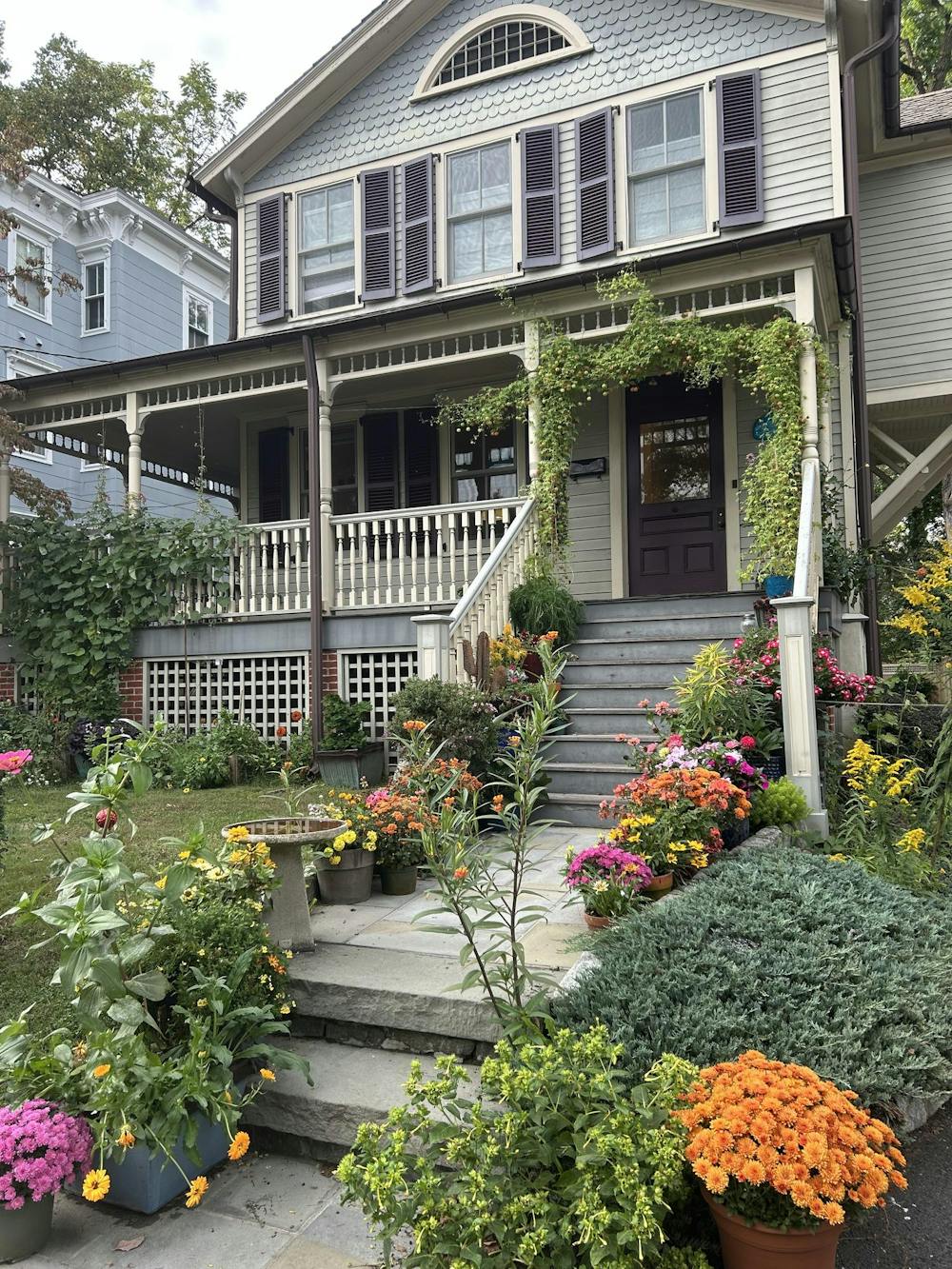
The salamander has crossed the road — again.
On Monday, the Princeton Town Council heard a proposal for a restoration project at Princeton Ridge East, an open space acquired on Dec. 30, 2024. Open Space Manager Inga Reich presented the first phase of the project. Reich said that the first phase, which is slated for Fall 2026, will focus on removing invasive plants such as Japanese honeysuckle, primarily through manual clearing. Reich said the site is “currently overgrown” and “a very hard site to walk through at the moment,” but that removing invasive species now could prevent them from spreading further into the surrounding forest.
According to Reich, the project could improve soil quality, reduce sediment runoff into downslope wetlands, and create a more accessible wooded environment for visitors, including a potential trail connection that would link habitats and provide an additional route toward downtown.
Reich noted that the project is intended to restore the area’s ecological function from an invasive-species-dominated shrub landscape to a healthier forest community.
“In the long term, planting will not only have a positive effect on the site in question, but also on the surrounding forest,” she said.
Reich warned that if the town did not intervene, invasive species could continue to expand and create long-term ecological damage.
“The trees will sequester carbon in the soil,” Reich said. Once the site is open to visitors, Reich says it will “look a lot nicer,” because invasive shrubs would be removed and the forest structure would start to recover.
Reich told the Council that crews would be directed to limit disturbance as much as possible.

“We don’t expect the manual removal to take more than a few weeks,” she said, predicting that immediate impacts should be “negligible.”
She noted that some short-term disruption would be unavoidable, including the installation of fencing. Medium and long-term impacts would include improved “soil structure and function.”
Council members questioned the project’s inclusion of volunteer labor and how the work might be organized.
Councilman David Cohen asked whether any groups had expressed interest in volunteering. Reich responded that a Princeton-based high school student volunteer group, the Ridgeview Turtles, had indicated interest in working on the project, specifically on trail creation.
Council President Michelle Pirone Lambros said that the proposal is “the right direction for the town to go in.”
During the public hearing on the project, residents focused on how restoration work could affect wildlife, particularly amphibians.

Princeton Professor of Neuroscience Lisa Boulanger, who lives adjacent to the property affected by the project, expressed concern over a spotted salamander population in a pond nearby.
In a previous Council meeting, Boulanger expressed concern over the well-being of the Princeton spotted salamander population.
The pond, though not in the treatment area, sits downstream — meaning that pesticides could flow into the pond. Boulanger requested that the town minimize the use of heavy machinery and herbicides, and urged the town to “push the timing into the later spring, early summer” so fewer salamanders were impacted.
Another resident, Stephen Hiltner, thanked the Municipality for acquiring the property and echoed concerns about machinery, adding that rubble removal from an on-site structure scheduled for demolition as part of the project could disrupt the habitat.
A major priority of the Council meeting was approving a funding application to the State of New Jersey for the work, under the Green Acres funding program. Councilwoman Mia Sacks noted that the “demolition of the [existing] buildings was a condition of the [Green Acres] funding,” and asked Reich how the town could avoid sensitive habitats during that work. Reich responded that if residents identify the location of the salamanders’ pool, staff would be able to plan their work around it.
The Council voted unanimously to approve the resolution authorizing submission of a Green Acres stewardship grant application for the Princeton Ridge East project.
Earlier in the meeting, Princeton Police Captain Thomas Lagomarsino reported on storm operations. He told the Council about recent scheduling changes, and that the police department deployed specialty units over the weekend to help manage storm-related incidents without overtime staffing.
“With these changes and having specialty units working on the weekends [the department was able to] get through with adequate staffing without having any overtime occur due to the storm,” Lagomarsino said.
Council members also asked about traffic safety during the storm, to which Lagomarsino responded by stating that residents were warned about the storm, resulting in the Municipality experiencing relatively few accidents, although there were some issues related to power lines.
Prompted by Pirone Lambros, Lagomarsino added that the Citizen’s Police Academy, an eight-week police training program for residents, has recently opened for applications. If enrollment is not filled by Princeton town residents, it will be opened to others, including Princeton University students.
Later, the Council discussed multiple ordinances that would amend municipal land use guidelines and zoning codes to create a series of affordable-housing districts, all of which were unanimously passed.
The ordinances are meant to enact portions of Princeton’s Fourth Round Housing Element and Fair Share Plan, which was approved by a Mercer County Superior Court judge on Friday, Feb. 13. The Municipality has a deadline of March 15 to adopt all implementing ordinances and resolutions.
The meeting agenda also included presentations on kiosk design contest winners and Palmer Square’s proposed 2026 events calendar.
The Princeton Town Council typically meets on the second and fourth Mondays of each month at 7 p.m. Its next meeting will be held on March 9.
Razvan Verde is a News contributor for the ‘Prince.’ He is from Newport News, Va. and can be reached at razvan.verde[at]princeton.edu.
Please send any corrections to corrections[at]dailyprincetonian.com.
A correction was made on Feb. 25, 2026: A previous version of this article referred to Council President Michelle Pirone Lambros as “Michelle Lambros.” The article has been updated to accurately represent Pirone Lambros’ full name. The ‘Prince’ regrets this error.
Read More

NJ AI Hub marks first anniversary with inaugural startup cohort
Zihan (Frank) XuFourteen selected start-ups receive weekly workshops, reverse pitches, corporate introductions, among other guidance over 12 weeks. The “AI accelerator” helps to test each company’s technology and fast-track its path to commercialization.
Fourteen selected start-ups receive weekly workshops, reverse pitches, corporate introductions, among other guidance over 12 weeks. The “AI accelerator” helps to test each company’s technology and fast-track its path to commercialization.
Three Princeton alumni awarded 2026 Fields Medal
Clara DochertyThe three alumni who received the medal are Yu Deng GS ’15, John Pardon ’11, and Jacob Tsimerman GS ’11.
The three alumni who received the medal are Yu Deng GS ’15, John Pardon ’11, and Jacob Tsimerman GS ’11.

How Charles Plohn ’66 brought his classmates together on the shelves
Nikki HanFor decades, Charles J. Plohn, Jr. ’66 has been collecting books published by members of his class. With nearly 700 titles in this collection, Plohn is attempting to find his library a permanent home.
For decades, Charles J. Plohn, Jr. ’66 has been collecting books published by members of his class. With nearly 700 titles in this collection, Plohn is attempting to find his library a permanent home.