



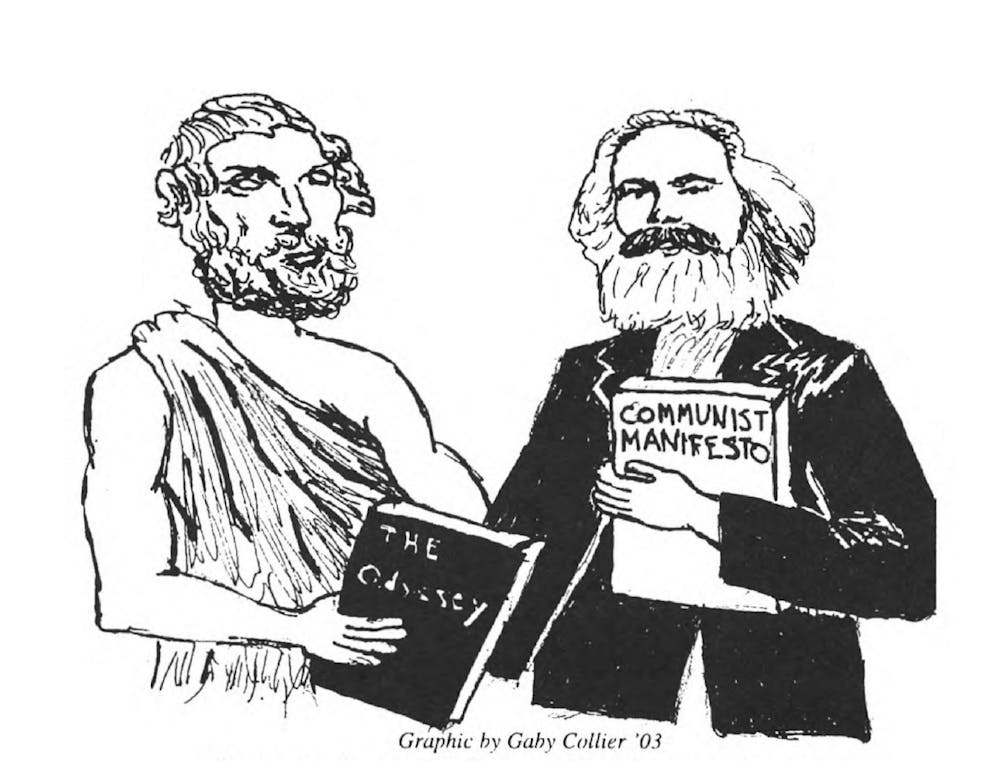
89 years ago, the pages of the ‘Prince’ featured a series of lively debates in the “To the Editor” section about the future of the humanities curriculum at Princeton.
One of the central issues of the debate, as Wallace Irwin Jr. ’40 wrote in his letter to the editor on Feb. 22, 1937, was striking a balance between the breadth of humanistic disciplines and the realistic limit of students’ time.
Irwin’s letter was a direct response to Temple Fielding ’39, who, just a few days prior, wrote a proposal for a drastic curricular change and published it in the ‘Prince.’ Fielding suggested a course combining content from different academic departments, offering undergraduates an interdisciplinary exploration of various cultural fields. “Because of degree and departmental requirements, time does not permit us to include in our curriculum courses which would prove broadening and valuable in later life,” he wrote. Fielding expected his self-produced proposal to change this situation.
According to Fielding’s vision, this course should take inspiration from the Department of History’s interdisciplinary course at the time History 101/102, which integrated diverse subjects like “anthropology, Near Eastern cultures and economic geography.” Covering a wider array of humanistic studies, the program should include “[a] quick survey of art from classics to surrealist,” a condensed musical education, as well as “a glance at the salient points of architecture, from Byzantine to pre-fabrication.”
For Fielding, the key was not specialization in a particular humanistic field, but rather comprehensive knowledge that would later prove to be useful in life. All that students need, he wrote, “would be the ability to distinguish Handel from Haydn, or Verdi from Wagner; the number of measures in a minuet would mean nothing to us.”
The agenda of such a course triggered Irwin’s critical response. Irwin was concerned the proposed course would only “enable the specializing scientist to talk in a drawing room with some comprehension of his subject.” Akin to “put[ting] education in Keglined cans,” he argued that the course would not equip students with a thorough and meaningful understanding of the cultural fields they study. Nevertheless, not all members of the undergraduate community shared Irwin’s opposing stance.
Some, like W. B. Hunter Jr. ’37, believed that a combined cultural course was “quite inessential compared, say, to a course in Military Science.” However, Hunter suggested that the practicality of the other sciences does not negate the significance of teaching “what every young graduate should know” through the various humanities. A science student, B. F. Howell Jr. ’39, also wrote to the ‘Prince’ before Irwin, saying the enormous amount of scientific coursework and the limited space for other elective courses discouraged students from “spending much time on any one phase of a cultural subject.” An integrated music-art-architecture course would be a “godsend” for someone mainly pursuing the sciences, he observed.
These letter-to-the-editor discussions about the humanities coursework were preceded by an official academic modification made by the University’s trustees less than a year ago. On April 9, 1936, the University adopted “A Divisional Program of Humanistic Studies,” aimed at encouraging undergraduate students to explore the humanities outside of their departments. This new Humanistic Program was considered a significant change at the beginning of 1937, but, as Fielding’s suggestion revealed, it remained unclear how feasible it was for a STEM student to explore the humanities as comprehensively as they might wish within their course schedule.

Today, the Princeton course closest to what Fielding envisioned 89 years ago is the year-long interdisciplinary Humanities Sequence (HUM Sequence), which began in 1992 as a joint initiative between Professor Theodore Rabb from the Department of History, Professor Robert Hollander from Italian, and John Fleming from English. While the sequence was initially centered around Western literature, history, music, and art, it now spans diverse geographical regions and offers versions in three different tracks: the classic Interdisciplinary Approaches to Western Culture, but also courses in East Asian Humanities and Near Eastern Humanities.
Today, with distribution requirements that were first introduced in 1947, both disciplinary breadth and depth of the humanities have been integrated into the liberal arts curriculum of a Princeton student, regardless of whether they are pursuing an A.B. or a B.S.E. degree. For those searching for an intensive humanities crash course, however, the HUM Sequence now exists to fill that void.
Yi (Chris) Xin is an assistant Archives editor for the ‘Prince.’
Please send any corrections to corrections[at]dailyprincetonian.com.
Read More

“The Art of Japanese Publishing” exhibit illuminates the history of Japanese illustrated literature
Hifza KaleemThe Milberg Gallery at Firestone Library is presenting "The Art of Japanese Publishing," an exhibition of rare illustrated books from the Marquand Library's collection that traces Japanese publishing from 1660 to 1960. Curated by Nicole Fabricand-Person and Holly Hatheway, it will be on display through December 6.
The Milberg Gallery at Firestone Library is presenting "The Art of Japanese Publishing," an exhibition of rare illustrated books from the Marquand Library's collection that traces Japanese publishing from 1660 to 1960. Curated by Nicole Fabricand-Person and Holly Hatheway, it will be on display through December 6.

Kwanza Jones ’93 and José Feliciano ’94 purchase the San Diego Padres for record $3.9 billion
Kai Kim and Ari AhdiehPrinceton alumni and billionaire couple Kwanza Jones '93 and José Feliciano '94 acquire the San Diego Padres at record price.
Princeton alumni and billionaire couple Kwanza Jones and José Feliciano acquire the San Diego Padres at record price.

Roundup: Joyce Carol Oates and Katherine Nouri Hughes’ book talk, U.S. News rankings, and meal swaps
Coralene Ellis, Riley Price, Devon Rudolph, and Wesley BartlettAuthors Joyce Carol Oates and Katherine Nouri Hughes read excepts of their latest works, student reactions to U.S. News ranking, and the new meal swap program.
Authors Joyce Carol Oates and Katherine Nouri Hughes read excepts of their latest works, student reactions to U.S. News ranking, and the new meal swap program.