



Lea en español aquí.
Princeton’s town council discussed a reduced speed limit on Nassau Street, a storm water utility, and taxes and streams of revenue affecting the municipality’s operating budget at its meeting on Monday, Nov. 24.
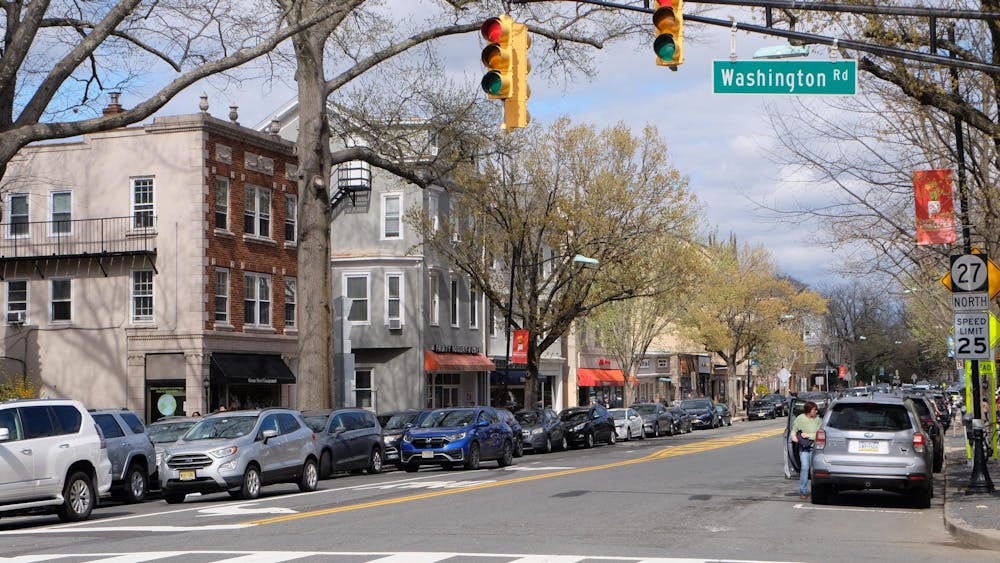
The council approved a reduction in the speed limit on New Jersey Route 27, which includes Nassau Street and Princeton-Kingston Road, to 25 mph within the municipality of Princeton. The default speed limit on suburban, residential roads in New Jersey is 35 mph. Council member Brian McDonald said that he was “delighted” that this change is being implemented and additionally hopes for “other opportunities” to improve safety in the town.
“There are a good number of residents who live along this corridor who are really excited about this, and think this is a major step to making [Princeton] safer for residents and children,” McDonald said.
This change will make the street safer for University students who frequent the area, according to Mayor Mark Freda.
Deputy Administrator and Municipal Engineer Deanna Stockton and Assistant Municipal Engineer James Purcell also presented to the council on progress on a feasibility study for creating a municipal stormwater utility in response to increased permitting compliance costs.
In Jan. 2023, the MS4 stormwater permit went into effect, imposing new requirements on stormwater management to address flooding and climate changes. One such requirement was for municipalities to retrofit all of the stormwater inlets in order to prevent sediment and trash from going into open waters. However, Princeton’s general funds budgeted towards stormwater are not sufficient for the required repairs.
In 2019, the state passed the Clean Stormwater and Flood Reduction Act, which enabled municipalities to create stormwater utilities in order to collect funding for improving water quality and stormwater management. A stormwater utility would allow the municipality to raise revenue without using a tax based on property values.

Princeton’s four-phase study on creating a stormwater utility began in 2022. The first two phases will determine whether the creation of the utility is optimal for the municipality. The municipality is currently in the second phase. The third phase will include designing a rate structure and soliciting public feedback. Implementing the utility will address current concerns over disproportionate taxing and the overextension of Princeton’s stormwater management resources following the increased MS4 permit requirements, according to Stockton.
Additionally, according to a graph presented at the meeting, residential taxpayers currently pay the majority of municipality taxes for stormwater management. Under the new stormwater utility, taxes will be distributed more equitably among all municipality property types.
“Currently, the stormwater program is financed by property owners through property taxes,” Stockton said. “A utility will allow us to recognize storm water as a municipal service.”
“This really is an equitable approach,” Council President Mia Sacks said. “The sooner the better so we can spread it out equitably.”
Ultimately, a new utility will address the aging and undersized infrastructure of the municipality, which is the cause of higher runoff in extreme weather, Stockton explained. There are currently a number of major capital projects to replace culverts and other stormwater facilities to address flooding issues.
The town council will continue evaluating options as the state’s compliance deadlines approach. Several members of the council expressed their support of moving forward with the third phase of the study.

The town council also discussed the municipality’s long-term capital plans, including upcoming expenditures for road maintenance, stormwater infrastructure improvements, and sanitary sewer upgrades.
“Interaction with the operating budget is really important, not just because the interest payments wind up in the operating budget but also because we have to understand what kinds of tax increases may be needed in the operating budget,” councilman David Cohen said. He also cited unusual stressors, like skyrocketing health insurance premiums, climate change-related costs, and Westminster campus operating expenses, as the reason behind a more conservative budget plan.
According to Cohen, timing — including how quickly certain facilities are needed and when existing debt can be fully paid back — plays an important role in implementing certain plans.
“We know historically we tend to be optimistic about how much we can get done in any given year,” Cohen said. “We’re trying to be more realistic about that going forward.”
In closing this part of the meeting, Freda said, “One of the biggest and most important things we do is figure out how we spend our money and what the impact on taxpayers will be.”
At the end of the meeting, the council discussed tree-removal requirements for permits. They also discussed imposing an occupancy tax on short-term rentals in the town. Both of these resolutions will be discussed at a public hearing on Dec. 22.
Meetings for the town council take place on the second and fourth Monday of each month at 7 p.m. The next meeting is scheduled for Dec. 8.
Elizabeth Hu is a News contributor from Houston, Texas. She can be reached at eh9203[at]princeton.edu
Clara Docherty is a staff News writer for the ‘Prince.’ She is from Lafayette, N.J. and typically covers campus clubs and institutional legacy. She can be reached at clara.docherty[at]princeton.edu.
Please send any corrections to corrections[at]dailyprincetonian.com.
Read More

Porchfest pivots to indoor festival due to inclement weather after being rescheduled
Sena ChangThis Saturday, Porchfest will be hosted indoors across eight “stages” in town due to inclement weather.

NJ Lt. Gov. Caldwell ’82 resigns after report finds sexual harassment and ethics violations
Oliver Wu and Luke GrippoCaldwell resigned a day after a report into allegations against him was released by Sherrill. The report concluded that he had violated multiple policies while engaging in sexual misconduct and unethical practices. Caldwell has disputed the findings.
Caldwell resigned a day after a report into allegations against him was released by Sherrill. The report concluded that he had violated multiple policies while engaging in sexual misconduct and unethical practices. Caldwell has disputed the findings.

High Meadows Environmental Institute unveils new Maya Lin installation on species loss
Mia Chen and Riley PriceBriger Hall's new Environmental Gallery opened on Sept. 22 with Maya Lin’s “What Is Missing?,” which shows large videos of endangered animals like whales, tigers, and giraffes.
Briger Hall's new Environmental Gallery opened on Sept. 22 with Maya Lin’s “What Is Missing?,” which shows large videos of endangered animals like whales, tigers, and giraffes.