



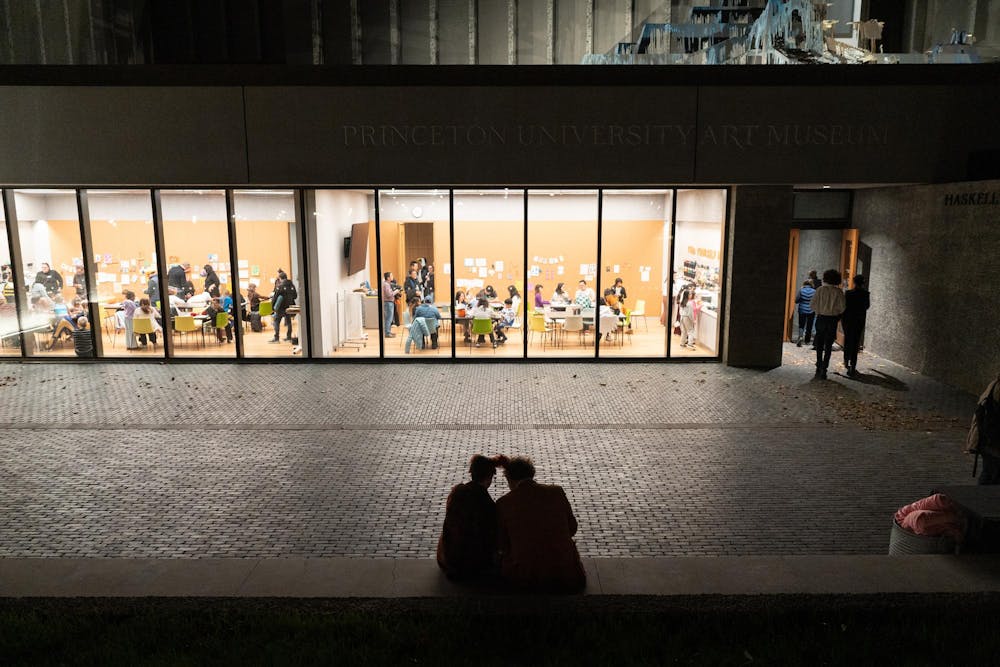
At least eight courses plan to take significant advantage of Princeton University Art Museum’s collections and classroom space in the spring.
The art museum reopened on Oct. 31, attracting almost 22,000 visitors to its 24-hour open house. The building contains an 8,800 square-foot education center, including two art studios, two seminar rooms, an auditorium, and five object study rooms. In addition, the central Grand Hall can be converted into a 250-person lecture hall.
Senior Associate Director for Education Caroline Harris will be teaching FRS 126: Behind the Scenes: Inside the Princeton University Art Museum alongside curator Veronica White. This course, offered only to first-year students, will focus on examining and analyzing different groups of museum artifacts selected by both students and faculty. Classes will take place in both the museum’s galleries and object study classrooms.
“We want [students] to engage deeply with issues in the Museum field, from collecting and provenance to conservation and issues of display,” Harris wrote in a statement to The Daily Princetonian.
“Given that the collections are globe spanning, they afford infinite possibilities for interdisciplinary engagement,” she added. “We hope that the students in the class, whatever major they decide to pursue, will continue to think of the museum as a resource for their intellectual development.”
Professor Maria Alessia Rossi, who will be co-teaching ART 430, titled “Seminar. Medieval Art: Collecting the Sacred: Mt. Athos in Princeton University Collections,” with Professor Charlie Barber, echoed the rare opportunities offered by the museum.
“Mount Athos is a remote peninsula in northeastern Greece governed by monks. Entrance is limited for men and prohibited to women. Access is thus one of the biggest challenges for researchers, making Princeton’s collections of Athonite materials a goldmine,” Rossi told the ‘Prince.’
Students in ART 430 will explore artifacts from the monastic communities of Mt. Athos from medieval times to early modernity.

Rossi said that “students will learn about artists, artistic practices, and model books by examining firsthand a remarkable collection of post-Byzantine artists’ drawings, known as anthivola, [in the museum].”
“Directly engaging with objects allows for the experience of scale, materiality, and craftsmanship in a way that images cannot capture,” Rossi added. “With this course, we wanted to combine traditional art history with the opportunity to handle and interact with objects directly, offering students the best of both worlds.”
Harris also highlighted the accessibility of staff to students. Students will be introduced to the museum’s curators, conservators, and other members of the museum staff.
“We hope that if [students] have questions or research projects later in their academic careers that relate to the Museum collections, they will feel empowered to reach out to us,” Harris wrote.
ART 442: Learning through Looking — European Drawings 1500–1800 will be taught by Professor Thomas Kaufmann and Laura M. Giles, curator of prints and drawings. The class will directly study works in the University Art Museum, with classes held in the object study rooms. They will also take advantage of some of the possibilities introduced with the new Creativity Labs.
Giles told the ‘Prince’ that her course will be bringing in “somebody who knows how to make handmade paper. I think that’s going to be the first class.”

Students are expected to explore drawings on display and held in storage, according to Kaufmann.
“We’re going to incorporate drawings that have recently entered the collection through gifts,” Giles said. “Many of them have not been worked on before, so this is really a chance for students to do original work.”
“We’ll be probably acquiring a work of art for the museum,” Kaufmann said, noting that the class will be working with an art dealer and the curators of the art museum.
“[Students will] get the strictly academic perspective. They’ll get the curators’ perspective,” Giles said. “I’ve been a curator here for 25 years, and I was curator at the Art Institute of Chicago before I came here … I’ll be talking to the students about building collections, working with collectors, and working with dealers.”
As the new museum settles into its role on campus as a hub for artistic and academic exploration, these new courses offer students the opportunity to work directly with its vast collection for the first time in five years.
The last piece of the museum complex, Marquand Library, is set to reopen on Jan. 26, the first day of the spring semester.
Christine Woods is a News and Archives Contributor for the ‘Prince.’ She is from New York City and can be reached at cw0453@princeton.edu.
Please send any corrections to corrections[at]dailyprincetonian.com.
Editor’s note: This piece has been updated to clarify that Marquand Library is part of the physical museum complex but is not run by the art museum.
Read More

Class is in session: Grading Coffee Club’s new fall menu
Siri IagnemmaContributing writer for The Prospect Siri Iagnemma reviews Coffee Club's newly released fall menu.
Play the Friday Crossword, ‘Something’s Gotta Give’
Luke K. SchreiberTake a break from studying with this tricky puzzle by Head Editor Luke K. Schreiber.
Take a break from studying with this tricky puzzle by Head Editor Luke K. Schreiber.
Orientation SHARE play replaces scene implying rape with groping
Riley Price and Kimberly HutchinsonThe content of Princeton’s annual SHARE play at Orientation was altered for the Class of 2030, after male actors were concerned about playing a character who was implied to be a rapist.
The content of Princeton’s annual SHARE play at Orientation was altered for the Class of 2030, after male actors were concerned about playing a character who was implied to be a rapist.