



Though Americans may immediately associate polling with Washington D.C. or New York City, the town of Princeton features prominently in the historical and current industry of public opinion surveys.
“There are dozens or hundreds of survey research professionals who live and work in the Princeton area,” noted Edward Freeland GS ‘92, associate director of the University’s Survey Research Center.
Princeton rose to prominence in the polling world quickly following Gallup’s 1936 breakthrough.
By 1955, Princeton was “the leading center of public opinion polling in the United States” with 14 companies employing 350 people, according to a Princeton Packet article published that year.
“Princeton has always been a key area, because Gallup started here,” Freeland said, explaining that some of the other polling companies “were spun off from Gallup.”
Public opinion polling soon expanded to be part of the University as well, with the founding of the Office for Public Opinion Research in 1940.
Yet even by 1955, the young field of polling had begun to change. Telephone surveys could be completed in as little as 48 hours, far outpacing Gallup’s traditional 10-day door-to-door surveys, according to the Packet article.
Polling in the new millennium

In today’s world, the internet has revolutionized polling, both as a means of reaching respondents and as a venue for distributing results to the public. In-person polling has largely faded away, and most research is restricted to telephones and the internet.
In the last decade, however, even traditional landline phones have begun to fade from the polling landscape. Younger people are more likely to have only a cell phone, and as a result, pollsters must make sure to capture cell phone-only households to receive accurate results.
In the current presidential campaign, missing such households would undercount Democratic presidential candidate Sen. Barack Obama (D-Ill.)’s support by two to three points, according to the Pew Research Center.
Gallup Inc., which is no longer based in Princeton but retains an office in town, uses random-digit dialing to correct for this problem. Randomly dialing listed telephone numbers ensures that cell phones and landlines have an equal chance of being reached.
“Everyone has an equal or known chance of falling into our sample,” Gallup Poll Editor-in-Chief Frank Newport explained.
The University has also remained engaged in the field of polling, albeit on a more local scale. Though the Office of Public Opinion Research no longer exists, the University’s Survey Research Center, founded in 1994, assists faculty, seniors and graduate students in crafting their own surveys for study in addition to administering surveys for the administration.

Members of the University community also have become involved in analyzing the plethora of polling data generated by this year’s presidential contest.
Molecular biology and neuroscience professor Sam Wang and Andrew Ferguson ‘08 maintain the Princeton Election Consortium, a website that uses state polls to calculate up-to-date electoral college maps. Wang first managed the site during the 2004 presidential election.
“In the end ... a pure poll-based calculation was a very good predictor of the race,” Wang said of the 2004 results.
Princeton polling companies figure prominently in his data collection.
During this past week, for example, Princeton Survey Research Associates International produced polling for the Minnesota Star Tribune indicating that Obama has gained on Republican candidate Sen. John McCain (R-Ariz.) in Minnesota.
“[Princeton] is still a national and worldwide hub [for polling],” Freeland said. “And that’s a real legacy of Gallup’s founding.”
Read More
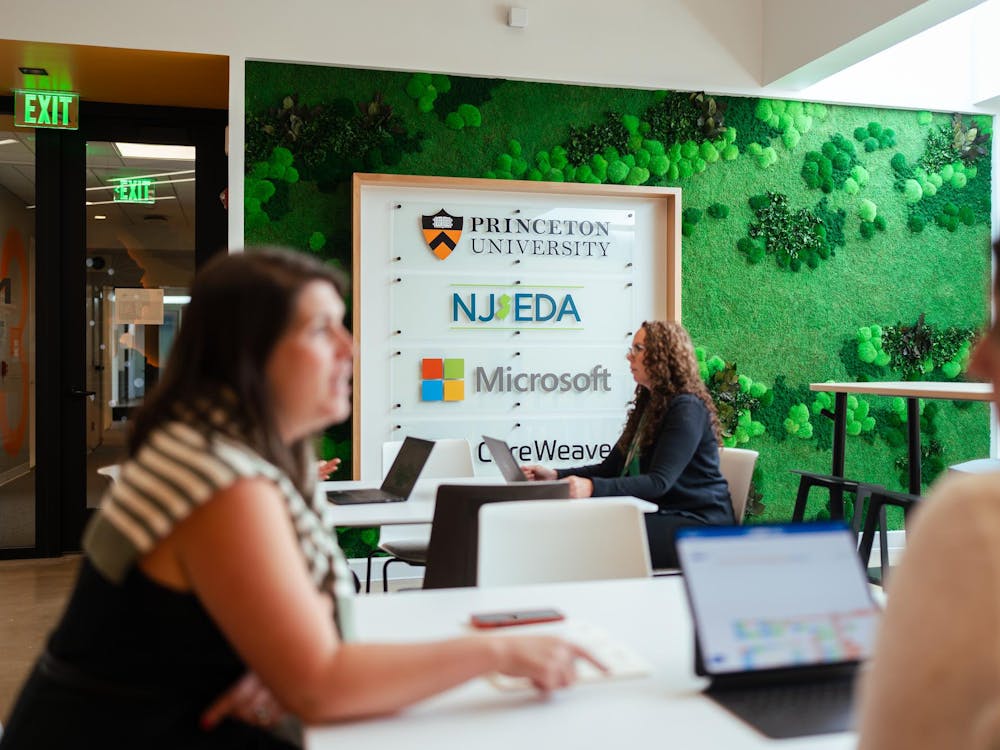
NJ AI Hub marks first anniversary with inaugural startup cohort
Zihan (Frank) XuFourteen selected start-ups receive weekly workshops, reverse pitches, corporate introductions, among other guidance over 12 weeks. The “AI accelerator” helps to test each company’s technology and fast-track its path to commercialization.
Fourteen selected start-ups receive weekly workshops, reverse pitches, corporate introductions, among other guidance over 12 weeks. The “AI accelerator” helps to test each company’s technology and fast-track its path to commercialization.
Three Princeton alumni awarded 2026 Fields Medal
Clara DochertyThe three alumni who received the medal are Yu Deng GS ’15, John Pardon ’11, and Jacob Tsimerman GS ’11.
The three alumni who received the medal are Yu Deng GS ’15, John Pardon ’11, and Jacob Tsimerman GS ’11.

Major gift from Leinweber Foundation to strengthen theoretical physics research
Daphne Lewis and Haeon LeeThe University is joining a national network of institutions advancing theoretical physics research, following the major gift. The foundation has committed over $165 million to top fundamental science research institutions during a period of uncertainty for research funding.