



Keller stressed that he hoped his gift would support “courses that have important technological components but that are very interesting to A.B. students because of the applications of technology and the industries that are supported by the technology.”
Vincent Poor GS ’77, dean of the engineering school, praised the gift, which “will have significant impact, not only on Princeton, but on engineering education more broadly,” he said in an e-mail.
The former Center for Innovation in Engineering Education, of which Poor is the founding director, will receive $20 million and was renamed the Keller Center; the other $5 million will be split evenly between a general-innovation fund in engineering and the Mpala Research Center in Kenya, which focuses on the sustainable use of land, water and animal resources.
Keller, who graduated with a degree in economics and is the founding chairman of the technology-focused college company DeVry, stressed his desire to “introduce A.B. students to the potential of technology.”
Keller cited increasing the percentage of A.B. students who take at least one technology or engineering course from its current 60 percent to “virtually 100 percent” as a central goal of his donation.
“All of us have a real requirement in our lives, in our families and in our businesses to make good use of technology,” Keller explained. “I just know that technology will have a place to make life better and more enjoyable,” he added.
Bringing students to engineering

The Keller Center, founded in 2005, is geared toward offering projects that enable students within the humanities, social sciences and engineering to draw on their various backgrounds to solve problems together.
“[M]ost engineering curricula already involve significant exposure to the humanities and social sciences, but here we are focusing more on how engineering relates to these fields through the societal issues surrounding technology and technological development,” Poor explained.
Electrical engineering professor Sharad Malik, the current director of the Center, said he hoped that these classes will enable students in different disciplines “to have a discussion and come to a solution that crosses these boundaries.”
“My sense is that these dialogues are happening, but not as much as they should,” he noted, adding that “there’s value in diversity, in talking to people who come from different points of view.”
The Center offers various courses aimed at attracting students from outside the sciences. These courses, which are generally listed as EGR courses, are open to all students and generally have no prerequisites to encourage enrollment from a wide range of students.
One of these EGR courses is EGR 250: Engineering Projects in Community Service (EPICS), which allows students to solve technology-based problems while working on projects for local organizations.

“It’s more than tying into my interest in the humanities,” said prospective English major Mariah Min ’10, also a cartoonist for The Daily Princetonian. “It’s getting me a broader insight into what’s available at Princeton.”
“We’re doing engineering activities, so it’s helpful for us to see what engineering principles are really involved in actual engineering projects,” said Laura Keay ’10, a chemistry major currently taking the course.
The projects, which included restoring a clock for a clock tower in Trenton, are “specifically for the community” and “help us learn what engineering is,” Keay said, adding that she also benefitted from seeing what engineers do on the job after college.
“We come to appreciate the events that lead up to the creation of all these mechanisms [that enable the clock to work] and we learn to respect . . . the people who started all these mechanisms,” Sara Oon ’10, an operations research and financial engineering major who is taking the EPICS course, said.
The Center also provides opportunities outside the classroom through internships, interaction with entrepreneurs and campus visits from leaders in technology-related industries.
Donating to the Center is not the first time that the Kellers have donated to the University. The couple also made a contribution to fund the construction of the Friend Center in 2001. Peter Friend ’63, after whom the Friend Center was named, was Keller’s friend and roommate.
Keller is also a trustee of Charter Club and vice chair of the executive committee of the University Board of Trustees.
-Michelle Wu contributed reporting to this article.
Read More
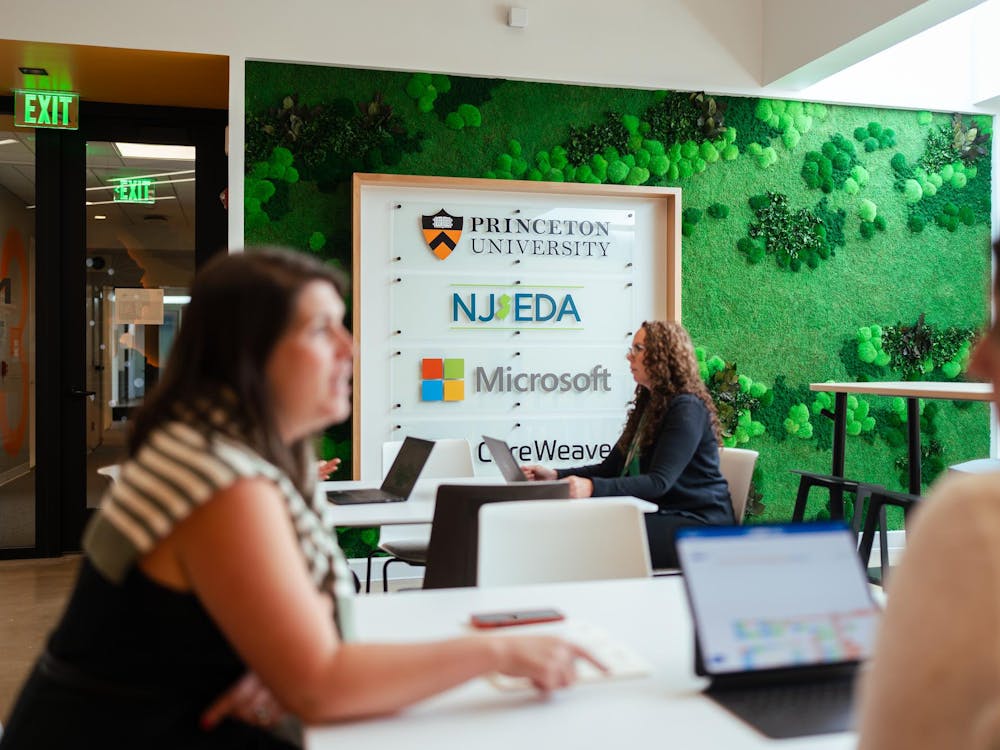
NJ AI Hub marks first anniversary with inaugural startup cohort
Zihan (Frank) XuFourteen selected start-ups receive weekly workshops, reverse pitches, corporate introductions, among other guidance over 12 weeks. The “AI accelerator” helps to test each company’s technology and fast-track its path to commercialization.
Fourteen selected start-ups receive weekly workshops, reverse pitches, corporate introductions, among other guidance over 12 weeks. The “AI accelerator” helps to test each company’s technology and fast-track its path to commercialization.
Three Princeton alumni awarded 2026 Fields Medal
Clara DochertyThe three alumni who received the medal are Yu Deng GS ’15, John Pardon ’11, and Jacob Tsimerman GS ’11.
The three alumni who received the medal are Yu Deng GS ’15, John Pardon ’11, and Jacob Tsimerman GS ’11.

Major gift from Leinweber Foundation to strengthen theoretical physics research
Daphne Lewis and Haeon LeeThe University is joining a national network of institutions advancing theoretical physics research, following the major gift. The foundation has committed over $165 million to top fundamental science research institutions during a period of uncertainty for research funding.