



Responding to binge drinking
The University has “been concerned about students who engage in high-risk drinking,” Tilghman said, adding that “there is a small ... number of our students on campus who are risking their lives through high-risk drinking.”
Tilghman recounted sitting in an intensive care unit last year with the family of a freshman who had been hospitalized for alcohol poisoning. The freshman had a 50/50 chance of survival after a night of serious binge drinking, she said.
“Anyone who had been sitting in that room with me would have wanted to think hard about making sure that didn’t happen again,” she said, adding that “we’re not going to solve this [problem] without student leadership.”
USG president Josh Weinstein ’09 agreed that “alcohol and underage drinking is a very serious issue on campus.”
To incorporate student opinion into the decision-making process, the newly created ACC is holding workshops over the coming weeks to discuss alcohol consumption with students, beginning this Friday. The committee, which consists of students, faculty and staff, is “reaching out to students” to “make this campus safer,” Tilghman said.
The ACC aims to recruit broad participation from the student body, said Sanjeev Kulkarni, professor of electrical engineering and master of Butler College. Kulkarni, who co-chairs the ACC, added that the ACC is meeting with a wide variety of groups, and that “we’re getting the conversation going.”
Tilghman cited incoming freshmen as “the most vulnerable” to alcohol-related problems, adding that peer pressure is one of the reasons freshmen might abuse alcohol. Students need “an effective way to talk to incoming freshmen and say you don’t have to go out and drink yourself into a stupor in order to fit into Princeton,” she said.

‘Aspire’ and the 10-year Campus Plan
Tilghman addressed the “Aspire” capital campaign, a five-year “marathon” in which the University hopes to raise $1.7 billion to “strengthen aspects of the University that are already very much a part of our university fabric” and to “respond to new fields, to changes that we see in academic disciplines,” Tilghman said.
A large portion of the funds from the campaign will be devoted to the expansion of the University’s neuroscience program, including plans to increase the number of neuroscience faculty members, Tilghman said.
“Neuroscience will be the truly transformative field in the 21st century,” she said, adding that neuroscience will be for the next 50 years what physics and molecular biology were for the 20th century — the edge of Princeton’s innovation.
Similarly, while Tilghman recognized the strength of Princeton’s art programs, she said that they “were not meeting student need.” The University has been looking for ways to place creative and performing arts at the center of the curriculum. One such way will be an expansion of “venues in which art will be performed and viewed on campus,” Tilghman said.
To enhance the arts community and other elements of campus life, the capital campaign will bolster the “ambitious” 10-year Campus Plan, which includes the Arts and Transportation Neighborhood as well as enhancements to the engineering school and the “science district,” in which the chemistry department and a neuroscience-psychology complex will be housed, Tilghman said.

USG vice president Mike Wang ’10 asked how the University planned to “make arts a part of the fabric of the undergraduate experience,” specifically whether a separate distribution requirement would be added.
Tilghman said the University did not plan to change distribution requirements, but just planned to “expand the number of opportunities” for involvement in the arts. The University would not create a separate degree program in the arts because “there is no better preparation to be an artist than a broad liberal arts degree,” Tilghman said.
Read More
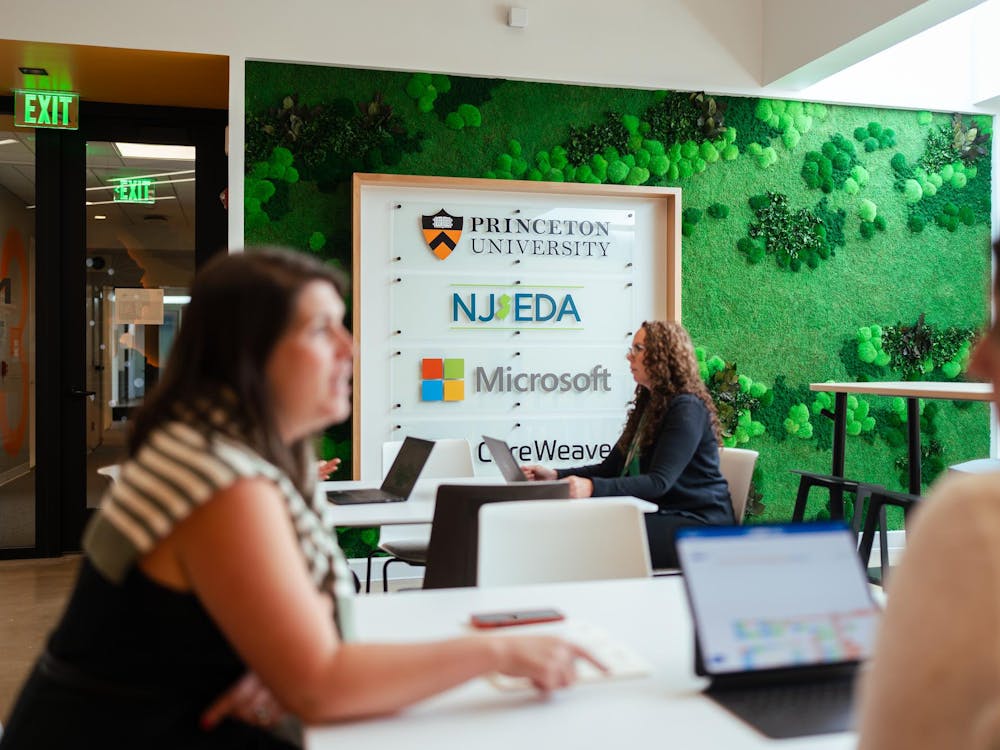
NJ AI Hub marks first anniversary with inaugural startup cohort
Zihan (Frank) XuFourteen selected start-ups receive weekly workshops, reverse pitches, corporate introductions, among other guidance over 12 weeks. The “AI accelerator” helps to test each company’s technology and fast-track its path to commercialization.
Fourteen selected start-ups receive weekly workshops, reverse pitches, corporate introductions, among other guidance over 12 weeks. The “AI accelerator” helps to test each company’s technology and fast-track its path to commercialization.
Three Princeton alumni awarded 2026 Fields Medal
Clara DochertyThe three alumni who received the medal are Yu Deng GS ’15, John Pardon ’11, and Jacob Tsimerman GS ’11.
The three alumni who received the medal are Yu Deng GS ’15, John Pardon ’11, and Jacob Tsimerman GS ’11.

Major gift from Leinweber Foundation to strengthen theoretical physics research
Daphne Lewis and Haeon LeeThe University is joining a national network of institutions advancing theoretical physics research, following the major gift. The foundation has committed over $165 million to top fundamental science research institutions during a period of uncertainty for research funding.