



Tucker Willsie '11 is on a mission to create a greener vehicle.
Willsie is working with a team of students and professors from MIT to design and race a fourto six-passenger vehicle that consumes 95 percent less energy than current vehicles. Called the Vehicle Design Summit (VDS), the project is a collaborative international endeavor to revolutionize the car industry and address global warming.
VDS, a student-led, nonprofit organization, was launched in 2006 by MIT with the aim of planning, building and marketing an electric plug-in hybrid vehicle within three years. The effort has united people from Princeton, Harvard and other schools across the world.
Willsie, who is currently Princeton's one-man team, has been assigned to oversee the project's management strategies. To this end, he is recruiting students and faculty at the University with backgrounds in material science, engineering or environmental science.
The Princeton team has been assigned to work specifically with the VDS team in China, which is building the vehicle's body and frame. "They're focused on very difficult scientific hurdles," Willsie said, explaining that the job of the Princeton team will be to make sure that its teammates in China "don't miss the overall vision."
Given the intellectual caliber of the Chinese scientists, Willsie admitted that it can be an intimidating task. "It's hard to give advice to geniuses, especially being a college freshman," he said.
Wilsie, who communicates with his teammates in China primarily via email, said he makes sure their focus on creating the lightest, cheapest product possible is balanced with an emphasis on environmental soundness. "We will be looking at the other teams' work and suggesting materials, techniques, etc., that will help to make the project more environmentally friendly," Willsie said in an email.
Willsie added that the VDS' mission is to build a product that can be assembled, disassembled, and used over and over again. "We basically don't want it to end up in a landfill," he said.

VDS aims to assemble a prototype of the vehicle by January 2008 so the China team can analyze how the parts fit together. The fully functional hybrid car, which promises to run for 18 hours a day, is set to be unveiled in India as early as August 2008.
Jonathan Krones, one of the project's advisers at MIT, said the endeavor is unique because it is "developing breakthrough technology in a collaborative atmosphere." Though building cars is usually an ultra-competitive corporate race, he said, the VDS project has become an intercultural team effort.
In addition to its collaboration with the Chinese team building the actual vehicle, Princeton has also been assigned to work with a team in India to strategize how to introduce the car there.
India's growing economy makes it an ideal launching site, Willsie said, since the VDS project aims to steer newly affluent individuals — a description that fits many of India's citizens — into using environmentally sound products. "We don't want them make the same kinds of mistakes that the West has made in the past 100 years," he said.
Anna Jaffe — one of the leading members of MIT's VDS team and a native of Princeton — said she and Willsie are family friends and that she introduced him to the VDS project during a recent Thanksgiving gathering.
Jaffe added that the VDS initiative is premised on the idea that people from different parts of the world can bring different strengths to a multifaceted project. "There are a lot of people in the world that have a lot more potential than we do," she said. "Science is global; technology is local."
Read More
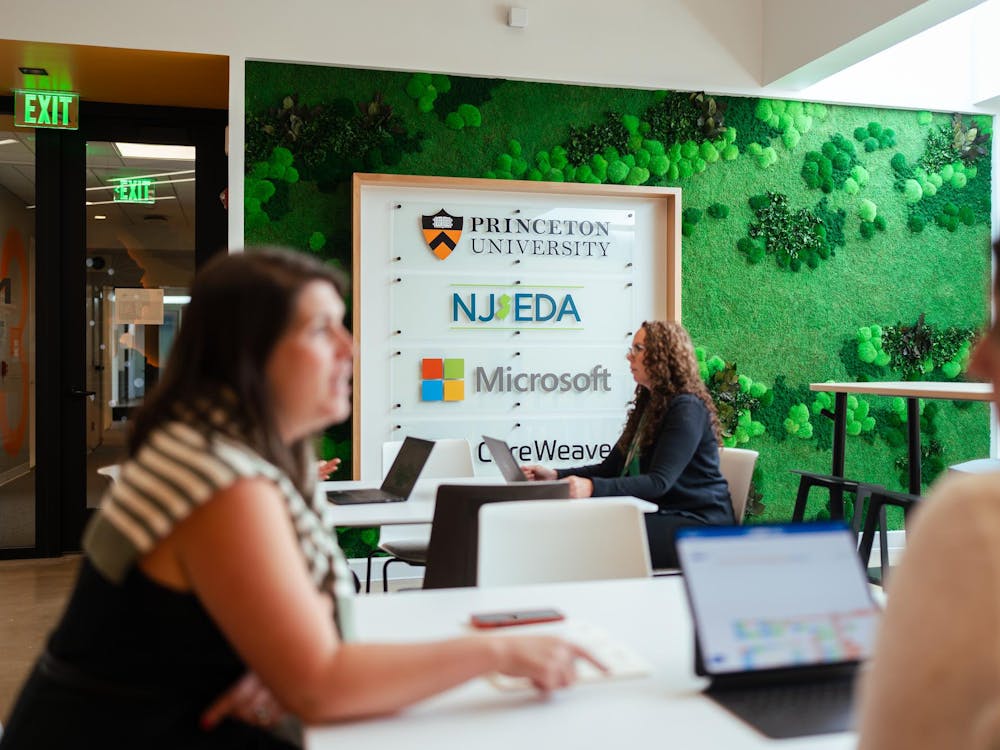
NJ AI Hub marks first anniversary with inaugural startup cohort
Zihan (Frank) XuFourteen selected start-ups receive weekly workshops, reverse pitches, corporate introductions, among other guidance over 12 weeks. The “AI accelerator” helps to test each company’s technology and fast-track its path to commercialization.
Fourteen selected start-ups receive weekly workshops, reverse pitches, corporate introductions, among other guidance over 12 weeks. The “AI accelerator” helps to test each company’s technology and fast-track its path to commercialization.
Three Princeton alumni awarded 2026 Fields Medal
Clara DochertyThe three alumni who received the medal are Yu Deng GS ’15, John Pardon ’11, and Jacob Tsimerman GS ’11.
The three alumni who received the medal are Yu Deng GS ’15, John Pardon ’11, and Jacob Tsimerman GS ’11.

Major gift from Leinweber Foundation to strengthen theoretical physics research
Daphne Lewis and Haeon LeeThe University is joining a national network of institutions advancing theoretical physics research, following the major gift. The foundation has committed over $165 million to top fundamental science research institutions during a period of uncertainty for research funding.