



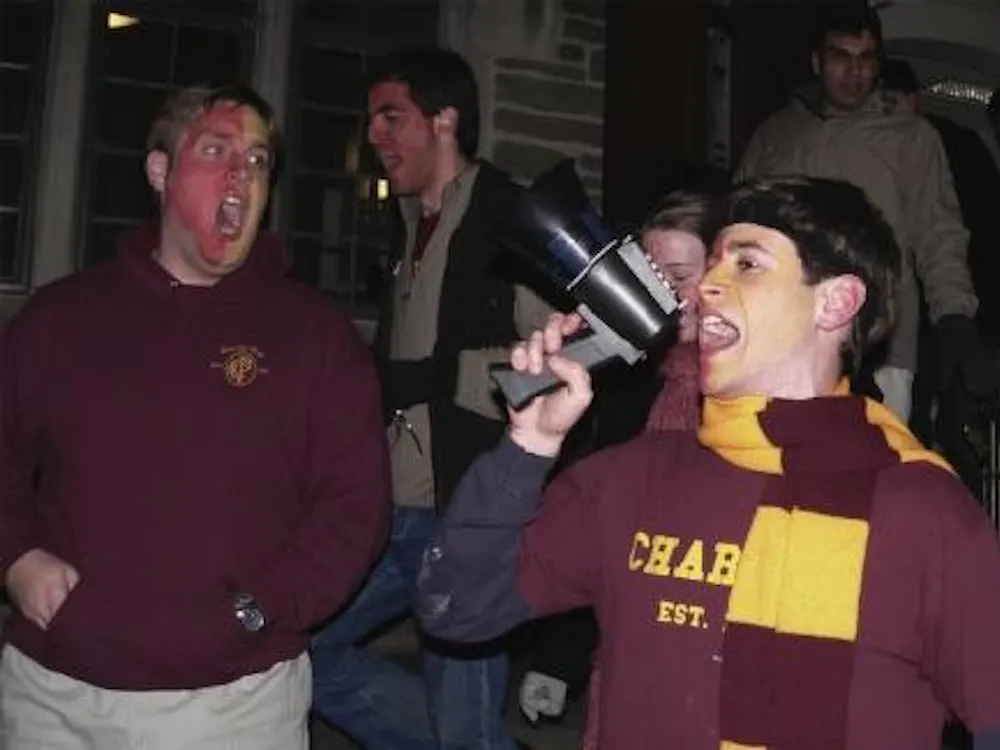
On the morning of Feb. 9, a freelance photographer for The New York Times followed Tower Club members on their annual bicker pickup trail down Prospect Avenue and onto campus, as they approached the dorms of new members.
This was not the first time a Times journalist has been on campus to chronicle the eating clubs. Reporters and editors have long been fascinated by the clubs' balance of perceived elitism and hard-partying college life. "If you search newspaper archives, I am sure you will find articles on Ivy League social life dating back to the beginning days of journalism," University spokeswoman Cass Cliatt '96 said in an email.
In recent months, however, national media scrutiny of Ivy League social life has heated up, with stories on the subject appearing in The New York Times, on the Associated Press wire and in the New York Observer. Professors and journalists attribute this trend to Americans' general fascination with elite institutions.
"When you go to Princeton, Harvard or Yale, you are seen as having joined the American elite," Boston Globe arts writer and visiting journalism professor Mark Feeney said. "Society is interested in members of its elite ... and young people that are apprenticing to become the elite."
Eye on Princeton
Less than two weeks after The Daily Princetonian reported on the Times' presence on campus, the New York Observer published an "undercover" story on the Street, detailing stereotypes of individual clubs and portraying the Street as racist and elitist.
These articles undoubtedly affect the reputation of Ivy League institutions. "In general, such parties do not project a very flattering imagery of college kids and of the colleges they represent," longtime University economics professor Uwe Reinhardt said in an email. His son, Mark Reinhardt '01, was president of Ivy.
Washington Post reporter T.R. Reid '66 echoed Reinhardt's comments. "As a general rule, the story of college students acting up is a hardy perennial for all journalism," he said in an email. "Readers and viewers love to be scandalized. Shocking conduct by the kids at the state university is always a good story; shocking conduct by brainy kids at Harvard and Princeton is an even better story."
Reid was on the University Board of Trustees from 2000 to 2004, and spent last semester on campus as a visiting professor of journalism.

"As for Bicker," he added, "it's a scandal that the [University] board [of trustees] and the students of Princeton tolerate such a shallow, elitist and hurtful social system. Stories about Bicker will continue to embarrass Princeton as long as Princeton lets Bicker continue."
But Interclub Council (ICC) president Will Scharf '08 said that those who continue to view the clubs as elitist "have an interest in sensationalizing" the issue, and that media coverage of the Street did not much affect public perception of the University.
"In just about every year, Princeton is rated as parents' [top] college choice for their kids," he said. "America's perceptions of Princeton are that of a stellar academic institution."
"This sort of periodic concentration on the bacchanalian aspects of Princeton's social life," he added, "doesn't have nearly as all-encompassing an effect as people are giving it credit for."
Ivy appeal
Though leaked facebook.com photos of underage drinking and high-profile instances of binge drinking and fraternity hazing have garnered the attention of the national press in recent months, the media's obsession with covering the social lives of elite institutions is certainly not a new trend.
The Times published an article about Princeton in October 2002 that described "the heart of what has again become a main topic on this bucolic campus: drinking." Citing several examples of alcohol-related emergencies on Prospect Avenue, the article focused on Ivy — "the oldest and perhaps stateliest of all," as the article called it.

But Tim Szostek '02, then the graduate advisor to the ICC, was quoted in the article as saying, "I don't think that more kids drink here than at other schools ... It's more of a national problem, binge drinking."
Journalists who cover national college trends have repeatedly singled out elite universities, such as Princeton, to use as examples. Even though drinking and partying trends at these universities follow the norm, readers are drawn to the Ivy League name and elitist intrigue.
"College students do stupid things," Feeney said, which are attractive to reporters "especially when they're done by intelligent people."
A May 16, 1999, article in the Times focused entirely on elitism and exclusivity at Ivy, listing names of the then-members who were the offspring of prominent public figures. Last month's Observer article also listed the names of several Ivy members from rich and famous families.
The focus on elitism guides the national media toward the Ivy League, especially aspects of the schools that are selective and exclusionary. "Ivy League colleges do give many smart, low-income youngsters a chance at the American dream," Reinhardt said, "[but] it would be hypocritical to pretend that these colleges do not also give youngsters of 'noble' lineage and wealth an advantage in admissions. The media, most of whose practitioners are solidly middle or even lower-middle class, naturally are dismayed by this transformation — perhaps jealous, even."
But Scharf countered that "any reasonable person looking at the Street would have to conclude that it's far superior and more egalitarian than anything at our peer institutions."
The obsession with fame and money is nothing new. From F. Scott Fitzgerald's "This Side of Paradise" to Tom Wolfe's "I Am Charlotte Simmons," the point of interest is elitism, wealth and power.
"Fitzgerald didn't write 'This Side of Paradise' just because he went to Princeton," Feeney said. "He wrote it because people wanted to read about it, too."
The 'herd mentality'
In an interview with the 'Prince' last month, Morgan said he was inspired to write his story about the clubs after talking to friends who were going through Bicker. Undoubtedly he was intrigued by the unique process, but he said he was "further interested when the New York Times reporter got thrown out of there."
The intensified attention could be a result of the media's internal connections and influences, or of increased competition for interesting stories. Chemistry professor Robert Cava, father of a Princeton senior, described it as a "herd mentality," where one subject seems appealing for a while "until something that appears more exciting to them comes around. That is probably what is happening."
"In my view, the media is not intrinsically interested in any issue, including this one," Cava added. "They are only interested in using anything they can latch onto temporarily to keep themselves going."
In recent weeks
One critical event that might have triggered this "media interest in the life of privileged college students," Reinhardt said, is the three Duke lacrosse players who were charged with rape last year and later had the charges against them dropped.
The Observer piece "seems to reinforce the imagery created by the Duke lacrosse incident. There are the themes of privilege, of wild parties and of sex," Reinhardt said.
"The dissonance created by the widely accepted lament that college women everywhere in the U.S. are victims of sexual harassment and rape, while at least some presumably proud college women think nothing of parading themselves in lingerie or pajamas before crowds of inebriated college men," Reinhardt said, may be another reason that the media is so interested in writing about social debauchery at elite universities.
In the Observer article, Cliatt reiterated the University's official policy on the clubs: that they are not regulated by the University, but rather by independent memberships and trustees.
Since reporters certainly will come knocking on the clubs' doors again, Cava suggested the clubs figure out how to tackle future inquiries from the national press. "It seems to me," he said, "that it would be wise for the eating-club officers to get together soon and decide on a unified strategy for dealing with the media."
Read More
Trump picks Will Scharf ’08 as new White House counsel
Sena Chang and Oliver WuScharf will enter the new position on Sept. 1, Trump announced in a social media post. While at Princeton, Scharf was the Charter Club and Interclub Council president, ran unsuccessfully for Undergraduate Student Government president, and was active in Jewish groups and conservative organizations.
Scharf will enter the new position on Sept. 1, Trump announced in a social media post. While at Princeton, Scharf was the Charter Club and Interclub Council president, ran unsuccessfully for Undergraduate Student Government president, and was active in Jewish groups and conservative organizations.
Suspended male Princeton student’s Title IX lawsuit against U. can proceed, appeals court rules
Sena ChangA federal appeals court ruled on July 21 that a Title IX lawsuit brought by a male undergraduate student can move forward.
A federal appeals court ruled on July 21 that a Title IX lawsuit brought by a male undergraduate student can move forward.
Princeton professors awarded NEH grants months after lawsuit
Luke GrippoMonths after a federal judge ruled that the sweeping cancellation of National Endowment for the Humanities (NEH) grants in 2025 was unconstitutional, two Princeton University professors — Eve Krakowski and Marina Rustow — were awarded new NEH grants.
Months after a federal judge ruled that the sweeping cancellation of National Endowment for the Humanities (NEH) grants in 2025 was unconstitutional, two Princeton University professors — Eve Krakowski and Marina Rustow — were awarded new NEH grants.