



Creative writing professor Gabe Hudson is one of 20 young novelists whose work was honored last night in New York by the British literary magazine Granta.
A sample of Hudson's fiction writing will be included in "Granta: Best of Young American Novelists 2," the magazine's second listing of the best American fiction writers under 35.
Hudson said in an interview that he is thankful to receive the award. "I feel very fortunate and always very grateful for any sort of acknowledgements," he said.
Hudson's first book, a collection of short stories entitled "Dear Mr. President," was published in 2002. Drawn from his experience as a Marine rifleman, it is a compilation of surrealistic short stories that revolve around the Gulf War.
The tales include one about a veteran with Gulf War syndrome who watches a man kill his cat. Another involves a veteran who grows an ear on his stomach. A third tells the story of a deserter who becomes trapped in a bunker with a group of chimpanzees.
"He's an amazingly gifted writer," creative writing program director Chang-rae Lee said of Hudson. "His stories are brilliant and sort of crazy but also really smart about his characters."
Creative writing professor Edmund White, a judge for Granta, explained the selection process. "We read 120 books," he said. "Publishers were allowed to suggest authors."
Granta published its first list of top young American writers in 1996, which included Madison Smartt Bell '79 and Jeffrey Eugenides, who will join the University's creative writing program next year.

Granta's recognition is not the first Hudson has received for his efforts. Previously, he won a Sue Kaufman Prize for First Fiction from the American Academy of Arts and Letters. He has also written for The New Yorker, McSweeney's, BookForum, GQ, Black Book and The Village Voice. He is an editor-at-large for McSweeney's.
Eli Horowitz, the managing editor of McSweeney's, has worked with Hudson for seven years. "He takes a certain surreality and blends it with either everyday life or ... with a horror story with a gritty romp," he said.
"[Granta] gives a little snapshot of where we are," Horowitz added. "I think it's a nice bit of encouragement [for Hudson]."
Hudson said he strives to emphasize the human side of narratives in his writing. "The novel's greatest tool is empathy — being able to empathize with another human being as fully as possible," he said. "The Marines was an exercise in that."
At Princeton, Hudson teaches a creative writing class on fiction. This year, he is a Hodder Fellow, an awarded position given through the Council of the Humanities to young authors who have published an acclaimed book and are continuing work on another. The course he teaches has been described as a boot camp, but Lee noted that Hudson has "long waiting lists for his classes."
Hudson is now working on his first novel, which recounts the story of a Vietnamese-American soldier in Iraq. He denied that the novel is a war story, however, classifying it instead as a tale about the manifestation of the unbelievable infused with Eastern thought.

He is interviewing for a teaching job in Seoul, South Korea, and is engaged to a woman who lives in Saigon, Vietnam. But he said he is grateful for the time he has spent at the University, adding that his peers at Princeton have provided welcome encouragement for his literary efforts.
"My colleagues at Princeton ... are an inspiration to me," he said, "and they've been incredibly supportive of my efforts and my writing of this novel."
Read More
Trump picks Will Scharf ’08 as new White House counsel
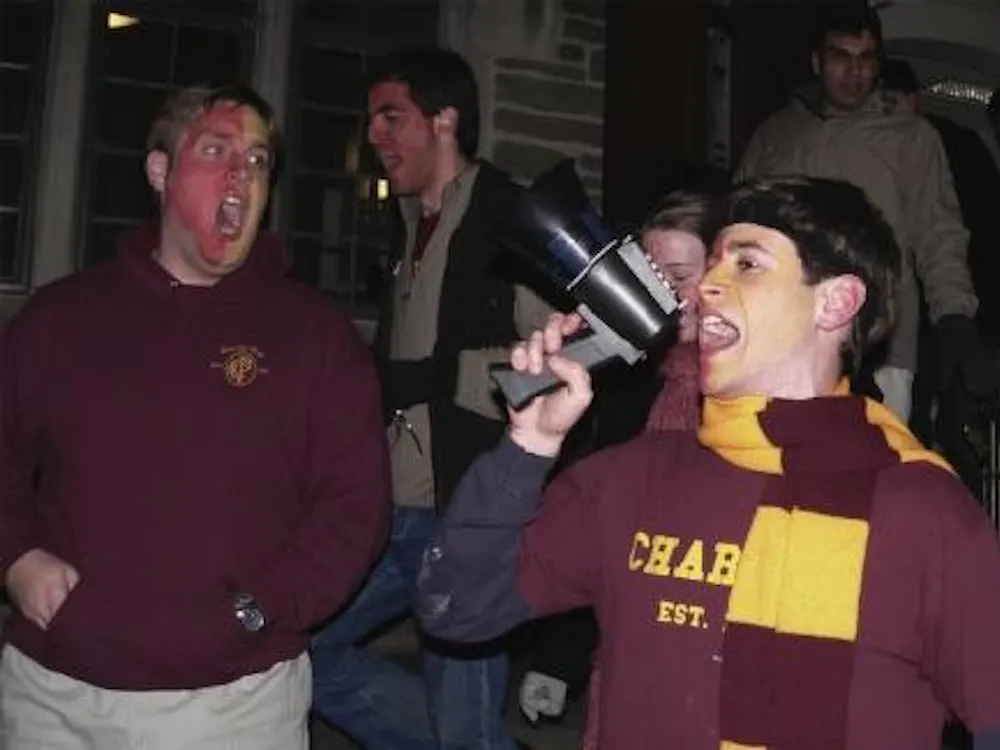
Sena Chang and Oliver WuScharf will enter the new position on Sept. 1, Trump announced in a social media post. While at Princeton, Scharf was the Charter Club and Interclub Council president, ran unsuccessfully for Undergraduate Student Government president, and was active in Jewish groups and conservative organizations.
Scharf will enter the new position on Sept. 1, Trump announced in a social media post. While at Princeton, Scharf was the Charter Club and Interclub Council president, ran unsuccessfully for Undergraduate Student Government president, and was active in Jewish groups and conservative organizations.
Suspended male Princeton student’s Title IX lawsuit against U. can proceed, appeals court rules
Sena ChangA federal appeals court ruled on July 21 that a Title IX lawsuit brought by a male undergraduate student can move forward.
A federal appeals court ruled on July 21 that a Title IX lawsuit brought by a male undergraduate student can move forward.
Princeton professors awarded NEH grants months after lawsuit
Luke GrippoMonths after a federal judge ruled that the sweeping cancellation of National Endowment for the Humanities (NEH) grants in 2025 was unconstitutional, two Princeton University professors — Eve Krakowski and Marina Rustow — were awarded new NEH grants.
Months after a federal judge ruled that the sweeping cancellation of National Endowment for the Humanities (NEH) grants in 2025 was unconstitutional, two Princeton University professors — Eve Krakowski and Marina Rustow — were awarded new NEH grants.