



One week after launching the Student Design Agency, managers Tiffany Wey '07 and Andy Chen '09 have received about 30 requests for T-shirt graphics, posters and web-design work.
They created this student-run business to respond to the demand for graphic design among on-campus groups and to create a new graphic design center for University students. Seventeen student designers have joined the agency so far.
Wey and Chen met last year while working on publicity for the Asian Night Market, a collaborative event held during April's Hosting weekend that showcases Asian-American culture on campus.
After seeing the need to streamline the processing of design requests on campus, Wey and Chen began to brainstorm in early October.
"Both of us were involved in a lot of freelance work [on campus]," Wey said, "but we were both frustrated by the process and decided the University could benefit from a centralized agency."
After proposing the idea to the Princeton Student Agencies, they gained support from the Office of the Dean of Undergraduate Studies (ODUS), especially Associate Dean of Undergraduate Students Tom Dunne, who decided to finance two initiatives to support the new organization.
ODUS is supporting the creation of an "idea center" in the USG office to give students a chance to meet with the agency's experienced design staff in an "office hours" setting to ask questions and learn about graphic design projects.
"Students on campus can be very creative with coming up with ideas but unable to execute professional quality projects," Chen said.

The new agency will cater to student groups and provide a means for generating design products at a fraction of the price charged by professionals.
ODUS will also fund student groups that want to use the Student Design Agency because web design costs, which run close to $20 per hour, might stretch group budgets.
One major drawback of operating a student organization is that 50 percent of the agency's proceeds will go to the University, Wey said.
"We'd like to emphasize the educational nature of the agency ... it's really not about the money," Wey said. Chen added that he and Wey could make much more money by freelancing their services.
The agency is working in conjunction with the Office of Communications to become the primary supplier of design and printing resources on campus. The office offered the new agency a home in its Chambers Street headquarters, which is equipped with high-end Macintosh computers and extensive databases of images and typefaces.
The partnership was created "to avoid unnecessary competition," Chen explained. He said both parties envision "sort of a mentor relationship: They provide computers and office space and advice, and in turn, we let them know what projects we're working on."

The agency's staff ranges from freshmen to graduate students, and many have experience in web design and print publishing. The staff has focused so far on the "collaboration and integration of talents," Wey said. Many of the students study in departments connected to design, such as the architecture school.
"It doesn't matter what your academic interests are ... if you have an interest in design," Chen said.
The agency will not only serve as a business, but also aims to help students gain graphic design experience. Agency employees will receive technical and artistic guidance in their design work by collaborating with University communications professionals.
The agency also hopes to generate support for graphic design courses and eventually a department.
"We'd like to see the creation of a formal curriculum," Chen said.
Read More
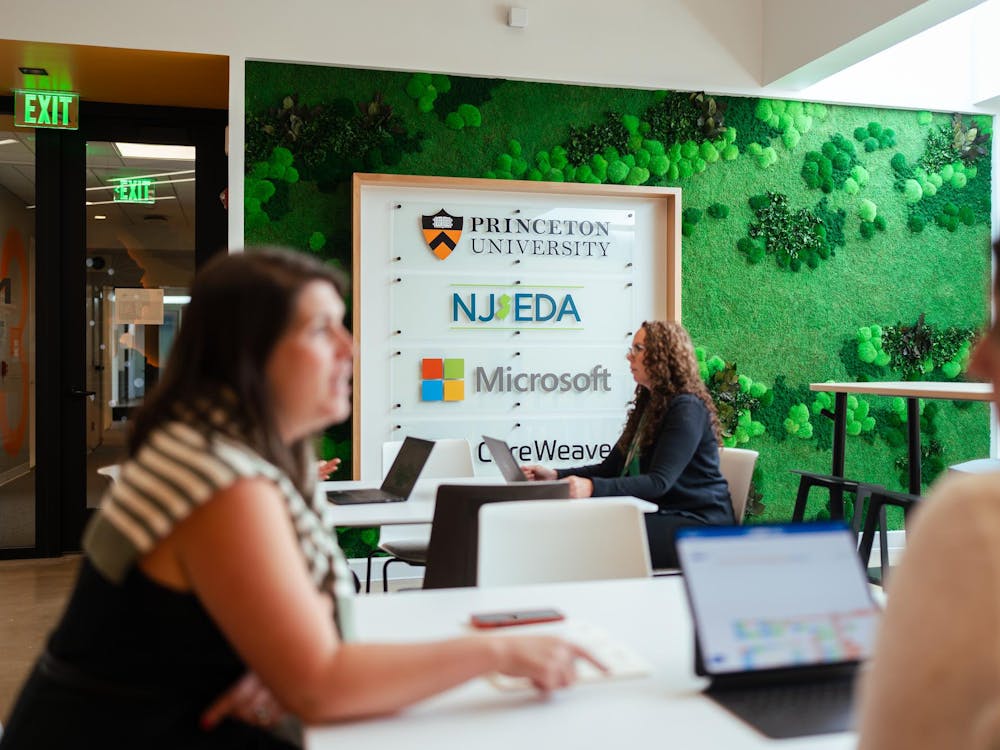
NJ AI Hub marks first anniversary with inaugural startup cohort
Zihan (Frank) XuFourteen selected start-ups receive weekly workshops, reverse pitches, corporate introductions, among other guidance over 12 weeks. The “AI accelerator” helps to test each company’s technology and fast-track its path to commercialization.
Fourteen selected start-ups receive weekly workshops, reverse pitches, corporate introductions, among other guidance over 12 weeks. The “AI accelerator” helps to test each company’s technology and fast-track its path to commercialization.
Three Princeton alumni awarded 2026 Fields Medal
Clara DochertyThe three alumni who received the medal are Yu Deng GS ’15, John Pardon ’11, and Jacob Tsimerman GS ’11.
The three alumni who received the medal are Yu Deng GS ’15, John Pardon ’11, and Jacob Tsimerman GS ’11.

Major gift from Leinweber Foundation to strengthen theoretical physics research
Daphne Lewis and Haeon LeeThe University is joining a national network of institutions advancing theoretical physics research, following the major gift. The foundation has committed over $165 million to top fundamental science research institutions during a period of uncertainty for research funding.