



Mardi Gras king cake was not the only draw for a panel discussion in McCosh 50 yesterday.
Around two dozen students, professors and community members convened to view clips from Spike Lee's "When the Levees Broke" and hear experts analyze the effects of Hurricane Katrina on New Orleans.
"After leaving here today, we hope you will carry in your hearts and your minds the importance of this tragedy," said Lauren Bartholomew '09, a Katrina Project co-founder and New Orleans resident.
A panel consisting of politics professor Melissa Harris-Lacewell, CBS correspondent Byron Pitts and New Orleans city council president Oliver Thomas used the clips from the Spike Lee documentary to launch a discussion on the ramifications of the hurricane. The event was cosponsored by the Black History Month Committee and the Katrina Project.
The panelists discussed various issues surrounding Katrina, including where to assign blame for what they described as the faulty government response; what the underlying socioeconomic and racial issues were; how the media covered the crisis; what lessons should be learned and what the future of New Orleans will be.
Media, Iraq to blame
A central theme of the lecture was the detrimental effect of racism on the response to Katrina. Media coverage, allocation of resources and response speed were all impacted by perceptions of the class and race of the victims, panelists said.
"I think that the news media as an institution is as racist as anything else in America," Pitts said.
The panelists also noted that Katrina revealed how U.S. involvement in Iraq could limit the resources available for federal disaster relief.

"The suffering in Katrina was a chance for people to discuss everything that was wrong with the Bush administration," Harris-Lacewell said.
Another aspect of the aftermath of Katrina discussed by the panelists was the plight of the survivors, many of whom still struggle to reestablish their pre-Katrina routines.
"There is still no central place for these people to go. They want to go home, but that's still not an option," Thomas said.
From concern to action
Harris-Lacewell recently taught a class entitled "Disaster, Race, and American Politics," which culminated with an Intersession trip to New Orleans.
Both Pitts and Thomas were in New Orleans during the catastrophe and shared perspectives of those involved in media and politics, respectively.
The lecture concluded by promoting spring break volunteer trips, which will let students contribute to relief work in the Gulf Coast area. Princeton Water Watch is cosponsoring a trip with the Katrina Project, and the SVC is also sponsoring opportunities for service.

Aitalohi Amaize '07, who took Harris-Lacewell's course and participated in the rebuilding trip over Intersession, explained that "New Orleans needs so much, it needs people who care, it needs hands, it needs so much ... and every one of us young people has an able body, and we can make a difference."
Read More
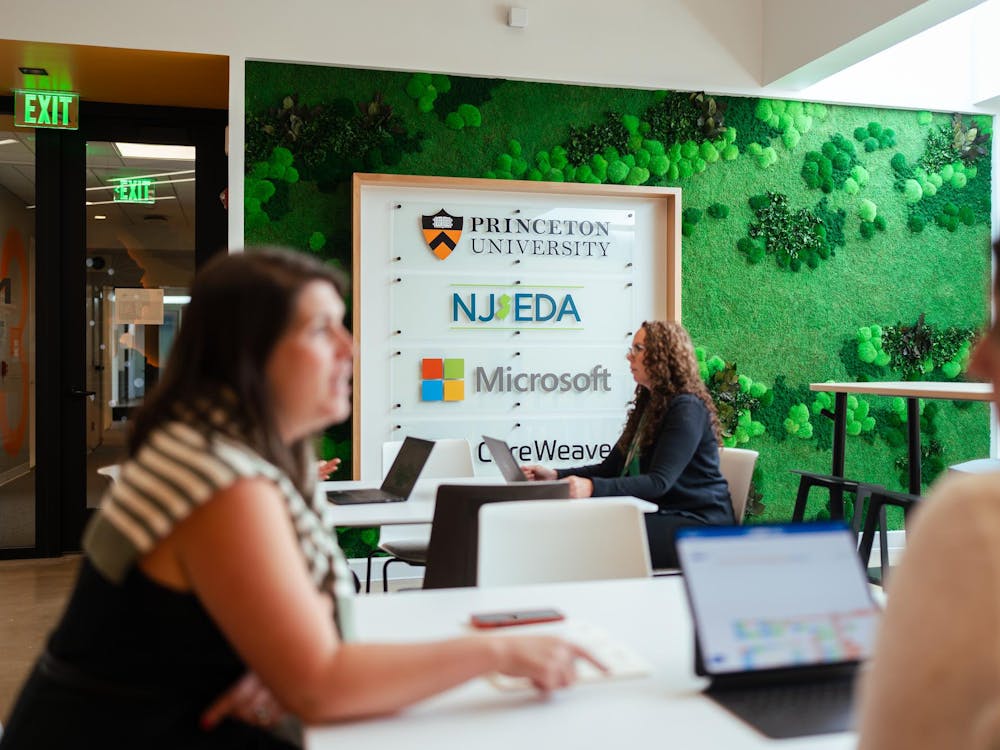
NJ AI Hub marks first anniversary with inaugural startup cohort
Zihan (Frank) XuFourteen selected start-ups receive weekly workshops, reverse pitches, corporate introductions, among other guidance over 12 weeks. The “AI accelerator” helps to test each company’s technology and fast-track its path to commercialization.
Fourteen selected start-ups receive weekly workshops, reverse pitches, corporate introductions, among other guidance over 12 weeks. The “AI accelerator” helps to test each company’s technology and fast-track its path to commercialization.
Three Princeton alumni awarded 2026 Fields Medal
Clara DochertyThe three alumni who received the medal are Yu Deng GS ’15, John Pardon ’11, and Jacob Tsimerman GS ’11.
The three alumni who received the medal are Yu Deng GS ’15, John Pardon ’11, and Jacob Tsimerman GS ’11.

Major gift from Leinweber Foundation to strengthen theoretical physics research
Daphne Lewis and Haeon LeeThe University is joining a national network of institutions advancing theoretical physics research, following the major gift. The foundation has committed over $165 million to top fundamental science research institutions during a period of uncertainty for research funding.