



Hoping to recruit the world's best scientists to work in Great Britain, the British government earlier this week announced a new fellowship program for talented young researchers.
The program, called the Royal Society International Fellowship and based partly on Germany's prestigious Humboldt Research Fellowships, may attract some Princeton scientists who wish to collaborate with their peers overseas.
Since "there's a lot of excellent research in my field" at universities in the United Kingdom, computer science professor David Blei said, the fellowship "would be a great chance to visit [those] institutions" and "work with colleagues that I usually don't see."
"It's the first scholarship for assistant professors that I've heard of that does this."
Alistair Darling, Britain's trade and industry secretary, announced the initiative on Oct. 23, saying that it will "push our world-class science base further and help give us a business edge."
"Like the Rhodes Scholarship has done in other areas, I hope that the new scheme will become a sought-after badge of honour for upwardly-mobile scientists and a must-have for the CVs of our future scientific leaders," Darling said in a statement.
The fellowship is also meant to boost cross-national ties after the fellows return to their home nation, and give scientists the chance to study topics — such as stem cells — that are restricted in the United States. Details of the program have not yet been released.
"Science has been one of Britain's best kept secrets. I want to change that," Darling said. "To be the best you need to work with the best."

Though the fellowship appears focused on established scientists, undergraduates would welcome a similar program.
"I think that many Princeton students would be interested in such a fellowship," Clark Fisher '07, who is applying to several science-related fellowships, said in an email.
"Considering that there are at least 15 students applying for Princeton's two endorsements for the Churchill Scholarship (a scholarship that supports scientific study at Cambridge), there is definitely demand for money to study science in the UK."
Read More
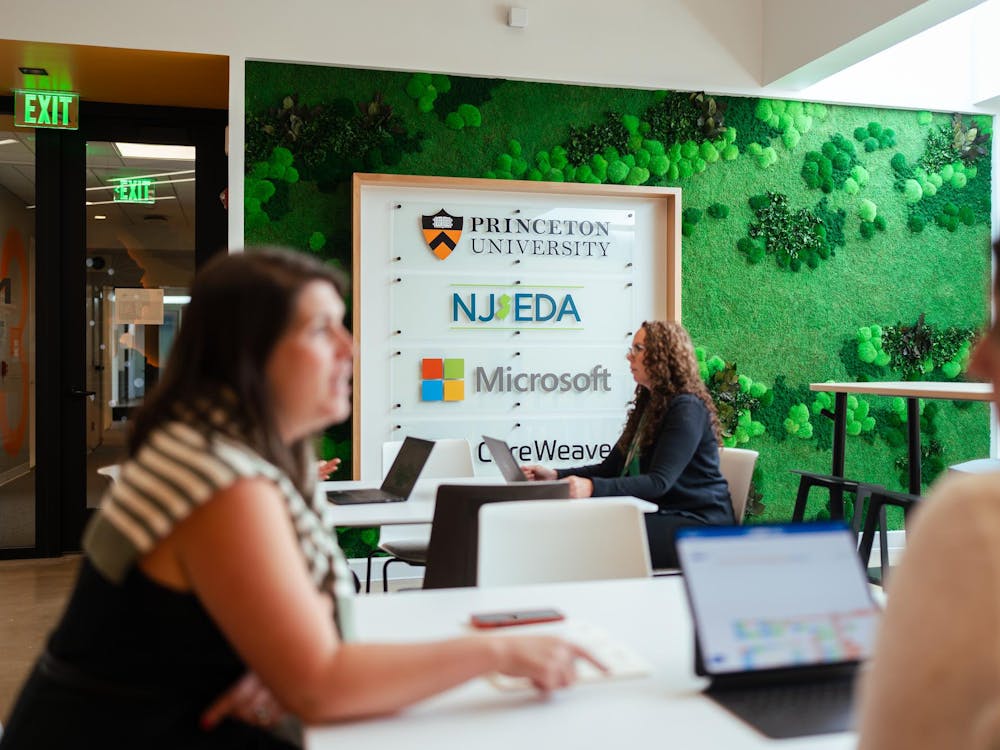
NJ AI Hub marks first anniversary with inaugural startup cohort
Zihan (Frank) XuFourteen selected start-ups receive weekly workshops, reverse pitches, corporate introductions, among other guidance over 12 weeks. The “AI accelerator” helps to test each company’s technology and fast-track its path to commercialization.
Fourteen selected start-ups receive weekly workshops, reverse pitches, corporate introductions, among other guidance over 12 weeks. The “AI accelerator” helps to test each company’s technology and fast-track its path to commercialization.
Three Princeton alumni awarded 2026 Fields Medal
Clara DochertyThe three alumni who received the medal are Yu Deng GS ’15, John Pardon ’11, and Jacob Tsimerman GS ’11.
The three alumni who received the medal are Yu Deng GS ’15, John Pardon ’11, and Jacob Tsimerman GS ’11.

Major gift from Leinweber Foundation to strengthen theoretical physics research
Daphne Lewis and Haeon LeeThe University is joining a national network of institutions advancing theoretical physics research, following the major gift. The foundation has committed over $165 million to top fundamental science research institutions during a period of uncertainty for research funding.