



Since 1984, art and archaeology professor William Childs '64 GS '71 has awoken most summer mornings at 4:15, early enough to buy fresh bread for the students he brought to Cyprus to excavate the ancient city of Marion.
The purpose of the dig, which was completed this year, was to determine the earliest points of interaction between the Cypriot copper mining center and ancient Greece. While previous research had found that trade between the two areas had developed by the sixth century B.C.E. and was strong into the fourth century, Childs and his group looked for potential Greek influence as far back as the ninth century.
Childs began the program primarily as a teaching tool for his students, more than 100 of whom have taken part over the years.
"We meant to continue the long tradition, since the 19th century, of training students to dig," Childs said.
While in Cyprus, Childs and his fellow archeologists, along with graduate and undergraduate students, reached the dig site by 5:45 a.m. to await the arrival of the sun and local "dig boys" who assisted in the excavation. For the next three-and-a-half hours, the group dug through the trenches, finding coins, lamps and terracotta shards.
"A lot of what you do in archaeology is kind of monotonous, lots of meticulous note taking," said Marya Grupsmith '07, a classics major who participated in the most recent dig. "But when someone finds something exciting ... everyone would come racing over."
After a half-hour break for "second breakfast," one of the five meals they ate daily, team members dug for another three hours before stopping to escape the afternoon sun and temperatures that often exceeded 100 degrees. With those six-and-a-half hours of digging per day, the group extensively excavated five sites, whose origins ranged from 312 B.C.E. — when Marion was destroyed by Ptolemy — to the eighth century.
Despite their success in unearthing artifacts, the excavators' original hypothesis — that there might have been early contact between Marion and the Greeks — was proved false. "In short," Childs explained, "we didn't find any ... contact in the ninth, eighth and seventh centuries with the Greeks."

Though it is now his life's work, Childs did not intend to study archaeology when he first entered Princeton. A prospective Wilson School major, he fell into archaeology only after the urging of his freshman adviser, classicist Robert Murray. "He looked at my course list and said it was the most boring thing he had seen in his life," Childs said, "and told me to take a course with Erik Sjoquist."
That one course led to a senior thesis on "Aspects of Greek Thought and Representational Art of the Fifth Century" and a Ph.D. in classical archaeology.
Though the excavation is now complete, the project is far from over. Each item uncovered must be thoroughly documented. A former student has spent five years working with the 20,000 unearthed terracotta shards — and she may have five years to go.
On campus, Christopher Moss, an art and archaeology publications editor, has the detailed task of inspecting, weighing and measuring each coin found. Childs, meanwhile, is writing up the group's findings for publication.
Grupsmith said that the excavation — a hands-on experience from the beginning — was the "best way to get involved in archaeology."
"It was really exciting to know you were contributing to a thing being completed and ready to be published."
Read More
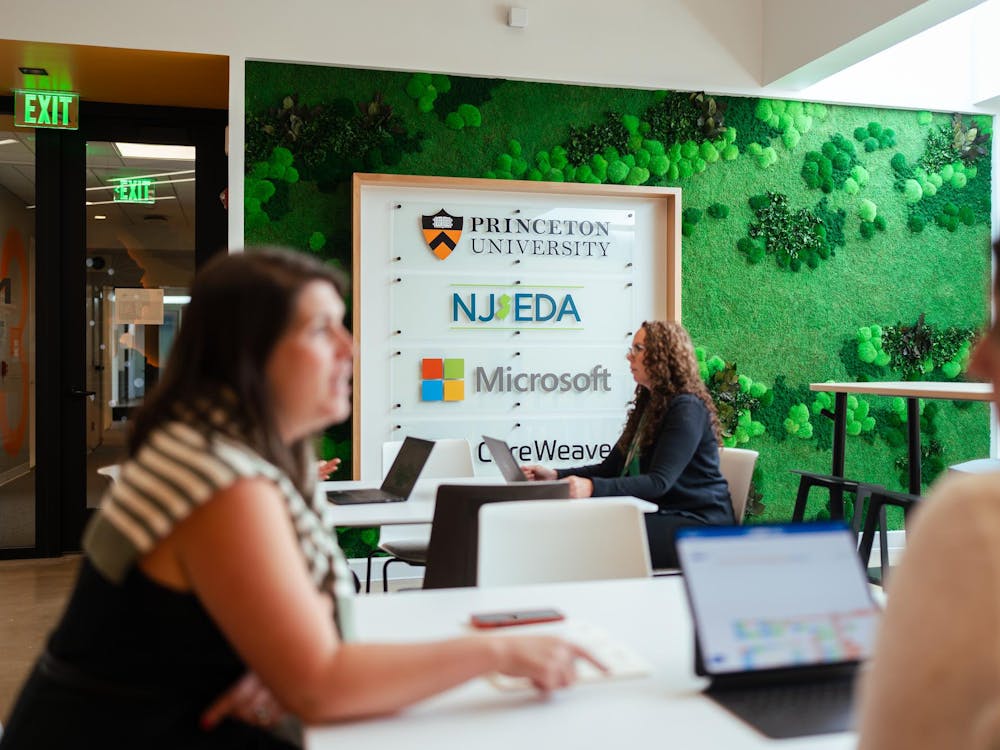
NJ AI Hub marks first anniversary with inaugural startup cohort
Zihan (Frank) XuFourteen selected start-ups receive weekly workshops, reverse pitches, corporate introductions, among other guidance over 12 weeks. The “AI accelerator” helps to test each company’s technology and fast-track its path to commercialization.
Fourteen selected start-ups receive weekly workshops, reverse pitches, corporate introductions, among other guidance over 12 weeks. The “AI accelerator” helps to test each company’s technology and fast-track its path to commercialization.
Three Princeton alumni awarded 2026 Fields Medal
Clara DochertyThe three alumni who received the medal are Yu Deng GS ’15, John Pardon ’11, and Jacob Tsimerman GS ’11.
The three alumni who received the medal are Yu Deng GS ’15, John Pardon ’11, and Jacob Tsimerman GS ’11.

Major gift from Leinweber Foundation to strengthen theoretical physics research
Daphne Lewis and Haeon LeeThe University is joining a national network of institutions advancing theoretical physics research, following the major gift. The foundation has committed over $165 million to top fundamental science research institutions during a period of uncertainty for research funding.