



Last semester, Amherst College offered a course in their political science department called "Taking Marx Seriously." The course description begins by asking the question every curious high school student abandoned after Global Studies I, namely, "Should Marx be given yet another chance?"
Which leads me to the scary conclusion that it takes a full semester to persuade college students that the answer is "no."
Princeton offers no such course. Our relationship to Marxist thought and thinkers in the continental tradition like Hegel and Nietzsche is one of aloof fascination.
There is an institutional stigma associated with teaching their works. Professor Shaw introduced the thinkers in her course POL 302: Continental Political Thought as the "bad boys" of western philosophy. My sophomore year academic advisor, upon hearing that I had decided to take GER 210: Introduction to Germany Philosophy warned, "Don't tell the philosophy department that you're reading Hegel," leading me to believe that Professor Burgess would have chased me down and beaten me with a copy of his introductory logic textbook. A preceptor in a philosophy course, asked to explain the difference between analytic and continental philosophy summarized it most succinctly when he replied: "Foucault is shit."
Yet for some reason, many students continue to view the dense and often incomprehensible writings of these figures — and Marx in particular — as representing a summit in intellectualism. There have been 65 senior theses written on Marx since 1926. That represents more than those written on J.S. Mill (20), Adam Smith (5), Alexis de Tocqueville (5), Friedrich von Hayek (3), Ayn Rand (3) and Milton Friedman (1) combined.
Examples equating Marxist thought with intellectual prowess are widespread. Just two weeks ago, Eric Herschthal '06 noted on this page the discrepancy between investigating the "teleological influence of Hegel on Marxism" and finding a job in a modern economy. Likewise, P.G. Sittenfeld warned incoming freshmen last semester that they would often encounter phrases like "the author strayed too far from Marx's model of dialectical materialism and took on an excessively Weberian pose."
If religion is the opiate of the masses, empty continental platitudes are the drug of choice for the academic bourgeoisie.
Here's a simple economic explanation of why students are drawn to vague continental theory. Given scarcity of time and resources, a student acts rationally if while minimizing time spent studying, he can still ensure a high grade, even if it means obfuscating the truth with academic cliches. Phrases like "teleological influence" and "Weberian pose" are certainly smart, insofar as they fill up the page and are rarely questioned by instructors.

To explain the interesting distribution of thesis topics, let's imagine not that more students have a genuine interest in Marxist theory but rather that it is easier to produce 100 pages on something that doesn't make a whole lot of sense to begin with.
There is a complicity of student and teacher in many classrooms. Take a phrase like "scientific Hegelianism." At some point in every student's career, he or she will be presented with the opportunity to: a) employ said phrase, b) not fully understand said phrase and c) understand that (b) is irrelevant.
How did we get to the point where academic fraud passes for keen insight?
As children of the eighties, we missed out on the golden age, when Marxist theory provided the framework for many an imagined revolution; when Frantz Fanon's "The Wretched of the Earth" and Georges Sorel's "Reflections on Violence" titillated students by supplying theory for violent upheaval; when studying at an institution also meant, paradoxically, attempting to overthrow it.
Being from Ithaca, I've often heard the story of the armed 1969 Willard Straight Hall Takeover repeated with some nostalgia. Those were the good old days, when confident men and women could uninhibitedly swing around phrases like "dialectical materialism" just as wildly as their handguns (or the other way around).
Could it be, in purely Marxist terms, that the revolutionary caste of 1969 has seized administrative power in some departments and now uses its position of authority to maintain a certain ideological superstructure?

After all, not all young men and women are blessed with a natural aptitude for clarity of thought. Why should grades or placement in universities suffer for it?
The bloodsucking capitalist hegemon, (i.e., Nassau Hall) reinforces this by imposing a class (i.e., quintile) system on its unwitting workers, who toil (i.e., sleep) all day in cramped conditions (i.e., bi-level quads) only to submit the fruits of their labor (i.e., theses on Marx) to a humiliating process of alienation from the end product (i.e., grading by experts).
Muddled thinkers of the world unite! J.R. de Lara is a politics major from Ithaca, N.Y. He can be reached at jdelara@princeton.edu.
Read More

Winning Ways: No. 16 women’s lacrosse secure Ivy League Tournament title with wins over Penn and Yale
Kai Kim and Lucas NorOver the tournament weekend, Princeton defeated Penn 15–10 and Yale 12–8 to earn their first Ivy League Tournament title since 2022.
Over the tournament weekend, Princeton defeated Penn 15–10 and Yale 12–8 to earn their first Ivy League Tournament title since 2022.

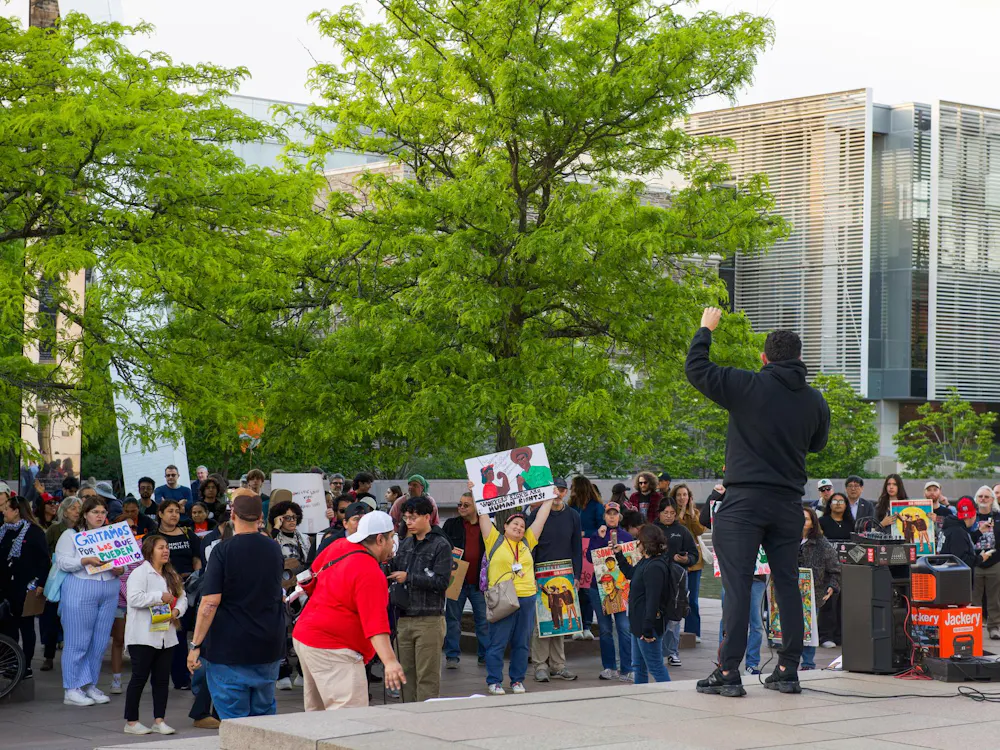
Annual May Day protest draws smaller crowd than expected
Toby ChangAbout 200–250 protesters gathered near Robertson Hall for a May Day march organized by Resistencia en Acción, calling for labor and immigrant rights. Speakers urged political action as the peaceful event concluded with community testimonies.
About 200–250 protesters gathered near Robertson Hall for a May Day march organized by Resistencia en Acción, calling for labor and immigrant rights. Speakers urged political action as the peaceful event concluded with community testimonies.