



Three University assistant professors won grants from the Sloan Foundation for outstanding potential in scientific research, the Foundation announced last week. Economics professors Helene Rey and Markus Brunnermeier and computer science professor Olga Troyanskaya received the $45,000 awards.
The 116 awards were granted to young researchers who are judged to have the potential to transform their fields. Thirty-two past Sloan winners have gone on to win Nobel prizes.
Troyanskaya is a pioneer in the field of bioinformatorics, which uses computational and mathematical techniques to analyze genetic data. She uses computers to detect gene changes that may signify cancer. Her computer models can detect these changes at the onset of the disease with very high precision.
"One of the most important changes of cells in cancer is chunks of chromosomes can be added or deleted," Troyanskaya said, describing what her models look for.
Brunnermeier's work has challenged the traditional economic belief that smart investors shy away from overpriced assets.
Analyzing data from the 2000 dot-com bubble, Brunnermeier found that when no one is sure when prices will fall, hedge funds will continue investing despite the risks. "Smart guys want to ride the bubble for a while — that's quite profitable," he said.
Optimism sometimes clouds people's investment decisions, he said. To model this, Brunnermeier has proposed an idea of "optimal expectations" to describe a feeling that one's investments will perform unrealistically well — as opposed to the old theory of a perfectly rational investor.
Brunnermeier hopes to extend his research further into behavioral finance and the new field of neuroeconomics.

Rey looks at financial crises and international capital flows. Her current work examines how the United States' trade and budget deficits affect the U.S. dollar.
She hopes the grant money will allow her to analyze larger and more precise data from international markets.
Mathematics professor Jordan Ellenberg also received a Sloan grant, thought he will conduct his research at the University of Wisconsin, Madison next year.
Read More
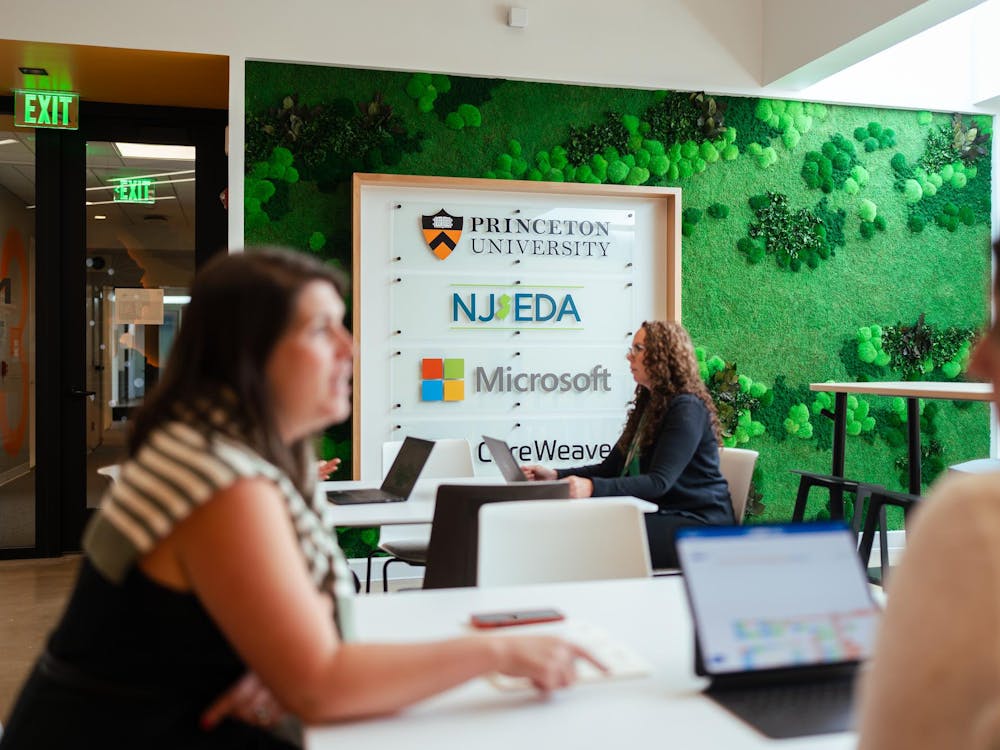
NJ AI Hub marks first anniversary with inaugural startup cohort
Zihan (Frank) XuFourteen selected start-ups receive weekly workshops, reverse pitches, corporate introductions, among other guidance over 12 weeks. The “AI accelerator” helps to test each company’s technology and fast-track its path to commercialization.
Fourteen selected start-ups receive weekly workshops, reverse pitches, corporate introductions, among other guidance over 12 weeks. The “AI accelerator” helps to test each company’s technology and fast-track its path to commercialization.
Three Princeton alumni awarded 2026 Fields Medal
Clara DochertyThe three alumni who received the medal are Yu Deng GS ’15, John Pardon ’11, and Jacob Tsimerman GS ’11.
The three alumni who received the medal are Yu Deng GS ’15, John Pardon ’11, and Jacob Tsimerman GS ’11.

Major gift from Leinweber Foundation to strengthen theoretical physics research
Daphne Lewis and Haeon LeeThe University is joining a national network of institutions advancing theoretical physics research, following the major gift. The foundation has committed over $165 million to top fundamental science research institutions during a period of uncertainty for research funding.