



When seniors Christo Logan and Adam Leive moved into their Dod Hall room this fall, they found a spacious common room with little else but a desk and two chairs. They added a futon, beaten leather armchair and coffee table, but it only did so much.
The two completed the room with a Plexiglass-walled, steel-trimmed bar, designed and built by Logan and funded by Leive.
"We just wanted an awesome bar," Logan said.
But completing the project was no small feat. Building the bar took over a month and cost around $500.
"Once we saw how expensive it was going to be, we went all out," he said.
Logan, an architecture major, spent several hours a day during September drawing the plans on AutoCAD, a standard architectural drafting program.
After trips back and forth to Home Depot, Logan decided on Plexiglass as his main material —creating a distinct modern touch. Liquor bottles and martini glasses shelved on the interior are thus visible from the outside.
For aesthetic purposes, half-inch squares are laid in a polka dot pattern all over the bar, crossed with diagonally carved-out strips that give the thin-walled structure more support. A stainless steel and wood plank serves as the counter-top.

Form meets function in the way the bar is put together, requiring no adhesives like glue or nails. Logan wanted to design a structure in which the 86 pieces could be snapped in place to make it easily transportable. He plans to give it to Leive next year for his room after college.
The bar has been such a success — friends come in at least twice a week for a cocktail — that Logan and Leive have turned it into the focal and visual center of the room. It stands squarely in the center of the common area, concealing the brick fireplace behind it.
They have recently added a silver-colored television and Denon stereo system to complement the transparent bar.
Even though Leive plans to take the bar with him after graduation, Logan does not plan to give up on the idea.
He says he may eventually copyright the design. "If I'm unemployed or really bored one day, maybe I'll see if I can manufacture it."
Hoping unemployment never comes, however, Logan said the bar will be an indispensable part of his architecture portfolio in applying for jobs this spring.

"Having a piece of built work for a student is not very common," he said.
Not all students are looking to use their bars beyond the dorm room.
Senior Wayne Austin constructed his mahogany-walled, pine-trimmed bar for Princeton use only.
In his four-room suite in the ellipse dormitory, Austin and his three other roommates reserved one room to serve as their very own taproom.
"I didn't have to convince the guys," Wayne said. "They were all for it."
Wayne spent $120 and two days of his fall semester. To build the bar, they bought the two-by-four dark-wood panels, nails and pine-wine strips that line the counter from Home Depot.
The strips serve as a barrier for spilled liquids and offer a contrasting caramel color to the deep brown wood panels.
Epoxy-seal, which has 60 times the coating power of normal lacquer, gives the bar an immaculate shine.
The special seal prevents spills from damaging the wood and is "also good for bouncing quarters," he said.
Wayne said his only architectural experience comes from building household objects like shelves and cabinets for his parents.
With a futon, green armchair, electric Zima sign and flat-screen TV already filling the room, the bar stands in the far back corner. It provides a distinctly traditional feel to an otherwise dingy bar room atmosphere.
Wayne plans to give the bar to his roommates next year, who are all juniors. But while it is still under his watch, he makes sure his room stays as clean as the bar itself.
"Your room can smell like a taproom if you don't watch out," he said.
Read More

Princeton University Orchestra and men’s ultimate frisbee team named in University’s latest hazing report
Andrew ArthurTwelve students in the Princeton University Orchestra and Men's Ultimate Frisbee team were found responsible for hazing violations in the University's latest Campus Hazing Transparency Report. Sanctions ranged from Dean's warnings to disciplinary probation.
Twelve students in the Princeton University Orchestra and Men's Ultimate Frisbee team were found responsible for hazing violations in the University's latest Campus Hazing Transparency Report. Sanctions ranged from Dean's warnings to disciplinary probation.

Murray-Dodge Café celebrates 50th Anniversary, drawing over 260 students
Hifza KaleemOn Wednesday, Murray Dodge Cafe celebrated its 50th anniversary, drawing more than 260 students to celebrate with free cookies and merchandise.
On Wednesday, Murray Dodge Cafe celebrated its 50th anniversary, drawing more than 260 students to celebrate with free cookies and merchandise.
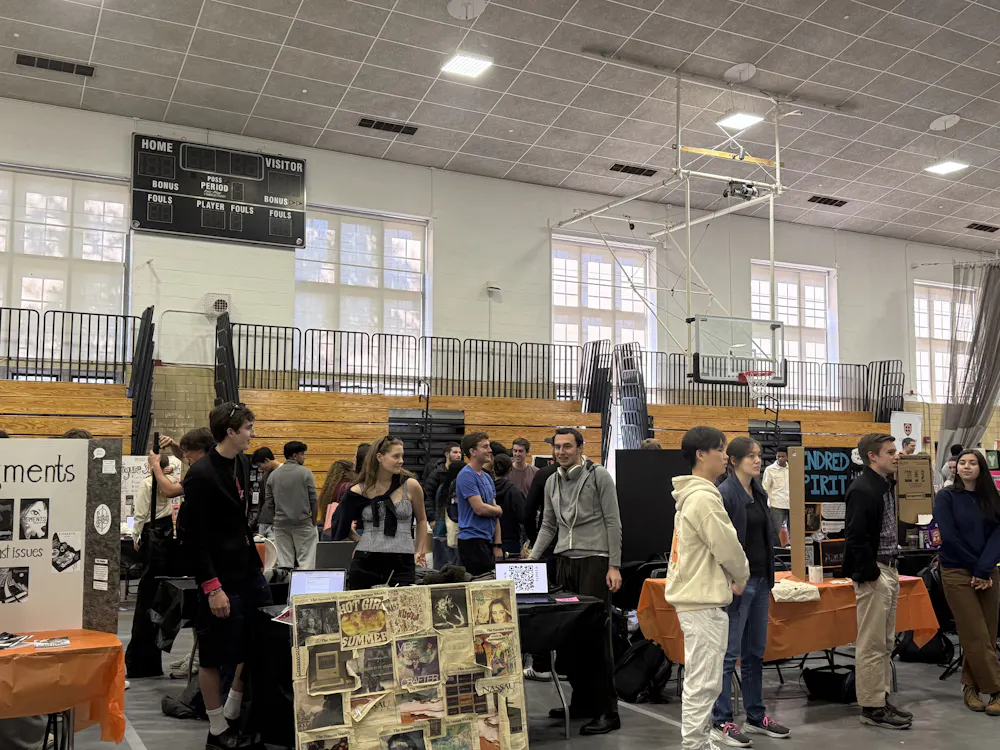
Students share mixed reactions as mandated officer and treasurer trainings return to in-person format
David EstradaThe University's student organization officers and treasurers returned to mandatory in-person training this fall after years of online sessions. Student reactions found parts of the training redundant or tedious, though most agreed the sessions were important.
The University's student organization officers and treasurers returned to mandatory in-person training this fall after years of online sessions. Student reactions found parts of the training redundant or tedious, though most agreed the sessions were important.