



The University's admissions yield dropped five percentage points from last year, declining to a five-year low, but Dean of Admission Janet Rapelye said the drop is not a problem.
The yield — the percentage of accepted students who chose to matriculate at Princeton — dropped from 73 percent in 2003 to 68 percent this year.
Rapelye said the decline is merely a consequence of a renewed focus in Princeton admissions: competing more directly with Harvard, Yale, Stanford and MIT for the best applicants.
"We're going for better students. We have more competition. We ought to be rejoicing that we're pushing that limit now," Rapelye said.
The number of "academic 1's" in the Class of 2008 — students who received the highest rank out of a possible five on the admissions office's scale that rates the academic quality of candidates — is higher than in recent classes.
Also, the average SAT score for the class rose to 730 in both the math and verbal sections, an improvement of 20 and 10 points, respectively, over last year's figures.
"We knew we were taking a group of students who had, on paper, a slightly better profile [than in previous years] and we also knew by doing that, they would have more choices. That happens at any school," Rapelye said. "We knew that our yield would be slightly lower because of that, and it was."
As the quality of a college's accepted-students pool increases, so does the number of "cross-admits," or students admitted to other schools.

An individual college's yield may drop under such circumstances as it competes with other schools for the best students.
The University's highest yield ever — 74 percent — occurred in 2002, with the Class of 2006. The number dipped slightly to 73 percent with the Class of 2007 before falling again this year.
Comparatively, the University's yield is similar to that of Yale and higher than those of MIT and Stanford. The University's number has consistently been lower than that of Harvard, which hit an all-time high of 79 percent this year.
Traditionally a high yield has been seen partly as a benefit of a binding Early Decision program, which assures a near-100 percent yield for part of the admitted-students pool.
Harvard's yield has increased in recent years despite its move to a non-binding Early Action program.
Based on information obtained from students admitted to the University who chose not to attend, Rapelye confirmed that most of Princeton's cross-admits choose Harvard, Yale, Stanford or MIT over Old Nassau.

Losing students to Harvard is nothing new, said Chris Avery, a professor at Harvard's Kennedy School of Government who researches the college admissions process.
In a 2000 study of 3,000 highly-qualified students admitted to the nation's most selective colleges, Avery found that in head-to-head battles, schools almost invariably lost out to Harvard.
"We found [that] essentially Harvard was winning most of the competitions for students," Avery said in an interview.
He cautioned that "basically what that's showing is that Harvard's a popular college. It doesn't mean it's better, just that it's popular."
Avery's study did not ask students why they chose Harvard over other schools, a question Rapelye seeks to address in the coming year.
"I think it's a great question to ask and one that we should be asking," she said.
In order to seek answers to that question and others, the University has contracted the services of an outside research firm to "determine what parents and prospective students think about us," Rapelye said.
"What are the positive impressions that we can build on? What are the negative stereotypes that we need to address, and frankly, what are the myths we need to debunk?" Rapelye asked.
Colleges already have information on students' preferences through the College Board's "Admitted Students' Questionnaire," Avery said, but that does not mean the University's new research effort is not valuable.
"To some degree everybody already has that information, but Princeton seems to be trying to get more detailed information," Avery said. "Historically that's something schools have always done."
But Rapelye said that, to the best of her knowledge, such a survey of perceptions of Princeton has never been conducted.
The undertaking will include questionnaires and focus groups for prospective students, parents and guidance counselors.
The product of the research will be a set of recommendations for the University's admissions office.
Rapelye said she hopes the research will help to "capture the impressions students have [of the University] and better articulate what we're good at."
The survey, she said, will help students to choose Princeton — and help Princeton boost its yield.
The drop in yield by itself cannot negatively affect Princeton's first-place rank in the popular U.S. News and World Report's annual college rankings. Yield was dropped as a factor of consideration one year ago, said Richard Folkers, director of media relations for the magazine.
Since the 2005 rankings are less than two months old, it is too soon to say what factors will affect next year's rankings.
"We have not yet begun the process for next year," Folkers said. "As in every ranking cycle, we will be reviewing our methodology."
Read More

Princeton University Orchestra and men’s ultimate frisbee team named in University’s latest hazing report
Andrew ArthurTwelve students in the Princeton University Orchestra and Men's Ultimate Frisbee team were found responsible for hazing violations in the University's latest Campus Hazing Transparency Report. Sanctions ranged from Dean's warnings to disciplinary probation.
Twelve students in the Princeton University Orchestra and Men's Ultimate Frisbee team were found responsible for hazing violations in the University's latest Campus Hazing Transparency Report. Sanctions ranged from Dean's warnings to disciplinary probation.

Murray-Dodge Café celebrates 50th Anniversary, drawing over 260 students
Hifza KaleemOn Wednesday, Murray Dodge Cafe celebrated its 50th anniversary, drawing more than 260 students to celebrate with free cookies and merchandise.
On Wednesday, Murray Dodge Cafe celebrated its 50th anniversary, drawing more than 260 students to celebrate with free cookies and merchandise.
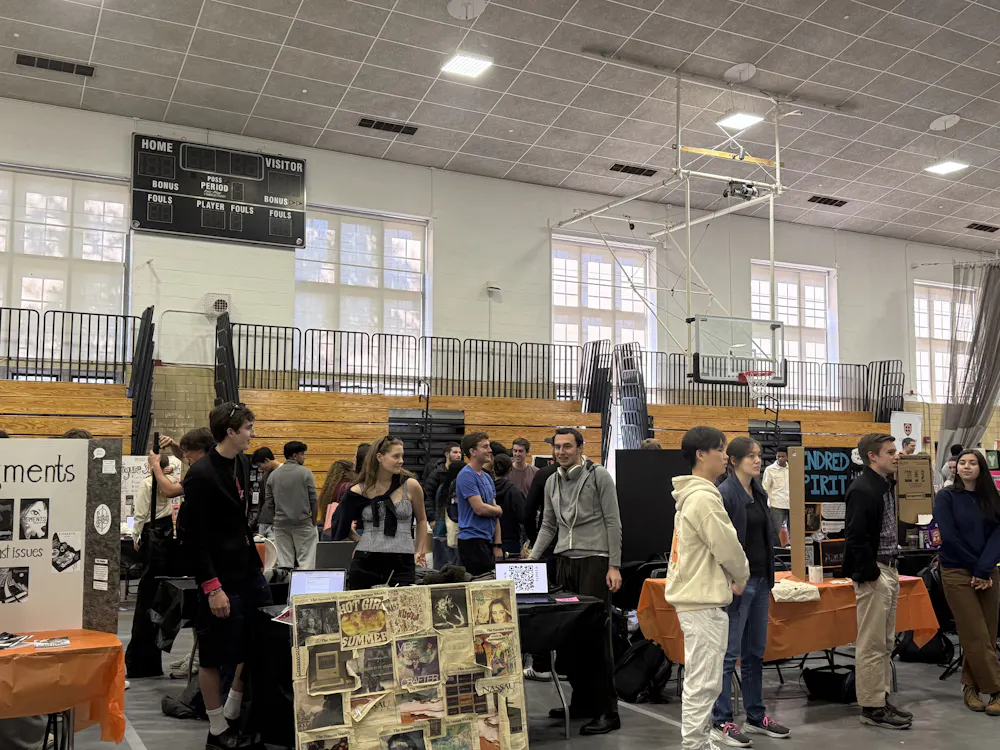
Students share mixed reactions as mandated officer and treasurer trainings return to in-person format
David EstradaThe University's student organization officers and treasurers returned to mandatory in-person training this fall after years of online sessions. Student reactions found parts of the training redundant or tedious, though most agreed the sessions were important.
The University's student organization officers and treasurers returned to mandatory in-person training this fall after years of online sessions. Student reactions found parts of the training redundant or tedious, though most agreed the sessions were important.