



Jeny Monroy wants to learn English for many reasons.
The language is a powerful tool that will allow her to converse with the students at Tiger Inn, where she works. It may open the doors to a better-paying job. But between her two jobs that allow her to send money to her four children in Guatemala, she lacks the time and spare change to take classes.
The Princeton Justice Project's Pa' Delante Committee has set out to fix Monroy's problem. This week, the group launched its first English classes for Latino University workers.
The program marks the first time a University group has provided English classes for speakers of other languages (ESOL) that specifically target eating club workers with late schedules.
The group says it is still waiting for University funding.
"At the Latino Heritage Month Workers' Party last year, many eating club workers expressed the need for longterm, serious ESOL classes that fit into their schedules," committee leader Rebeca Gamez '05 said. Sarah Holloway '06 co-chairs the committee's efforts.
Twelve staffers turned out Monday for the 8:30 p.m. class at the Fields Center. At the end of the class, Cottage Club employee Alfredo Escobar said, "I think that everybody here would like to come every day if possible."
In response to the turnout, Pa' Delante plans to organize similar classes on Wednesdays, Thursdays and Fridays.

The sessions will act as a supplement to the other ESOL classes run by Community House — which sponsors classes most evenings in the greater Princeton community — and the Student Volunteer Council, for which students travel to downtown Trenton.
Pa' Delante's classes differ from others because they focus on the belief that "learning English is a tool for empowerment," Holloway said.
The program is based on an English for Action program in Providence, R.I., that aims to teach Latinos English vocabulary that will enable them to "speak clearly to their bosses and their kids' teachers, and learn the vocabulary they will need in everyday life," Holloway added.
Throughout the semester, the classes will focus on conversational English through mock interviews, resume writing and other scenarios.
The program will also emphasize community building and will attempt to expose workers to the resources of the greater Princeton community.
"We want to take a field trip to the public library and show them how to set up an email account and how to type faster," Holloway said.

The leaders will take the class to the Latino Health Fair, to be held in Princeton on Nov. 13. They also want to bring speakers — such as an immigrant lawyer — to meet with classes on a monthly basis.
Pa' Delante is currently seeking funding through the University's Projects board, the PACE Center and specific departments in order to facilitate these plans.
Ivy and Colonial are the only two eating clubs with established ESOL classes for their Latino staffers. Students said these classes have allowed them to build ties with staff in addition to teaching them English.
"I think that, on the surface, the eating clubs can be awkward, elitist systems to some extent. Kids are being served meals by mostly Latino workers," Ivy tutor Stephanie Amann '05 said. "So the students need to make an effort to not make it like that."
"For me, being a tutor really helps," Amann said. "I always speak to the workers in Spanish. As a result, we have a much closer and very respectful relationship."
Pa' Delante aims to expand the opportunities for workers at the Street to learn English.
The eating clubs' new community service initiative, the Prospect Alliance for Community Action (PACA), aims primarily "to initiate programs that reach those beyond just members of the University community," said Inter-Club Council and Quadrangle Club President J.W. Victor '05.
However, now that PACA is aware of Pa' Delante's efforts, its leaders plan to work together with the group to make ESOL tutoring available to all club staff, said PACA chairwoman and Colonial officer Jen Lewellen '05.
Gamez said she hopes the small Pa' Delante program will grow quickly not only so that students can teach English, "but to make bonds with the young workers that we see every day. Each side has something to learn."
Read More

Princeton University Orchestra and men’s ultimate frisbee team named in University’s latest hazing report
Andrew ArthurTwelve students in the Princeton University Orchestra and Men's Ultimate Frisbee team were found responsible for hazing violations in the University's latest Campus Hazing Transparency Report. Sanctions ranged from Dean's warnings to disciplinary probation.
Twelve students in the Princeton University Orchestra and Men's Ultimate Frisbee team were found responsible for hazing violations in the University's latest Campus Hazing Transparency Report. Sanctions ranged from Dean's warnings to disciplinary probation.

Murray-Dodge Café celebrates 50th Anniversary, drawing over 260 students
Hifza KaleemOn Wednesday, Murray Dodge Cafe celebrated its 50th anniversary, drawing more than 260 students to celebrate with free cookies and merchandise.
On Wednesday, Murray Dodge Cafe celebrated its 50th anniversary, drawing more than 260 students to celebrate with free cookies and merchandise.
Students share mixed reactions as mandated officer and treasurer trainings return to in-person format
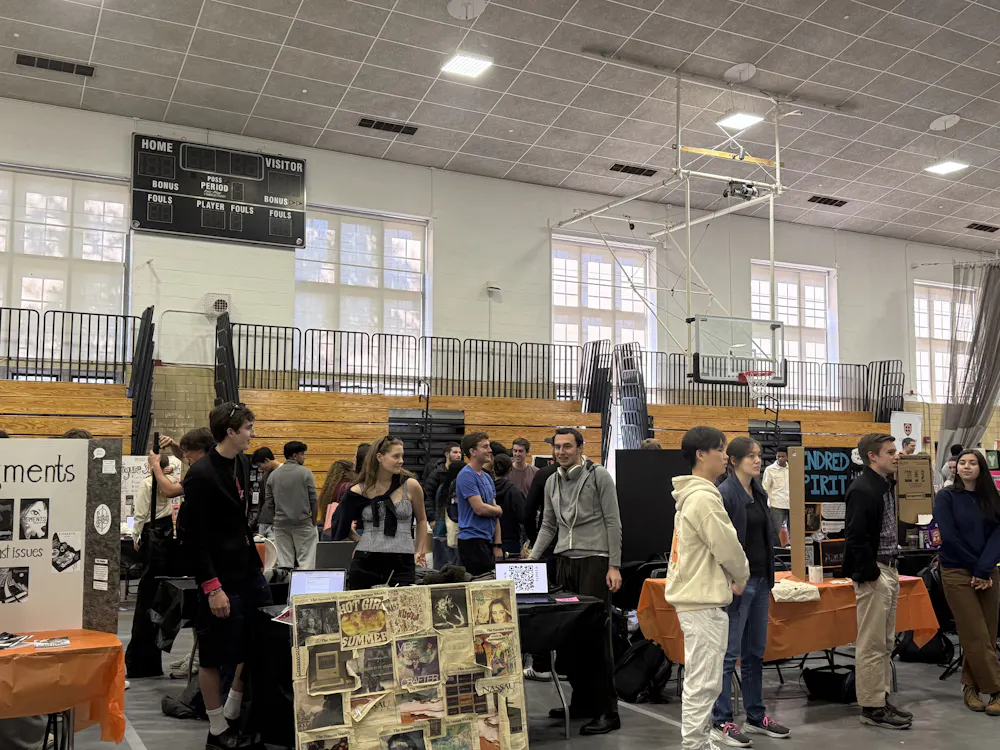
David EstradaThe University's student organization officers and treasurers returned to mandatory in-person training this fall after years of online sessions. Student reactions found parts of the training redundant or tedious, though most agreed the sessions were important.
The University's student organization officers and treasurers returned to mandatory in-person training this fall after years of online sessions. Student reactions found parts of the training redundant or tedious, though most agreed the sessions were important.