



Countless University students are closet addicts of sites like thefacebook.com. They surf the directory pages to look at people's pictures, read their witty and sometimes fantasized profiles, and maybe even check out their relationship statuses.
But many of these students have not yet come across the extensive world of live journals.
"It's an even better stalker tool than thefacebook.com," Yvon Wang '08 joked in an email. Live journals are a specific brand of blog — short for web log — that allows people to interact through sites like LiveJournal.com. There are a number of sites that offer similar posting capabilities, including Blogger and Xanga.
The online journals allow users to post frequent, long, and sometimes very personal entries that readers can comment on. Kait Reilly '07 started a live journal in March 2003. Her interaction through LiveJournal "removes me from the insulated world I live in, if only for a few moments a day, and exposes me to absolutely every sort of person," she said in an email.
Reilly recently met an anonymous person through a live journal who claims to be from Iowa and is the "most conservative person" she has ever encountered.
"I don't know anything about him/her except that he/she is Catholic and considers President Bush to be a 'liberal wuss,'" she said.
"I think I have spent some 40-50 hours this semester responding to his/her comments about women's rights, gay rights, HIV prevention and the role of religion in science . . . I have been forced to rethink my beliefs down to their fundamental roots," she said.
Although Reily uses LiveJournal as a means to discuss current events, other University students say they use live journals for many different reasons.

During his sophomore year, Mike Dinitz '05 and his three roommates created their own journals at about the same time. "My live journal is mainly just about stuff going on in my life, so clearly I'm the one most interested in it, but I have had some very interesting discussions," Dinitz said.
Amruta Sarma '08 said she primarily uses her live journal to keep in touch with friends from home.
"My best friend goes to school in North Carolina, so it's kind of difficult to find out how she is. The way we figure out what's going on is by writing stuff in live journals. Then, all we have to do is find the time to sit down and read," she said.
Some students also use live journals as an outlet for their emotions and a substitute for a traditional paper journal. "It kind of allows people to see a different side of you, and not necessarily the side you would portray if you were face-to-face with someone," Sarma said.
Users can customize the security levels of their journal entries. They can allow public access for anybody on the Web or can post "friends-only" entries that are accessible only to those people the user has listed. These controls ensure that strangers cannot read and copy a user's personal thoughts.
Doug Hohensee '08 said he believes all online journalists share a common motive. "Everyone writes on LiveJournal to get attention. That's why they're there: other people can read them. If you wanted privacy, you'd get a paper diary," he said in an email.

The online phenomenon of live journals has also expanded into interactive communities, online journals in which members can post comments and pictures.
"Princetonians" is an example of such a community. It has 106 members whose interests include "black squirrels, Harvard sucks a lot, incompetent cops, hoagie haven, intellectualism, grade grubbing and the Wa," according to the site.
Most students use the forum to advertise campus events or to ask questions about certain policies. The site often receives entries from potential students who are interested in campus life and hints about admission.
"I have found that quite a few Princetonians were hostile towards those people because they feel that the community is only for Princeton students to talk about campus issues, not for prospective students to find out their chances of getting in," Sonia Dominicus '07 said in an email.
A contentious issue is that of anonymous negative responses to entries. After having made an effort in a journal, "having people spam you with anonymous comments is extremely annoying," Dinitz said.
Read More

Princeton University Orchestra and men’s ultimate frisbee team named in University’s latest hazing report
Andrew ArthurTwelve students in the Princeton University Orchestra and Men's Ultimate Frisbee team were found responsible for hazing violations in the University's latest Campus Hazing Transparency Report. Sanctions ranged from Dean's warnings to disciplinary probation.
Twelve students in the Princeton University Orchestra and Men's Ultimate Frisbee team were found responsible for hazing violations in the University's latest Campus Hazing Transparency Report. Sanctions ranged from Dean's warnings to disciplinary probation.

Murray-Dodge Café celebrates 50th Anniversary, drawing over 260 students
Hifza KaleemOn Wednesday, Murray Dodge Cafe celebrated its 50th anniversary, drawing more than 260 students to celebrate with free cookies and merchandise.
On Wednesday, Murray Dodge Cafe celebrated its 50th anniversary, drawing more than 260 students to celebrate with free cookies and merchandise.
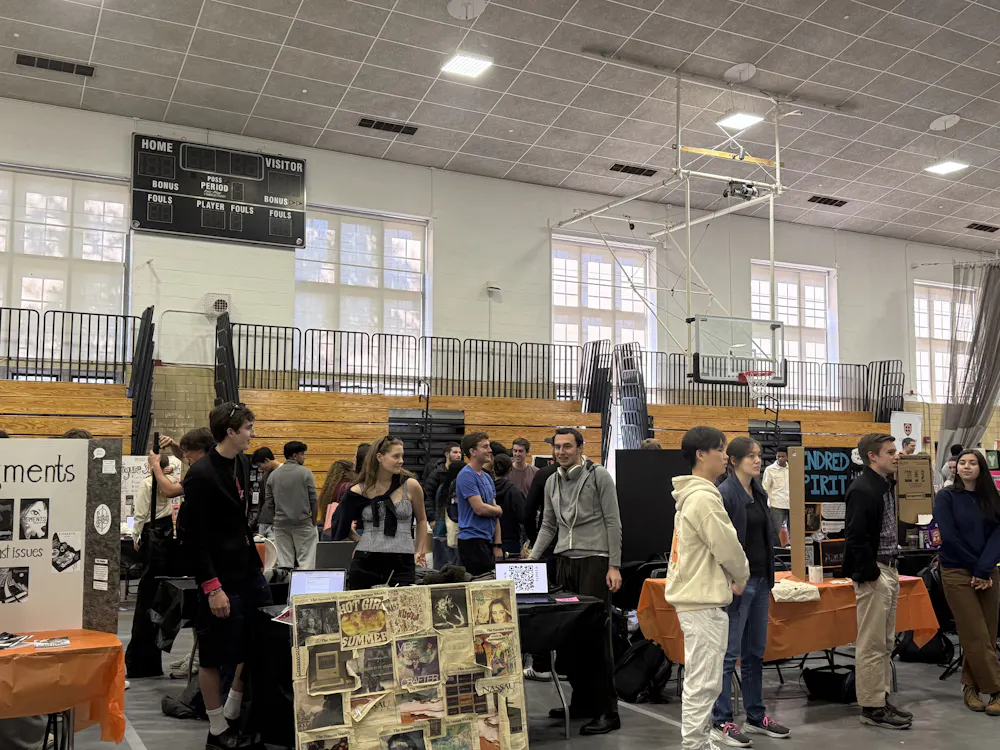
Students share mixed reactions as mandated officer and treasurer trainings return to in-person format
David EstradaThe University's student organization officers and treasurers returned to mandatory in-person training this fall after years of online sessions. Student reactions found parts of the training redundant or tedious, though most agreed the sessions were important.
The University's student organization officers and treasurers returned to mandatory in-person training this fall after years of online sessions. Student reactions found parts of the training redundant or tedious, though most agreed the sessions were important.