



If Princeton undergraduates were the only Americans allowed to vote in the upcoming presidential election, Sen. John Kerry would win in a landslide, taking 62 percent of the vote to President George W. Bush's 24 percent. This is the most fundamental of the results of the most recent Daily Princetonian poll — conducted by phone on Oct. 14 — which asked nearly 360 undergraduates to share their opinions on a variety of questions pertinent to the upcoming elections.
That particular result is based on the responses of 286 students who said they were likely to vote in this year's election. The results have a margin of error of five percentage points.
Evan Baehr '05, president of the College Republicans and candidate for Princeton Borough Council, offered an explanation of the strong campus preferences. Supporting Kerry might be the "hip thing to do," he said, in part because "we're consuming anti-Bush messages regularly, not only from the media but also from our professors."
Jay Saxon '05, president of the College Democrats, also attributed the strong support for the more liberal candidate to the traditional leftward leanings of academia.
Despite the strong feelings of many on campus, 13 percent of respondents remain unsure of whom they will be supporting on Nov. 2.
In addition to their preferences in the current election, respondents were asked with which, if any, party they identified themselves.
The results indicate that more than twice as many students would call themselves Democrats as Republicans, 42 percent to 19 percent. However, a full 38 percent of respondents said that they did not associate themselves with either of the two major parties.
The vast majority of respondents supported the candidate running for the party they supported: 82 percent of Republicans support Bush, and 88 percent of Democrats support Kerry. Among those who did not associate with one party or the other, Kerry was the clear choice, winning the support of 60 percent of these respondents while Bush received the support of only 17 percent of these students.

Of those sampled, more than half (57 percent) thought that either Iraq or terrorism was the most important issue in play for this election. Healthcare, the economy, and education were the most important issues for another 38 percent of respondents.
However, there was virtually no correlation between students' presidential preferences and their most pressing issue. This contrasts with national polls where Bush maintains an advantage on the subjects of Iraq and terrorism, while Kerry is seen as stronger on domestic issues.
One tenth of the campus plans on being politically active over Fall Break, our results showed. Though the majority of those who plan to be active do support Kerry, the margin is not as large as Kerry's among likely voters. That is, a larger fraction of campus republicans plan on being active than campus democrats.
"I would be very pleased if that many [students] turned out," said Baehr, who, helped organize the P-Votes initiative. "If 600 students, [roughly one tenth of the student population], worked on campaigns, that would be all the College Democrats, all the College Republicans and around 200 others," he said.
Saxon agreed, suggesting such a level of activity would represent a significant increase over previous years.
In addition to questions about the presidential race, respondents who are registered to vote locally were asked about their views on Baehr's candidacy for a seat on the Borough Council. Nearly half of the eligible voters surveyed (46 percent) said they were unsure as to whether they would support Baehr, who had said earlier that a successful campaign for him would rely heavily on strong student support.

Of the remaining respondents, 28 percent planned to support Baehr, while 26 percent did not. Due to the smaller sample size of this poll, these figures are accurate to only plus or minus 9 percentage points.
Baehr remained confident in his chances for victory, suggesting that many students would, in fact, cast ballots for him rather than a local candidate whose name they wouldn't even know come election day.
Read More

Princeton University Orchestra and men’s ultimate frisbee team named in University’s latest hazing report
Andrew ArthurTwelve students in the Princeton University Orchestra and Men's Ultimate Frisbee team were found responsible for hazing violations in the University's latest Campus Hazing Transparency Report. Sanctions ranged from Dean's warnings to disciplinary probation.
Twelve students in the Princeton University Orchestra and Men's Ultimate Frisbee team were found responsible for hazing violations in the University's latest Campus Hazing Transparency Report. Sanctions ranged from Dean's warnings to disciplinary probation.

Murray-Dodge Café celebrates 50th Anniversary, drawing over 260 students
Hifza KaleemOn Wednesday, Murray Dodge Cafe celebrated its 50th anniversary, drawing more than 260 students to celebrate with free cookies and merchandise.
On Wednesday, Murray Dodge Cafe celebrated its 50th anniversary, drawing more than 260 students to celebrate with free cookies and merchandise.
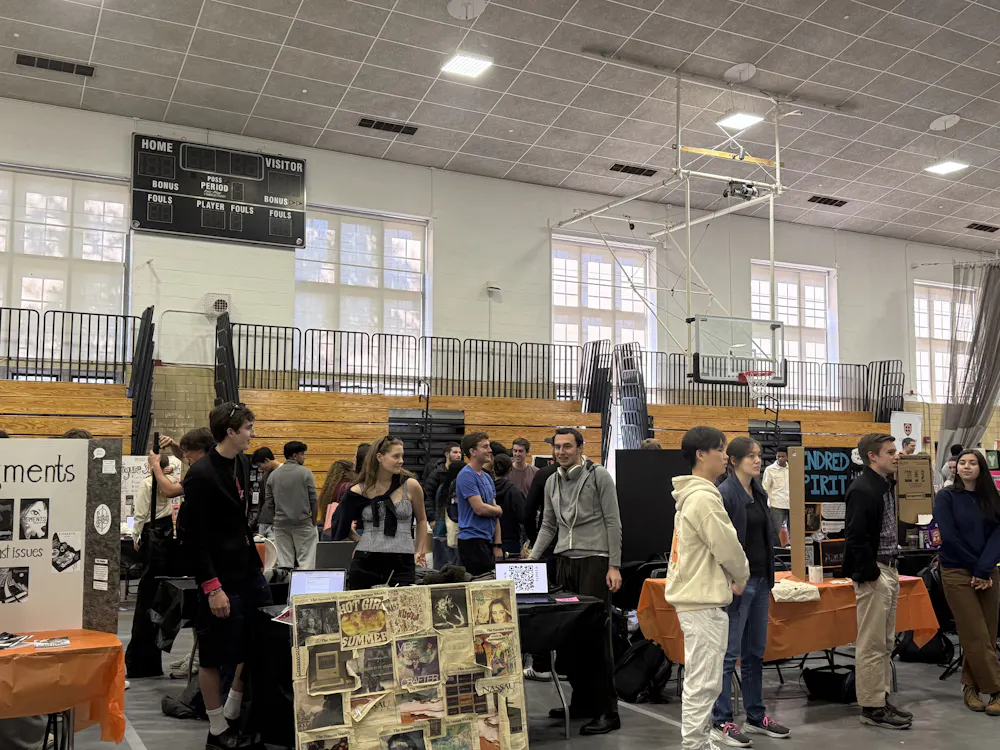
Students share mixed reactions as mandated officer and treasurer trainings return to in-person format
David EstradaThe University's student organization officers and treasurers returned to mandatory in-person training this fall after years of online sessions. Student reactions found parts of the training redundant or tedious, though most agreed the sessions were important.
The University's student organization officers and treasurers returned to mandatory in-person training this fall after years of online sessions. Student reactions found parts of the training redundant or tedious, though most agreed the sessions were important.