



When former University employee Jessie Washington was asked to examine the Office of Religious Life's (ORL) endowment accounts in October 2002, she had no idea her report would turn into a major source of conflict in a $600 million lawsuit.
But that's exactly what happened.
The report, which claims the University mishandled certain restricted donations to the office, has become a lightning rod in the contentious suit filed by the Robertson family two years ago against the University for control of the $600 million endowment behind the Wilson School.
According to a copy of her Religious Life Endowment Review of February 2003, Washington argued that about $1.2 million dollars or 59.1 percent of endowment funds for ORL were used to supplement the University's general spending. At the time, ORL's budget was approximately $800,000.
The Robertsons, who accuse the University of misspending the Robertson Foundation endowment behind the Wilson School, say Washington's report supports their claim that Princeton has a history of diverting donations from their intended purpose to the University's own benefit.
Yet the University and its lawyers have questioned Washington's expertise and brushed aside her findings, saying that an official investigation into the religious life office didn't reveal the problems Washington found.
Nonetheless, the University said it is working to improve how it handles endowment spending. It also says the effort is not in response to Washington's report.
In her report, Washington said she found 12 problems, out of 36 accounts for which donations were restricted to specific purposes. She said other accounts weren't listed because "the money was so diverted."

She said these findings might be emblematic of a bigger problem. "There is no reason to believe that religious life or campus life accounts have been treated differently from other departments," Washington wrote in the memo. "I feel this is evidence of a systemic problem that warrants further review."
In July 2002, the Robertson family sued the University and the University trustees who sit on the board of the Robertson Foundation, established in 1961 by family members to dramatically expand the Wilson School's graduate program.
The Robertsons allege that the University has done what Washington feared: spending a gift for other purposes, specifically more than $100 million of the original donation on projects unrelated to the gift's purpose — training graduate students for careers in government service.
When the Robertsons sought to file a new complaint with added allegations in June, the University focused on the claims about ORL.
"The allegation [regarding funds in ORL] was thoroughly investigated and determined to involve no wrongdoing," the University said in the statement on June 17, a day after the Robertsons proposed an amended complaint.
"Ms. Washington's investigation is important because it shows that the University decides unilaterally that language donors may have believed to be binding are merely expressions of preferences that can be discarded," said Seth Lapidow, a Robertson family lawyer.
A request in campus life

From November 2000 to January 2003, Washington served as special projects manager for the office of Vice President for Campus Life Janet Dickerson.
Dickerson asked Washington in October 2002 to conduct an inventory of ORL's endowment accounts to provide information to Dean of Religious Life Thomas Breidenthal about funds available for new programs.
"We wanted to understand the nature of gifts [made to ORL]," Dickerson said. "I did not instruct her to conduct more than an internal inquiry about the endowment accounts."
As Washington researched the allocation and tracking of the restricted accounts, she found what she believed to be "inadequate information systems, poor business processes and questionable actions," her report says.
"I started to see problems by just standing at the photocopying machine and putting documents in order. It was like a psychological double-take. Am I seeing what I'm seeing?" Washington said.
"There were symptoms of things wrong before I even did a report, and when I crunched the numbers, that showed the whole story."
Washington's two-year term under Dickerson ended in January 2003, and the Office of the Vice President for Development Brian McDonald hired her for a four-month position in February to do similar financial research on donor records and endowment accounts.
While working for McDonald, Washington completed the 10-page review of ORL's endowment funds and recommended an outside audit to review the problem.
But Dickerson said Washington took the original project too far. "Jessie's concerns about usage of funds, which is inconsistent with applicable legal restrictions, were later found to be invalid by a formal internal audit review," Dickerson said.
"She took it upon herself to make a case against the University and reached her own conclusions."
Response and credibility
On Feb. 19, 2003, Washington sent copies of her completed review to Dickerson, Breidenthal and McDonald, as well as Associate Provost for Finance Steven Gill '73.
One day later, Washington sent her review to former Vice President of Administration Charles Kalmbach '68 GS '72 and University General Counsel Peter McDonough because of the "given severity of the problems," she wrote in the letter to them.
"These issues could have serious legal implications," Washington wrote. "These problems affect every unit in the University that relies on endowment income."
Washington also asked Kalmbach and McDonough to take action as soon as possible.
"The fact is that several senior administrators and officers of the University praised the report as 'good work,'" Washington said in an interview.
"And my ability to understand the complexity of endowment accounting is exactly why the office of the VP for development later hired me to do similar work on their behalf."
Yet Princeton's lawyer in the Robertson Foundation suit, Douglas Eakeley, has said that Washington did not have the expertise to conduct an inventory of ORL's endowment funds.
In addition, McDonough said he views the report as "a memorandum that offered her perspective from a limited vantage point."
But Washington said her background gives her plenty of experience.
She received a masters in business administration from Dartmouth's Tuck School of Business in 1997 and had experience as an auditor at the accounting firm Ernst & Young.
Internal audit
On April 2, 2003, McDonough brought Washington's memo to the first working meeting of the University's Executive Compliance Committee, which oversees the Office of Internal Audit.
Internal Audit performs operations and financial reviews for administrative and academic departments.
The new committee — which included McDonough, Kalmbach, Treasurer Christopher McCrudden and former University Vice President and Secretary Thomas Wright '62 — dealt with a range of compliance issues from finance to athletics.
McDonough said the new committee was the right place to consider Washington's findings.
"We directly reviewed the matters Washington raised in her memo and periodically told her of the University's progress of looking into the matter," he said.
The committee decided Washington's work merited further inquiry and asked the Office of Internal Audit to conduct a formal review of the memo.
But, counter to Washington's suggestion, the University did not initiate an outside audit.
"In judgment of the Executive Compliance Committee, the inquiry and analysis to be done was best suited to being undertaken by the University's internal audit department," he said.
"That's why we, and other organizations and companies, maintain an internal audit function."
McDonough telephoned Washington on April 2, and again on April 10, to tell her of the committee's decision to involve Internal Audit.
"Ms. Washington told me she appreciated our 'stepped approach,'" McDonough said.
McDonough said the internal audit, which the University completed in April 2004, contained "no material findings of wrongdoing."
He added that he is confident that the "University has an appropriate attentiveness to the sorts of things that seemed to be of concern to Ms.Washington."
"For instance, to the extent that Ms. Washington may have worried that certain endowed funds were being used for purposes which were inconsistent with legal restrictions on those funds," he said, "Internal Audit's review did not uncover or confirm facts to support that conclusion."
McDonough declined to discuss specifics because Washington's report has become part of the lawsuit against the University. The internal audit has been sealed in court.
Effect on suit
Washington's claims have allowed the Robertson family to say that Princeton has a pattern of ignoring donor-intent to use restricted gifts toward the University's general fund.
"I would simply say that having reviewed the [internal audit], the situation is not as straightforward as the University would have us believe," Lapidow said.
But Lapidow acknowledged that nobody sharing Washington's views has come forward.
Though the court case has dimmed talk about the details of the Washington report and the subsequent internal audit, McDonough said the University frequently reevaluates how to better handle administration.
"Internal Audit's review of the matters raised by Ms. Washington has provided us with an opportunity, and additional data, as we continue to ask ourselves how we can improve the administration of the University," he said.
"Undoubtedly, the University can evolve systems and improve our ways we administer the area of restricted funds, just as we examine and hopefully improve the way we do numerous other things."
McDonough made clear, however, that any effort the University may undertake is not in response to a particular incident, including Washington's research.
Washington left the University after her term-position job expired in June 2003 and now works at a large consulting firm in Washington, D.C.
Read More

Princeton University Orchestra and men’s ultimate frisbee team named in University’s latest hazing report
Andrew ArthurTwelve students in the Princeton University Orchestra and Men's Ultimate Frisbee team were found responsible for hazing violations in the University's latest Campus Hazing Transparency Report. Sanctions ranged from Dean's warnings to disciplinary probation.
Twelve students in the Princeton University Orchestra and Men's Ultimate Frisbee team were found responsible for hazing violations in the University's latest Campus Hazing Transparency Report. Sanctions ranged from Dean's warnings to disciplinary probation.

Murray-Dodge Café celebrates 50th Anniversary, drawing over 260 students
Hifza KaleemOn Wednesday, Murray Dodge Cafe celebrated its 50th anniversary, drawing more than 260 students to celebrate with free cookies and merchandise.
On Wednesday, Murray Dodge Cafe celebrated its 50th anniversary, drawing more than 260 students to celebrate with free cookies and merchandise.
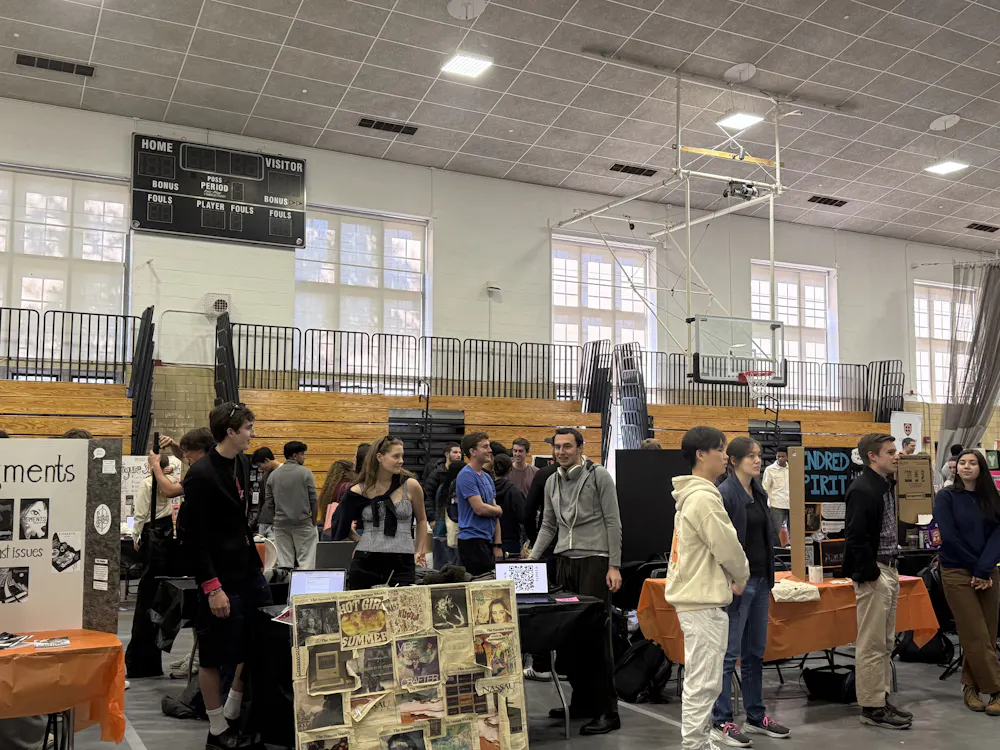
Students share mixed reactions as mandated officer and treasurer trainings return to in-person format
David EstradaThe University's student organization officers and treasurers returned to mandatory in-person training this fall after years of online sessions. Student reactions found parts of the training redundant or tedious, though most agreed the sessions were important.
The University's student organization officers and treasurers returned to mandatory in-person training this fall after years of online sessions. Student reactions found parts of the training redundant or tedious, though most agreed the sessions were important.