



Don't knock the accuracy of political polls until you see the methods behind the madness. Don't completely believe them either.
According to Princeton Survey Research Associates International (PSRAI), a worldwide polling group with offices in Princeton and Washington, D.C., political and social surveys are conducted at random in order to represent a population at large. A single poll becomes an accurate estimation, but never an exact figure, said Larry Hugick, chairman of PSRAI.
"We serve clients by telephone interviewing, polling on-line and mail surveys," Hugick said. "We want to help clients see what the public thinks and how the public thinks."
In an election year, polls gain significance in the public eye.
"This contest requires a critical decision and polls inform voters. Developments in campaigns are useful to voters," G. Evans Witt, chief executive of PSRAI, said.
"We conduct polls for nonprofits and for the media such as our Newsweek poll," Hugick said.
He said most of PSRAI studies are conducted for nonprofit organizations, although the company also conducts a small portion of its business for commercial corporations.
Hugick was the former managing editor and former vice president of the Gallup Poll in the 1980s. He said he views the presidential election polls as a "horse race" in which people want to see what others think of important issues.

"People look for things such as approval rating. Do people want to see [President] Bush for four more years? Are they satisfied with how the President is handling certain issues?" he said.
Though skepticism might be directed toward these polls, the studies are conducted with probability science.
Respondents are selected at random, such that the results yield a certain amount of precision to the general population.
"If Bush has a 48 percent to 44 percent lead over [Sen.] Kerry, we must keep in mind error and the time they're taken," said Hugick.
In this case, there is a three-point margin of error that applies to the spread, he noted. Another possible scenario could have Kerry leading Bush at 47 percent to 45 percent.
Even if there is a 95 percent confidence interval involved in the tests, it is unlikely that an individual poll represents the population at large, Hugick said.

Instead, he encouraged people to view a large number of polls in order to look for recurring trends in the data.
For example, Hugick discouraged the popular idea that New Jersey is a swing state for the 2004 presidential election, citing controversial methodology in the polling.
PSRAI conducts polls of public health domestically and worldwide in addition to political polls.
According to its website, the organization prides itself on its independence, integrity and data collection.
Among its wide variety of clients are Aetna, The World Bank, the Canadian Embassy in the United States, NBC News and U.S. News and World Report.
"We have conducted amazing work in 65 countries . . . with global attitudes . . . and health care," said G. Evans Witt, chief executive of PSRAI.
As a CEO, Witt said he must "wear both hats" as an administrator and analyst, though he has a staff of statisticians, poll developers and analysts.
PSRAI's involvement with the Knight Foundation proves to be a prime example of domestic assistance to nonprofit groups. The Miami-based foundation makes grants to poor communities.
The PSRAI's polls help the nonprofit decide how to allocate funds for the greatest benefit of a community, Witt said.
On a global level, PSRAI's president, Mary McIntosh, conducted studies on the multinational quality of life.
The organization also conducted a survey on childhood immunization in Thailand, Nepal, Zimbabwe and Tanzania. In addition, PSRAI works with the Kaiser Family Foundation to use polls to understand such issues as Medicare, teenage sex and HIV/AIDS.
If anyone knows anything about the merits of polling, it's George Gallup Jr. himself.
"Polling performs a vital function in a democracy. It allows us to know the public's will at all times," Gallup Jr. said in a phone conversation on Sunday.
Read More

Princeton University Orchestra and men’s ultimate frisbee team named in University’s latest hazing report
Andrew ArthurTwelve students in the Princeton University Orchestra and Men's Ultimate Frisbee team were found responsible for hazing violations in the University's latest Campus Hazing Transparency Report. Sanctions ranged from Dean's warnings to disciplinary probation.
Twelve students in the Princeton University Orchestra and Men's Ultimate Frisbee team were found responsible for hazing violations in the University's latest Campus Hazing Transparency Report. Sanctions ranged from Dean's warnings to disciplinary probation.

Murray-Dodge Café celebrates 50th Anniversary, drawing over 260 students
Hifza KaleemOn Wednesday, Murray Dodge Cafe celebrated its 50th anniversary, drawing more than 260 students to celebrate with free cookies and merchandise.
On Wednesday, Murray Dodge Cafe celebrated its 50th anniversary, drawing more than 260 students to celebrate with free cookies and merchandise.
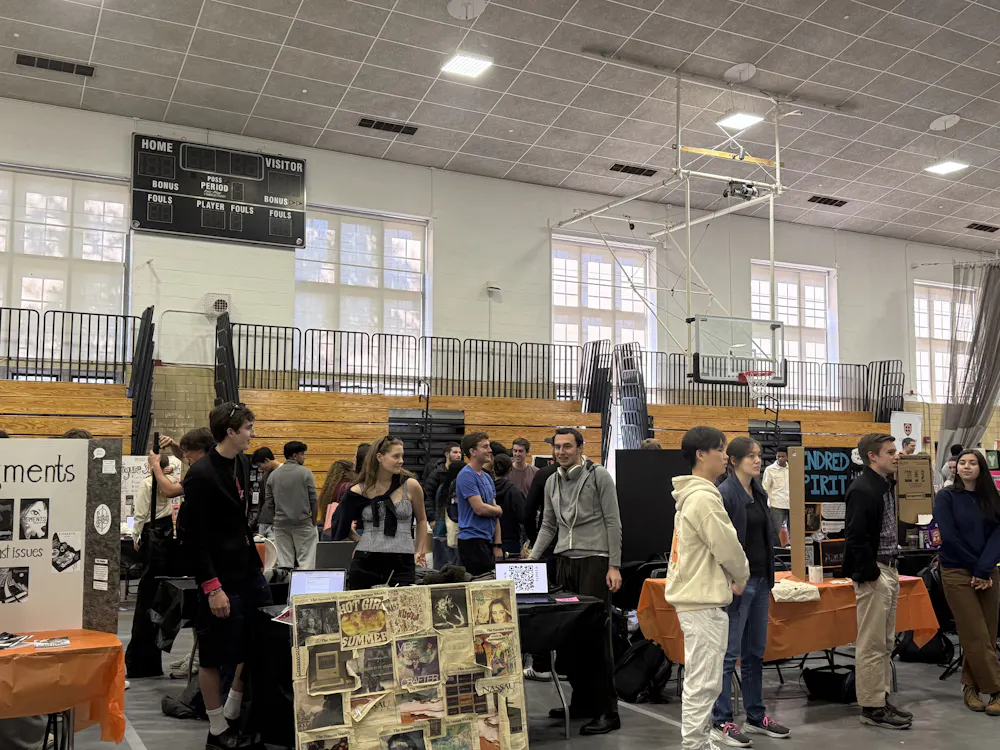
Students share mixed reactions as mandated officer and treasurer trainings return to in-person format
David EstradaThe University's student organization officers and treasurers returned to mandatory in-person training this fall after years of online sessions. Student reactions found parts of the training redundant or tedious, though most agreed the sessions were important.
The University's student organization officers and treasurers returned to mandatory in-person training this fall after years of online sessions. Student reactions found parts of the training redundant or tedious, though most agreed the sessions were important.