



A Bulgarian, a Slovakian and an American sit in the lobby of Robertson Hall on Monday afternoon.
It sounds like the premise for a politically incorrect joke, but the three students — candidates for a masters in public administration from the Wilson School — were nothing but serious when asked about the Robertson Foundation suit.
They defend the graduate program, which a $35 million grant by Charles Robertson in 1961 dramatically expanded, has done a good job at sending students in government service.
The Robertsons, however, who filed suit against the University in 2002 to reclaim the nearly $600 million endowment behind the Wilson School, says the School has failed in that job. That is only one reason that the family sued.
"[Wilson School] Dean [Anne-Marie] Slaughter ['80] has been very encouraging and supportive of the value of education that best prepares us for skill in broader and applicable fields — not just a single private sector," said Peter Kuseky, a master's candidate at the school from Slovakia.
The original benefactor, Charles Robertson '26, made the contribution in the heart of the Cold War to ensure that capable graduates would enter public service.
The University has said the graduate Wilson School program sends between 40 to 50 percent of its students into the public sector — a percentage it says is comparable to similar programs.
Steve Barnes, assistant dean of external affairs at the Wilson School at WWS, said that from 1998 to 2002, between 37 and 55 percent of MPA recipients who entered the job market went on to serve in government or international organizations..

But the Robertsons say that's not enough. They're not going into government service — even if they might be going to work for nonprofits, the family says.
The three students, working on a policy memo, said students are pursuing service careers.
"If people wanted to go to private sector, they would more likely attend a graduate school geared toward business. That's not the case here," Dressi Dimitirova, a Bulgarian master's student, said.
Not all WWS graduates who enter public end up in traditional public-sector jobs. Still, graduates maintain they were pursuing service careers.
Scott Lee, an American student, said he intends to work in the healthcare field.
"I don't think that betrays the mission of the school," he said. "Now, NGO's [nongovernmental organizations] play a much larger role in the world than three to four decades ago."

One professor said that while he encourages students to enter public service, he also realizes that serving the public can take different forms.
"When I speak of public policy, I define this very broadly. This can be in local government, in NGOs, and nonprofits," Wilson School professor Stanley Katz said, while acknowledging that some students enter other fields, including medicine, law, business and the humanities.
The Wilson School suit focuses largely on the graduate program.
But in the undergraduate program, students disagreed about how big a role public service plays in career strategy.
Whereas ORFE major Evan Coopersmith '06 said he receives "two to three emails a day about I-banking groups and consulting firms visiting campus," Wilson School major Matthew Shapiro '05 said, "There's a strong emphasis of public policy [and] no emphasis on entering the financial sector."
Kathryn Lynn, another Master's candidate, said that the "Woodrow Wilson [school] has a clearly defined goal: to improve the world. People here believe they can cause change. The Robertsons should be proud and look at the talent and dynamic the kids in this program have."
Read More

Princeton University Orchestra and men’s ultimate frisbee team named in University’s latest hazing report
Andrew ArthurTwelve students in the Princeton University Orchestra and Men's Ultimate Frisbee team were found responsible for hazing violations in the University's latest Campus Hazing Transparency Report. Sanctions ranged from Dean's warnings to disciplinary probation.
Twelve students in the Princeton University Orchestra and Men's Ultimate Frisbee team were found responsible for hazing violations in the University's latest Campus Hazing Transparency Report. Sanctions ranged from Dean's warnings to disciplinary probation.

Murray-Dodge Café celebrates 50th Anniversary, drawing over 260 students
Hifza KaleemOn Wednesday, Murray Dodge Cafe celebrated its 50th anniversary, drawing more than 260 students to celebrate with free cookies and merchandise.
On Wednesday, Murray Dodge Cafe celebrated its 50th anniversary, drawing more than 260 students to celebrate with free cookies and merchandise.
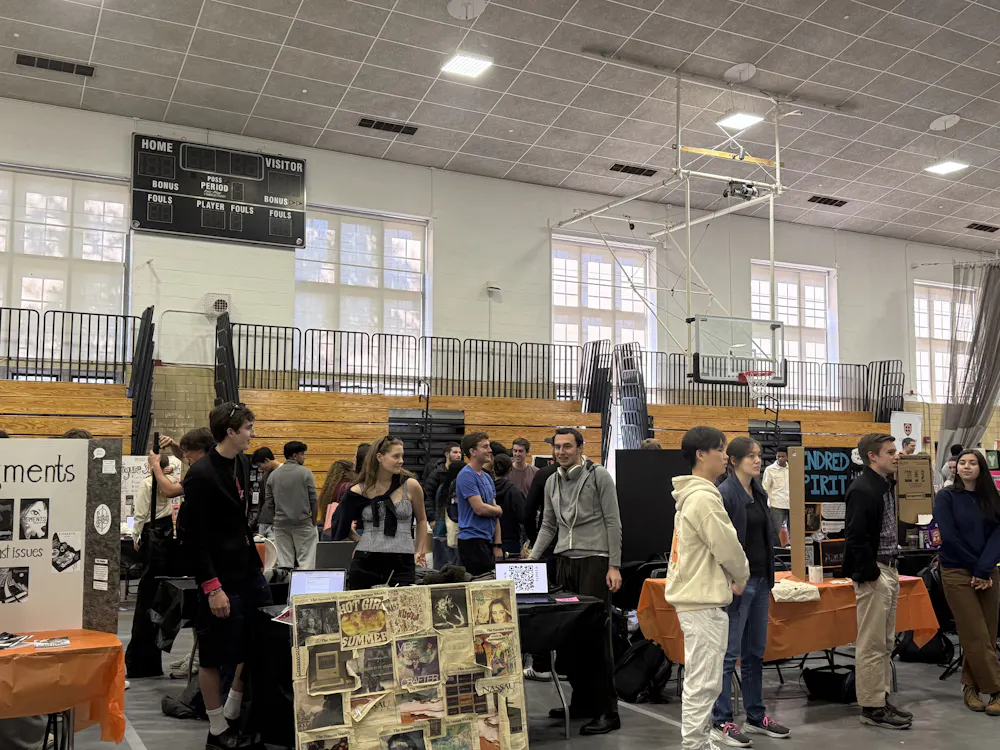
Students share mixed reactions as mandated officer and treasurer trainings return to in-person format
David EstradaThe University's student organization officers and treasurers returned to mandatory in-person training this fall after years of online sessions. Student reactions found parts of the training redundant or tedious, though most agreed the sessions were important.
The University's student organization officers and treasurers returned to mandatory in-person training this fall after years of online sessions. Student reactions found parts of the training redundant or tedious, though most agreed the sessions were important.