



Following the University's adoption of proposals to counter grade inflation last spring, the Faculty Committee on Examinations and Standing has decided to add quintile rank to student academic records. University Registrar Joseph Greenberg notified the undergraduate student body of the change in an email Monday.
"After each semester, the quintile ranking system sorts all the enrolled students in your class into five groups according to GPA," Greenberg said in the email. "Quintile 1, the highest of the five rankings, includes the top 20 percent of students in your class, Quintile 2 the next 20 percent . . . and Quintile 5 includes the bottom 20 percent of the class." Students may view their quintile rank confidentially on the My Academic Record page via the Office of the Registrar's website.
Dean of the College Nancy Malkiel said that quintile rank will provide students "a context in which to understand what their grades mean." For many students, quintile rank will be solely "informational," she said, while for less dedicated students, the rank may serve a motivational role.
A student whose GPA falls in one of the lower quintiles may want "to recalibrate the effort they're putting into their coursework — devote a little more attention to academics," Malkiel said.
She described a hypothetical student who "comes to Princeton expecting to get all B's, and considers that doing well. Maybe that is doing well and maybe it isn't; the quintile rank will help this student to see where they stand relative to their peers."
Given the sensitive nature of academic records, University officials stressed the confidentiality of the data. "The quintile ranking is only for your own information. It will not be reported externally. Like your GPA, it is available internally only to academic deans, directors of studies, and Registrar staff," Greenberg said.
Though students routinely volunteer their GPA on resumes and graduate school applications, Malkiel said she does not believe that graduate schools or employers would request that students voluntarily report their quintile rank, since few other academic institutions use the same system.
Some students, however, worry that students with high quintile rankings could use the information for self-promotion.

"As far as jobs or graduate schools, I think it's nice for those toward the top," said Marty Taylor '05, "but for those toward the bottom it seems like a slap in the face of sorts."
One freshman who wished to remain anonymous said, "I think the quintile system is bad because of the psychological effect. It places people in categories which can result in self-fulfilling prophecies. If you tell someone they are bad or bad in relationship to others, then they subconsciously internalize it, and may do less well."
As for why the faculty chose quintiles as opposed to other common percentiles, Malkiel admitted that the strata "were not arrived at by any scientific method. Quartiles were a little too big, deciles a little too small. Quintiles seemed to be about right."
Read More

Princeton University Orchestra and men’s ultimate frisbee team named in University’s latest hazing report
Andrew ArthurTwelve students in the Princeton University Orchestra and Men's Ultimate Frisbee team were found responsible for hazing violations in the University's latest Campus Hazing Transparency Report. Sanctions ranged from Dean's warnings to disciplinary probation.
Twelve students in the Princeton University Orchestra and Men's Ultimate Frisbee team were found responsible for hazing violations in the University's latest Campus Hazing Transparency Report. Sanctions ranged from Dean's warnings to disciplinary probation.

Murray-Dodge Café celebrates 50th Anniversary, drawing over 260 students
Hifza KaleemOn Wednesday, Murray Dodge Cafe celebrated its 50th anniversary, drawing more than 260 students to celebrate with free cookies and merchandise.
On Wednesday, Murray Dodge Cafe celebrated its 50th anniversary, drawing more than 260 students to celebrate with free cookies and merchandise.
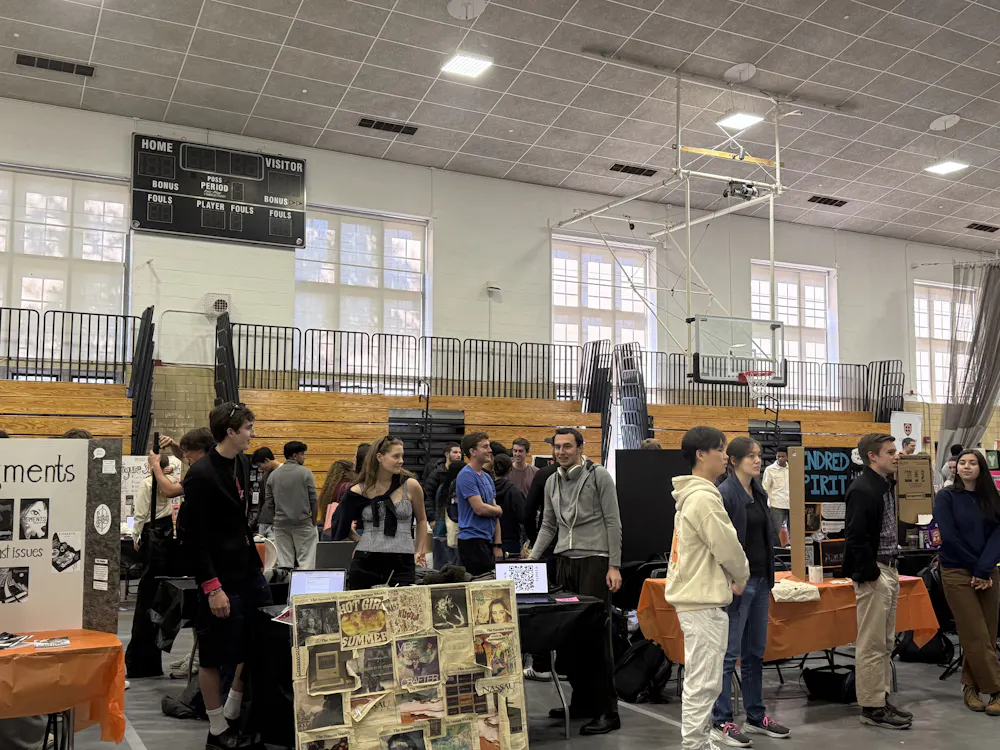
Students share mixed reactions as mandated officer and treasurer trainings return to in-person format
David EstradaThe University's student organization officers and treasurers returned to mandatory in-person training this fall after years of online sessions. Student reactions found parts of the training redundant or tedious, though most agreed the sessions were important.
The University's student organization officers and treasurers returned to mandatory in-person training this fall after years of online sessions. Student reactions found parts of the training redundant or tedious, though most agreed the sessions were important.