



Students this year have the opportunity to study astrobiology, a multidisciplinary field that, according to the Student Course Guide, aims to "discover life's origins and to seek extraterrestrial life."
Astrophysics professor Ed Turner describes the new course, AST255: Life in the Universe, as "pedagogically challenging."
"Not all is known," explained Turner, one of the professors for the course. "It is not a mature subject," which can be difficult for students, he said.
"There is no consensus on what an astrobiologist should know," Turner added. "When I go to conferences, there are people in fields from computer science to biology."
The field of astrobiology is just 20 years old and only Washington State University currently offers a doctoral degree in the field, Turner said.
Much of the material in the course is speculative and contains contradictory theories. It is this immature stage of astrobiology that some find so appealing.
Logan West, a sophomore in the course and a 'Prince' photographer, noted, "Part of the fun is that you don't know the answer . . . we are trying to answer the ultimate question."
The highlight of the class, for some students, is a trip over fall break to Yellowstone National Park to observe organisms that live in extreme environments such as hot springs and ice. Study of these environments may be useful to preparing for a future Mars mission.

"The hot springs in Yellowstone contain many very primitive organisms and is an ideal location to study the origins of life" explained geology professor Tullis Onstott, another course instructor. The class, which only accepted 25 students, filled up very quickly, in part due to the free trip.
The Sophomore Initiative, which tries to help sophomores decide on a major, and the new NASA Center for Astrobiology at Princeton, helped create the new course.
Every five years, universities compete to bring a NASA "center" to their campus. Last year, Harvard and MIT both lost their centers and Princeton was invited to join the Universities of Tennessee and Indiana to work on a project titled "Detection of Biosustainable Energy and Nutrient Cycling in the Deep Subsurface of Earth and Mars."
However, the study of astrobiology at the University is not entirely new. Turner noted that there are a few graduate students and one senior doing research in the field.
The class will also be funded by the Sophomore Initiative for three years and then reevaluated. Onstott and Turner both hope that the course will grow to become a certificate program or possibly a concentration in astrobiology. Onstott is quick to point out that such a program would take time to develop and that the future of student study of astrobiology at the University will depend on student feedback and progress in the field.
The course is cross-listed in the astrophysics, geology and ecology and evolutionary biology departments.

Professor Turner noted that two chemistry professors are also affiliated with the course but "the registrar had trouble cross-listing in more than three departments."
Read More

Princeton University Orchestra and men’s ultimate frisbee team named in University’s latest hazing report
Andrew ArthurTwelve students in the Princeton University Orchestra and Men's Ultimate Frisbee team were found responsible for hazing violations in the University's latest Campus Hazing Transparency Report. Sanctions ranged from Dean's warnings to disciplinary probation.
Twelve students in the Princeton University Orchestra and Men's Ultimate Frisbee team were found responsible for hazing violations in the University's latest Campus Hazing Transparency Report. Sanctions ranged from Dean's warnings to disciplinary probation.

Murray-Dodge Café celebrates 50th Anniversary, drawing over 260 students
Hifza KaleemOn Wednesday, Murray Dodge Cafe celebrated its 50th anniversary, drawing more than 260 students to celebrate with free cookies and merchandise.
On Wednesday, Murray Dodge Cafe celebrated its 50th anniversary, drawing more than 260 students to celebrate with free cookies and merchandise.
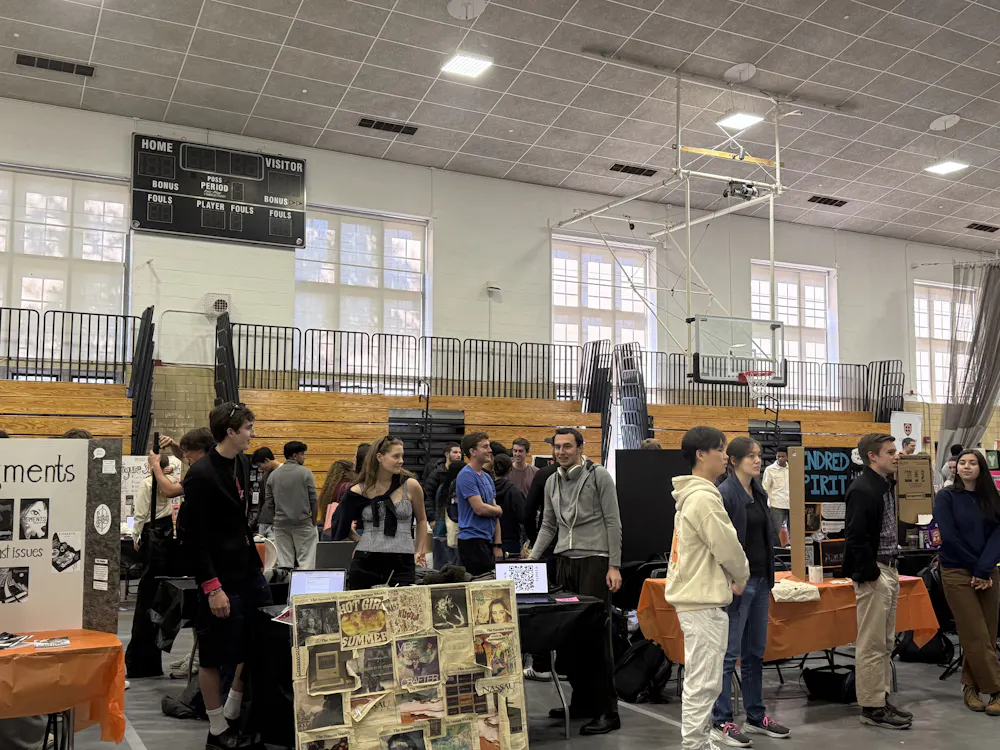
Students share mixed reactions as mandated officer and treasurer trainings return to in-person format
David EstradaThe University's student organization officers and treasurers returned to mandatory in-person training this fall after years of online sessions. Student reactions found parts of the training redundant or tedious, though most agreed the sessions were important.
The University's student organization officers and treasurers returned to mandatory in-person training this fall after years of online sessions. Student reactions found parts of the training redundant or tedious, though most agreed the sessions were important.