



Freshman Courtney Freer sat in Tuesday's POL 210: Political Theory lecture listening as the professor steamed through her notes on Aristotle's Politics. Twenty minutes into the class Freer's erect posture began to slouch, her pen moved half as vigorously, her eyes drifted between podium and clock, podium and clock. With five minutes left, her pen lay flat on her desk, her bags were packed and her gaze fixed on the minute hand in McCosh 50.
Freer was hardly alone in her boredom near the classes end. POL 210 — an introductory political theory course surveying works from Plato to Hobbes to Machiavelli — is almost a rite of passage on campus. Largely taken by freshman and sophomores, it usually draws in young Princetonians eager to read classic works.
However, this year's course enrollment has significantly dropped — from 315 students last fall to 205 this year. And while the number of freshman in the class remains relatively consistent, it is among sophomores, juniors and seniors that the course seems to have lost some of its allure.
But POL 210 is not the only course to suffer shifts in enrollment this fall. Across the departments a number of classes have had uncharacteristic swings in students.
With 80 compared to 142 sophomores in POL 210 this year, and 20 rather than 41 seniors enrolled — there are consistent trends to this year's drop in numbers.
First-time professor Jennifer Pitts noted that the politics department put a cap on enrollment this year — at 230 as opposed to 430 in years past — but in no year was this maximum reached.
"I didn't specifically intend to change any perception of the course," Pitts wrote in an email, "though I did try to make clear in the first lectures that, even though it's introductory, POL 210 is a demanding course."
In previous years with professor Maurizio Viroli teaching the course, there were two papers in lieu of exams, and many former students noted they simply read the books required for their paper topic. This year there are two papers and a final exam.

Brady Becker '06 thought POL 210's audience was thinning "because [the department] tried to make [the class] harder."
One student speculated that the class was less popular for one reason — no professor Viroli.
And without Viroli, reactions to this year's lectures have been mixed.
"The first impression I got of professor Pitts is that she seemed to be very knowledgeable, she's really organized, explains things very well and speaks clearly," Gao said.
But, he added, "[Pitts] is very young and talks too fast."
Becker disagreed, "The lectures are too dry, too slow."

However, even with Viroli at the helm, the course and professor did not always garner high marks. On the student course guide, Viroli's lectures were described as anything from "boring" and "rarely funny" to "insightful."
Rising in popularity
In contrast to POL 210, REL 252: The Early Christian Movement on the upswing of popularity. Last year only 20 students enrolled compared to 97 this year. The professor Elain Pagels has not changed, but her fame certainly has.
"My mom saw her on C-SPAN." Grant Gittlin '08 said. "She told me if I didn't take this course, I didn't deserve my acceptance [to Princeton]."
Students cited teacher recognition as the most common reason for enrollment.
Pagels published a New York Times bestselling book last year titled "Beyond Belief" and frequented talk shows to discuss the Dan Brown's bestselling novel "The Da Vinci Code."
On Wednesday afternoon in McCosh 28, nearly all the seats were taken with students attentively gazing back from their books at Pagels, who paced back and forth encouraging students to ask questions and read aloud from the texts.
"Pagels is a good lecturer," wrote Rebecca Gillepsie '05 in an email. "And the material is fascinating."
However, some students expressed discomfort with Pagel's lecture style, saying that the course wasn't what they expected.
"Her lecture style seems much better suited to the smaller 30 person class," said Daniel Klemperer '06, an ORFE major.
For many students, Pagel's fame was only part of the reason they took the class.
Taking REL 252 was "a self-discovery process," Jing Jin '06 said. "Almost everyone who is taking this course is trying to find a confirmation of their faith."
Energy and expectations
Uncharacteristic shifts in enrollment also hit ENG 310: Shakespeare I.
The course saw a significant swing from 55 students last year to 114 students this fall.
It is also being taught by professor Lawrence Danson instead professor Leonard Barkan.
And the shift may have influenced some students decisions to take the class.
Patrick Cunnigham '05, for one, said he took the class because Danson was teaching it.
Danson is known to be an energetic professor — often jumping around the lecture podium modulating his voice to the Shakespearan character he impersonates.
In an a student course guide review written when Danson taught the course four years ago, a student said, "He speaks very eloquently and expands on the most interesting threads and main themes and relationships in the plays."
But there may be other reasons for ENG 310's marked increase in enrollment this year. While Danson is new to the course, so is his grading policy.
Last year, when the course was taught by Leonard Barkan, the course was exam-based.
"The first thing Danson tells you is that there isn't going to be a final exam." Cunningham said.
Danson attributed the rise in popularity to a multitude of factors.
It could be "a temporary glitch, or a scheduling issue, or the result of a change in department requirements, or of a different teacher, or a host of other things that have nothing to do with what you so charmingly call 'popularity.'" he wrote in an email.
Read More

Princeton University Orchestra and men’s ultimate frisbee team named in University’s latest hazing report
Andrew ArthurTwelve students in the Princeton University Orchestra and Men's Ultimate Frisbee team were found responsible for hazing violations in the University's latest Campus Hazing Transparency Report. Sanctions ranged from Dean's warnings to disciplinary probation.
Twelve students in the Princeton University Orchestra and Men's Ultimate Frisbee team were found responsible for hazing violations in the University's latest Campus Hazing Transparency Report. Sanctions ranged from Dean's warnings to disciplinary probation.

Murray-Dodge Café celebrates 50th Anniversary, drawing over 260 students
Hifza KaleemOn Wednesday, Murray Dodge Cafe celebrated its 50th anniversary, drawing more than 260 students to celebrate with free cookies and merchandise.
On Wednesday, Murray Dodge Cafe celebrated its 50th anniversary, drawing more than 260 students to celebrate with free cookies and merchandise.
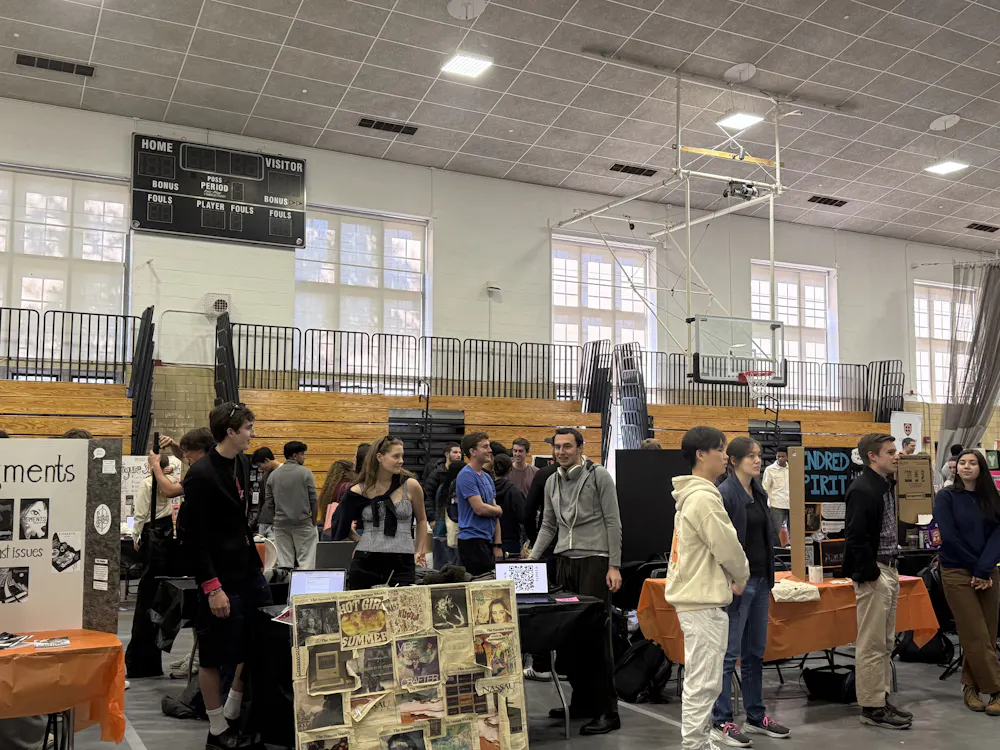
Students share mixed reactions as mandated officer and treasurer trainings return to in-person format
David EstradaThe University's student organization officers and treasurers returned to mandatory in-person training this fall after years of online sessions. Student reactions found parts of the training redundant or tedious, though most agreed the sessions were important.
The University's student organization officers and treasurers returned to mandatory in-person training this fall after years of online sessions. Student reactions found parts of the training redundant or tedious, though most agreed the sessions were important.