



Melissa Huang, a sophomore who was found dead in her University room by her parents and a custodian earlier this month, died after ingesting the toxin cyanide, officials said Thursday.
President Tilghman made the announcement by email Thursday morning to all students, but administrators and local officials urged the campus community not to jump to conclusions about what this development might mean.
"The medical examiner determined that the cause of death was cyanide," said Casey DeBlasio, a spokeswoman for the Mercer County Medical Examiner's Office, adding that "the manner of death is still listed as undetermined."
The most common types of cyanide are hydrogen cyanide, a colorless gas with a faint, bitter almond-like odor, and potassium and sodium cyanide, both white solids also with bitter, almond-like odors. All of these substances can be lethal when ingested by humans.
It was not clear how Huang came into contact with cyanide.
"Cyanide causes suffocation in the body at the cellular level," said Rose Anne Soloway, associate director of the American Association of Poison Control Centers (AAPC). "We think of suffocation as something that stops our breathing, but cyanide prevents our cells from using oxygen. The various cyanides work the same way in our body."
Cyanide has no household or pharmaceutical purpose and "typical places where cyanide might be encountered would be laboratories, particularly industries that use cyanide as part of their manufacturing process," Soloway said.
Members of the Department of Chemical Engineering — where Huang, 19, spent the summer doing research — could not be reached to determine whether any form of cyanide is available or used in their labs.

Officials at the University's Environmental Health and Safety Office (EHS) and the Department of Public Safety were also unavailable for comment.
The EHS lab safety manual, available on its website, includes a section on safety procedures regarding hydrogen cyanide.
Lauren Robinson-Brown '85, the University's communications director, said "the investigation remains open and therefore we cannot comment." She was unable to elaborate on any aspect of the investigation and discouraged individuals from engaging in speculation until it is complete.
Legitimate uses of cyanide in industry include electroplating, metallurgy, production of chemicals, photographic development, making plastics, fumigating ships and some mining processes, according to the Agency for Toxic Substances and Disease Registry.
There were eight cyanide fatalities in the United States in 2002, the most recent year for which data is available, according to the 2002 Annual Report of the American Association of Poison Control Centers Toxic Exposure Surveillance System.
Of those eight fatalities, one was due to cyanide exposure in a house fire and the remaining seven were due to ingestion. Of those seven, six were suicides.

The AAPC report documented 1,153 other fatalities related to toxin exposure, and the Centers for Disease Control and Prevention reported a total of 30,622 suicides in 2001, the most recent year for which data is available.
Though there are many instances in which individuals can be exposed to cyanide — smoking cigarettes, eating lima beans or almonds, or touching certain types of soil — death from such exposure "would not be expected," Soloway said.
In small amounts, the body is able to metabolize cyanide. "If you were to be poisoned by it, you need to overwhelm your body's mechanisms for detoxifying it," Soloway said.
An agent at the Centers for Disease Control Hotline said 200-300 milligrams of potassium or sodium cyanide — less than one hundredth of an ounce — is lethal.
"If there is enough involved, it can be very quick," Soloway added.
Counseling and support
With the support of University Health Services (UHS), Wilson College — Huang's residential college — has organized a meeting for all college students, staff and faculty. Wilson residential advisers and assistant masters will also be meeting with UHS counselors later this week.
"In general, the entire college staff and members of both the health services and the [Office of Religious Life] have done an excellent job of organizing formal meetings such as these and also of making themselves available on an 'as-needed' basis," said Wilson College Dean Lisa Herschbach.
In her email to students, Tilghman noted that there will be a memorial service for Huang on Oct. 17 in the University Chapel.
"I know she touched the lives of many members of this community and will be long remembered," Tilghman wrote.
Princetonian Staff Writer Mike Hsu contributed reporting to this article.
Read More

Princeton University Orchestra and men’s ultimate frisbee team named in University’s latest hazing report
Andrew ArthurTwelve students in the Princeton University Orchestra and Men's Ultimate Frisbee team were found responsible for hazing violations in the University's latest Campus Hazing Transparency Report. Sanctions ranged from Dean's warnings to disciplinary probation.
Twelve students in the Princeton University Orchestra and Men's Ultimate Frisbee team were found responsible for hazing violations in the University's latest Campus Hazing Transparency Report. Sanctions ranged from Dean's warnings to disciplinary probation.

Murray-Dodge Café celebrates 50th Anniversary, drawing over 260 students
Hifza KaleemOn Wednesday, Murray Dodge Cafe celebrated its 50th anniversary, drawing more than 260 students to celebrate with free cookies and merchandise.
On Wednesday, Murray Dodge Cafe celebrated its 50th anniversary, drawing more than 260 students to celebrate with free cookies and merchandise.
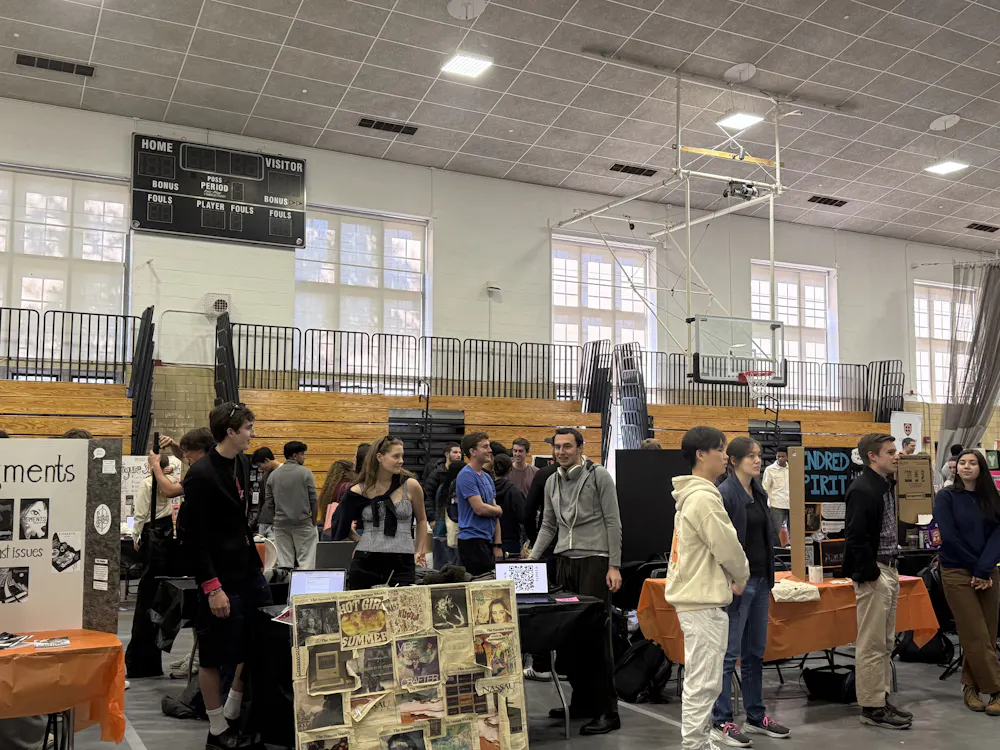
Students share mixed reactions as mandated officer and treasurer trainings return to in-person format
David EstradaThe University's student organization officers and treasurers returned to mandatory in-person training this fall after years of online sessions. Student reactions found parts of the training redundant or tedious, though most agreed the sessions were important.
The University's student organization officers and treasurers returned to mandatory in-person training this fall after years of online sessions. Student reactions found parts of the training redundant or tedious, though most agreed the sessions were important.