



Born in Canada and an economist by training, former University President Harold Shapiro GS '64 might seem an unlikely choice for America's Olympic organization.
Yet, Shapiro has recently been appointed to one of 11 seats on the recently overhauled U.S. Olympic Committee Board of Directors.
The announcement, made in June, confirmed Shapiro as an independent member of the new board.
Of the members, three are also on the International Olympic Committee, two are selected by athletes, two are nominated by the governing bodies of individual sports and four are independent. The previous USOC Board of Directors had 123 members.
"I didn't know this was going on until I got a call from the head of the nominating committee," Shapiro said. "I was a little mystified to be honest."
Shapiro said he thought he had been selected because the search focused on those "who are independent, who have not been a part of [the old USOC], know how to run organizations, and have a reputation for integrity and could really build a new governance structure for the U.S. Olympic movement."
The need for new governance came following allegations of corruption among USOC directors. Charges of financial irregularities, nepotism and mismanagement led to eight resignations, including that of then CEO of the USOC, Lloyd Ward.
"Congress let it be known that if the USOC didn't reform itself, they would step in and do it for them," Shapiro explained.

Shapiro, a former president of the University of Michigan and chairman of the National Bioethics Advisory Commission, is currently a professor of economics and public policy at the University.
Though he calls himself a "sports enthusiast," he did not participate in competitive athletics beyond the high school level.
Shapiro said he believes as former president at both Princeton and Michigan, he had "a modest impact" in the athletic programs. Shapiro served on the executive committee of the NCAA during his tenure as president of Princeton.
Shapiro also said he is familiar with issues regarding the use of performance-enhancing drugs through his work in bioethics, though he doubted that the issue would be his primary focus in the USOC.
He said the new board is "just getting organized now," and hopes to eventually "provide what was lacking before: accountability, transparency and respectability in order to help the Olympic movement the best way we can."
Shapiro stressed the potential importance of the USOC. "The nice thing about sports . . . is that if you can run the Olympics appropriately and successfully, this can have a big influence on young people."

He expressed some doubts about the future of athletics. The commercialization of sports, particularly at the college level, represents a "serious longterm problem," Shapiro said.
Shapiro also worries about the ever-expanding budgets and scale of college athletics programs. Despite these reservations, Shapiro said, "I believe in athletics.
I believe if they are run properly, they can make a terrific contribution. But they have to be run properly and that is the challenge."
Given his new role on the USOC board, that challenge falls squarely on the shoulders of Shapiro and his colleagues. "The tough work begins now," he said.
Read More

Princeton University Orchestra and men’s ultimate frisbee team named in University’s latest hazing report
Andrew ArthurTwelve students in the Princeton University Orchestra and Men's Ultimate Frisbee team were found responsible for hazing violations in the University's latest Campus Hazing Transparency Report. Sanctions ranged from Dean's warnings to disciplinary probation.
Twelve students in the Princeton University Orchestra and Men's Ultimate Frisbee team were found responsible for hazing violations in the University's latest Campus Hazing Transparency Report. Sanctions ranged from Dean's warnings to disciplinary probation.

Murray-Dodge Café celebrates 50th Anniversary, drawing over 260 students
Hifza KaleemOn Wednesday, Murray Dodge Cafe celebrated its 50th anniversary, drawing more than 260 students to celebrate with free cookies and merchandise.
On Wednesday, Murray Dodge Cafe celebrated its 50th anniversary, drawing more than 260 students to celebrate with free cookies and merchandise.
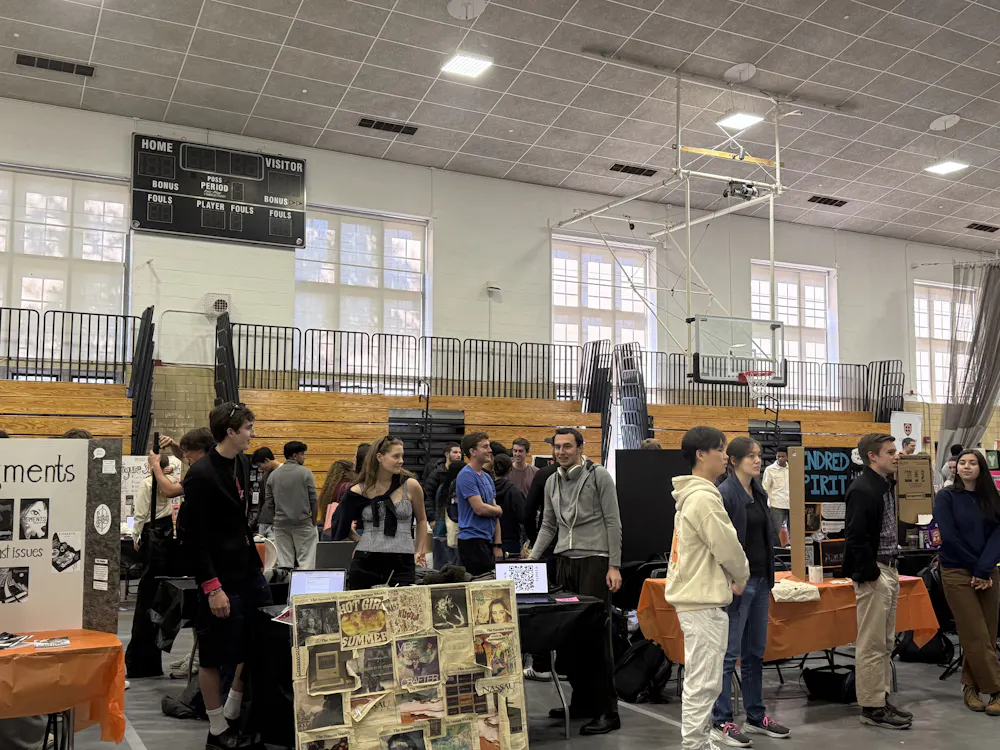
Students share mixed reactions as mandated officer and treasurer trainings return to in-person format
David EstradaThe University's student organization officers and treasurers returned to mandatory in-person training this fall after years of online sessions. Student reactions found parts of the training redundant or tedious, though most agreed the sessions were important.
The University's student organization officers and treasurers returned to mandatory in-person training this fall after years of online sessions. Student reactions found parts of the training redundant or tedious, though most agreed the sessions were important.