



The plaintiffs in the Robertson Foundation suit will go before a judge on Sept. 24 to request to amend their complaint with significantly more damaging claims.
Building on their argument that the University has tried to seize control of the foundation's assets for projects not authorized by the foundation's charter, the Robertson family now claims the University has inappropriately spent more than $100 million of the gift.
On June 16, the Robertson family members filed a request to amend their lawsuit against the University. The suit seeks to regain control of the nearly $600 million endowment behind the Wilson School.
Judge Neil Shuster of Mercer County Superior Court is presiding over the case that was filed in July 2002. A court-ordered mediation has failed to produce any agreements.
The family now says that Princeton has a pattern of using foundation-specific gifts to supplement the University's general spending.
"Princeton's actual wrongdoing . . . exceeds the Robertson family's worst suspicions," says the new complaint, as the plaintiffs have submitted it.
The University is denying the allegations.
"The plaintiffs' request to amend their original complaint is just an abusive publicity ploy," said Douglas Eakeley, Princeton's lawyer in the case. "Many of the new allegations are not only false, but also insulting."

In a written statement released after the filing, Princeton said the accusations "appear to have been motivated more by a desire to harm the University than to advance the goals and objectives the foundation has supported for more than 40 years."
But the Robertson family — relatives of Charles '26 and Marie Robertson, who gave $35 million in 1961 to dramatically expand the graduate program of the Wilson school — says the University has abused the gift's original purpose: training students for government service, especially international service.
The new claims are based largely on information and records the University provided the Robertsons in the case.
Seth Lapidow, a Robertson family lawyer, cites a 1973 memo by Provost Sheldon Hackney to then-President William Bowen GS '58 as a basis for the plaintiffs' claims.
In the memo, Hackney expresses reservations about the existence of the Foundation as a separate entity with control over its own investment decisions.
"In the very long run, it would be a good thing if the Foundation itself were to be dissolved and the funds given to the University earmarked for the same purposes for which they are currently used," Hackney wrote in the memo.

The memo indicates that since the early 1970s, the University has had a longterm goal to subvert the intent of the donors, Lapidow claimed.
But Eakeley argues the plaintiffs are misreading the memo.
"There were concerns from time to time about the relationship [between the University and the Foundation] as it would be in any relationship between two institutions joined at the hip," he said. "The author [Hackney] is recognizing the fundamental obligation of the University to live up to its commitments and agreement to the formation of the Foundation."
In November, the University members of the Robertson Foundation outvoted the family in a decision to give the University's investment firm PRINCO more say in how to manage the Foundation's investments. From now on, PRINCO will decide where to invest the Foundation's assets.
The Robertson family viewed the 4-3 vote as another instance of the University taking control of the Foundation's assets.
"Now that the endowment has been transferred to PRINCO, we realize that the University never had any doubt that this is what they were going to do," Lapidow said.
But the University said the move was taken after a review of 10 other potential investment advisers.
"The endowment had gotten too large and the global economy is too volatile for a volunteer committee to oversee the assets," Eakeley said. "The board concluded that no one else out there was as capable and well situated as PRINCO to manage the Foundation's assets."
The Foundation investment committee will continue to have oversight and make final decisions, he said.
Among the new claims is that Princeton has a history of diverting donations from their intended purposes to the University's own use and benefit.
Lapidow cites a report by former University employee Jesse Washington calling into question how donations to the University's Office of Religious Life were used.
"I discovered many problems with the management of the University's endowed funds. . . . this is evidence of a systemic problem that warrants further review," Washington wrote, in documents provided by the plaintiffs.
Eakeley, however, said that the University investigated Washington's report and found it essentially incorrect.
"The filing also fails to point out that Washington didn't have the expertise to look into the issue and publishes her report as if it were the truth and written by an expert," Eakeley said.
In addition, the plaintiffs' claim that the University used funds from the Foundation to help pay for graduate school fellowships in the sociology, politics and economics departments — while largely ignoring the original purpose of the gift.
"The Robertson family believes their gift was given for a specific purpose at the Wilson School, where graduate students can train themselves for work in government," Lapidow said.
The filing also says that in 1992, the University began charging the Foundation for teacher salaries in the University's Office of Population Research and Center for International Studies — now in the Princeton Institute for International and Regional Studies.
"We feel the money should be used to pay teachers to teach and encourage students to go into government service," said Lapidow. "Princeton has lost sight of that vision, unfortunately for all us."
But the University says the spending was needed to strengthen three departments related to the Wilson School's interdisciplinary program.
"There are various elements that go into having a vibrant program in public and international affairs," Eakeley said.
Eakeley also said the defendants — President Tilghman, the University and University-appointed trustees to the Foundation — agree that Foundation funds should only be used for the purposes authorized by the Foundation. But he said they reject the suggestion that the OPR and CIS are not integral parts of the Wilson School.
Lapidow brushed aside the explanation.
"The defendants can essentially justify anything as supporting the Wilson School," he said. "There are no limits to how money can be used in the University's view if they can rationalize the spending."
A trial won't come for another year in October 2005 if the parties don't settle.
Until then, the bickering will continue, but with an eye on resolution.
"The Robertson family is interested in seeing if they can resolve the issue [before the trial]," Lapidow said. "We live in hope."
Read More

Princeton University Orchestra and men’s ultimate frisbee team named in University’s latest hazing report
Andrew ArthurTwelve students in the Princeton University Orchestra and Men's Ultimate Frisbee team were found responsible for hazing violations in the University's latest Campus Hazing Transparency Report. Sanctions ranged from Dean's warnings to disciplinary probation.
Twelve students in the Princeton University Orchestra and Men's Ultimate Frisbee team were found responsible for hazing violations in the University's latest Campus Hazing Transparency Report. Sanctions ranged from Dean's warnings to disciplinary probation.

Murray-Dodge Café celebrates 50th Anniversary, drawing over 260 students
Hifza KaleemOn Wednesday, Murray Dodge Cafe celebrated its 50th anniversary, drawing more than 260 students to celebrate with free cookies and merchandise.
On Wednesday, Murray Dodge Cafe celebrated its 50th anniversary, drawing more than 260 students to celebrate with free cookies and merchandise.
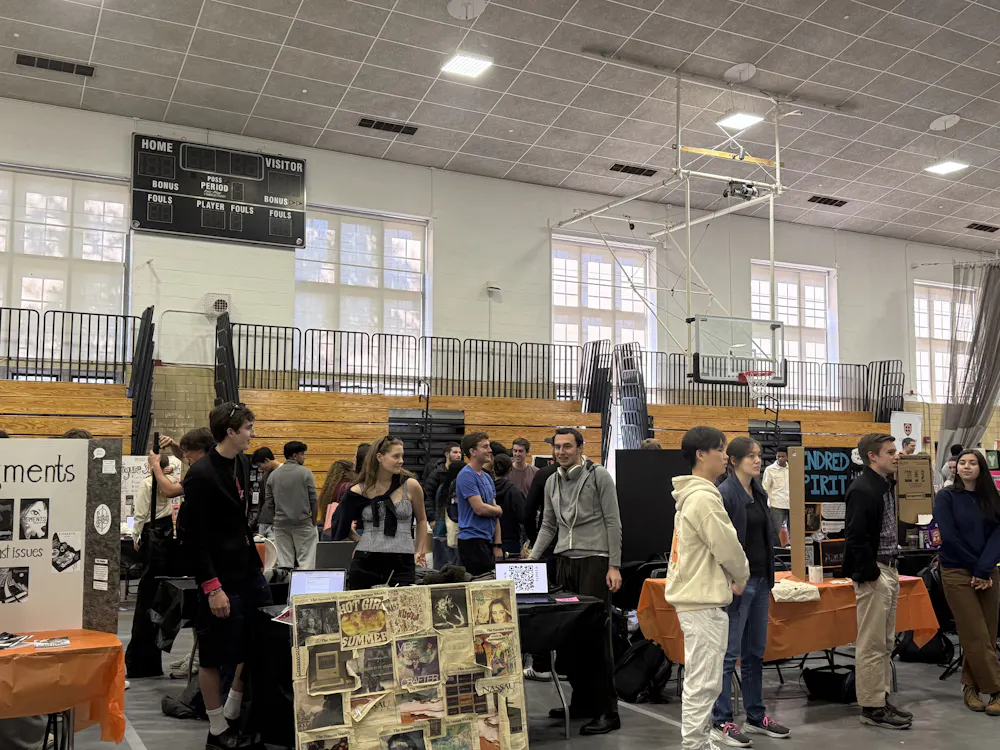
Students share mixed reactions as mandated officer and treasurer trainings return to in-person format
David EstradaThe University's student organization officers and treasurers returned to mandatory in-person training this fall after years of online sessions. Student reactions found parts of the training redundant or tedious, though most agreed the sessions were important.
The University's student organization officers and treasurers returned to mandatory in-person training this fall after years of online sessions. Student reactions found parts of the training redundant or tedious, though most agreed the sessions were important.