



The U.S. Department of Energy chose Princeton's Plasma Physics Laboratory to lead the United States' participation in an international fusion energy project known as the International Thermonuclear Experimental Reactor (ITER).
"We wanted to do it because it gives us an intellectual role in planning this experiment and making sure it succeeds," said Robert Goldston GS '77, director of the plasma physics lab. "This is very important for the future of fusion energy."
In what Goldston described as an "amazing step" towards the development of nuclear fusion, ITER aims to construct the first device capable of producing self-sustaining burning plasma — the substance necessary for nuclear fusion to take place — for significant periods of time.
The project is a joint effort between the U.S., China, South Korea, Japan, Russia and Europe, each of which is responsible for funding and building part of the reactor.
The Princeton group was named the coordinating laboratory for U.S. construction efforts earlier this year. The U.S. arm of the project, with a funding estimate of $500 million, is expected to begin next October.
Oak Ridge National Labs, in Tennessee, will also be contributing. The reactor is scheduled to begin running in 2014 and has an anticipated lifetime of about 20 years.
"[ITER] is to demonstrate the feasibility of fusion energy, not of a fusion reactor," Goldston explained. "It's not the intention to make net electricity in its present form. ITER is sort of a halfway step."
Fusion occurs when hydrogen atoms join together under extremely hot temperatures. The reaction produces helium and an enormous amount of energy that scientists hope will one day be harnessed to power the electricity grid.

Research on fusion has been under way for decades, but ITER would be the most productive reactor ever built, Goldston said.
"Fusion is a virtually limitless source of energy," said Stan Milora, director of Oak Ridge National Lab's fusion energy program. "You get the primary fuel from water, so it's available to all nations. It has no airborne pollutions, no greenhouse gas emissions. So basically, it has all those attractive characteristics you'd want from a power source."
Unlike fission, the method nuclear power plants use to produce electricity and which uses heavy elements such as uranium, fusion releases energy through the production of light elements such as helium. As a result, the raw materials in a fusion power plant cannot be used to create nuclear weapons.
Nathaniel Fisch, who directs the plasma physics program at the University, said that fusion sidesteps the risks of nuclear proliferation inherent to the fission method.
"You can't really divert [fusion] materials for terrorist purposes," he said.
A fusion power plant would also be free from the risk of meltdown.

"There is no risk of the kinds of things that happened at Chernobyl and Three Mile Island," Goldston said.
Nuclear fission plants, he explained, require stockpiles of reactive fuel while a fusion system would need significantly less.
"There's no risk of a meltdown because there's nothing to melt down," Goldston said. "It's fundamentally safer."
Hazeltine stressed importance of fusion energy research in light of the world's ever-growing energy consumption.
"The situation is going to be so critical a few decades from now that we need to have a number of things on the table to address an enormous need of energy," he said. "Fusion looks like one of the stronger alternatives."
If ITER is successful the future for fusion energy is bright, Goldston said.
"In something like 34 years from now, we could be putting electricity on the grid from a demonstration power plant," he said.
"That means by 2050 you could be beginning to be visible in the world energy scene, and then have a really significant impact in the latter half of the century."
Read More

Princeton University Orchestra and men’s ultimate frisbee team named in University’s latest hazing report
Andrew ArthurTwelve students in the Princeton University Orchestra and Men's Ultimate Frisbee team were found responsible for hazing violations in the University's latest Campus Hazing Transparency Report. Sanctions ranged from Dean's warnings to disciplinary probation.
Twelve students in the Princeton University Orchestra and Men's Ultimate Frisbee team were found responsible for hazing violations in the University's latest Campus Hazing Transparency Report. Sanctions ranged from Dean's warnings to disciplinary probation.

Murray-Dodge Café celebrates 50th Anniversary, drawing over 260 students
Hifza KaleemOn Wednesday, Murray Dodge Cafe celebrated its 50th anniversary, drawing more than 260 students to celebrate with free cookies and merchandise.
On Wednesday, Murray Dodge Cafe celebrated its 50th anniversary, drawing more than 260 students to celebrate with free cookies and merchandise.
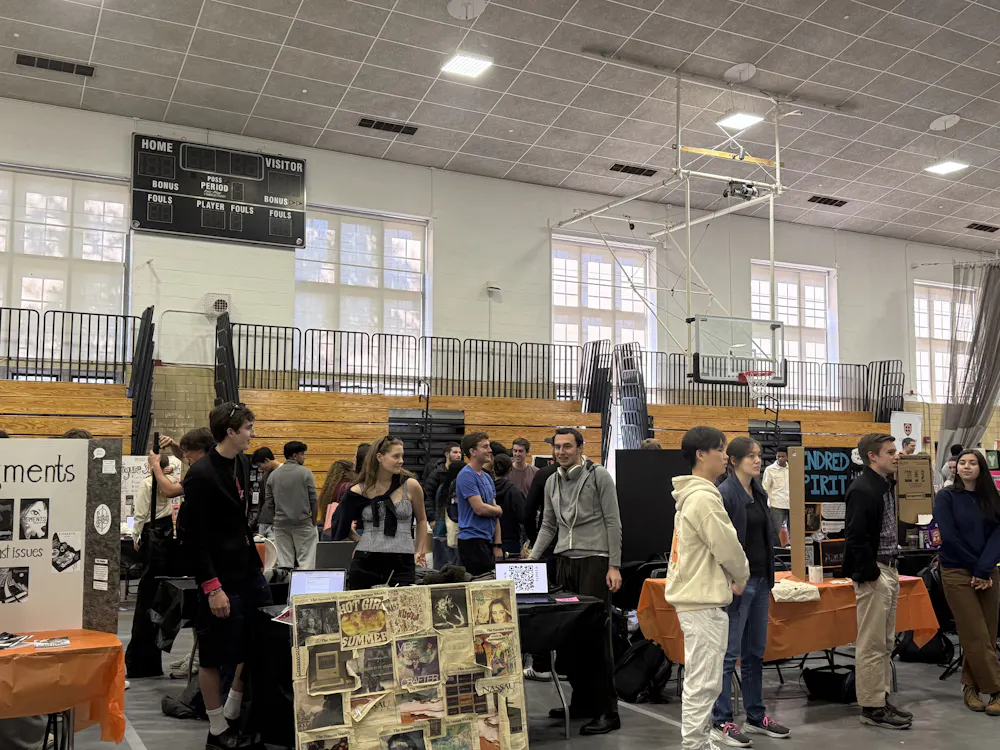
Students share mixed reactions as mandated officer and treasurer trainings return to in-person format
David EstradaThe University's student organization officers and treasurers returned to mandatory in-person training this fall after years of online sessions. Student reactions found parts of the training redundant or tedious, though most agreed the sessions were important.
The University's student organization officers and treasurers returned to mandatory in-person training this fall after years of online sessions. Student reactions found parts of the training redundant or tedious, though most agreed the sessions were important.