



Over 100 people are crowded into a committee room of the N.J. State House, sitting in rows of wooden chairs, standing in the back and even lining the hallways. Five hours have passed since the public hearing on sterile needle exchange began, and the room grows quiet as another speaker is called to testify.
She sits at the desk, looks up at the faces of the state assemblymen and begins, "Hi, my name is Erin Blake, and I'm here representing the Princeton Justice Project's Needle Exchange Today (NEXT) campaign for Syringe Access."
Blake '06, president of the Princeton Justice Project (PJP), was one of many who testified before the N.J. Assembly's Health and Human Services Committee last Thursday in response to two bills that would legalize the sale and distribution of sterile syringes.
After seven hours of statements, the committee approved bills A3256 and A3257, which would allow residents 18 years or older to buy up to 10 syringes over the counter. The bills — passed by a 7-2 vote — were split along party lines with Democrats casting the seven positive votes.
If passed by the full assembly, the bills would also allow municipalities to establish needle exchange programs. This service would send health care providers into effected communities to exchange clean needles for dirty ones used by intravenous drug users.
"The bottom line is that many addicts don't have the wherewithal to seek drug treatment," said Assemblyman Reed Gusciora, third co-prime sponsor of the bill and legislator for Princeton's district. "Now they will have direct contact with health care providers."
The committee's approval represents a surge of support for sterile syringe legislation that has been wallowing in the state Congress for over a decade because of its relation to intravenous drug use.
"The facts speak for themselves," Gusciora said. "The spread of AIDS through intravenous drug use is getting worse; we've gotten to the point of a public health crisis."

New Jersey and Delaware are the only two states that do not allow needle sales in local pharmacies.
In August, Gov. James McGreevey said he would sign the bill into law. With McGreevey's impending Nov. 15 resignation, he has had "the freedom to tackle some difficult issues. McGreevey tasked [Health and Senior Services] Commissioner [Clifton] Lacy to work with the legislature and come up with a proposition to pass the needle exchange program" before he leaves office, McGreevey spokesperson Juliet Johnson said.
University Chief Medical Officer Daniel Silverman also supports the needle exchange bills. "Those individuals determined to use I.V. drugs will use whether or not clean needles are made available to them," he said. "Offering them needle exchange or access to small numbers of clean syringes over the counter may help prevent the spread of deadly diseases that complicate the course of I.V. drug abuse, and which reduce the use of precious medical resources to treat avoidable illness."
Statistics show that over 31,000 New Jersey residents have AIDS or are living with HIV, placing the state fifth nationally in cumulative AIDS cases. Roughly one third of the state's current cases are related to injection drug use, according to the most recent New Jersey HIV/AIDS report.
Opposition to the bills
But there remains vehement opposition to the bills in the assembly and among residents. Assemblymen Sam Thompson and Eric Munoz said the needle exchange program is irresponsible public policy and state funds would be better spent on drug treatment programs, according to a press release from their offices.
Clarke Smith '07, a 'Prince' sports writer and secretary of the College Republicans, agrees. "I think this proposal is absolutely ridiculous," Smith said. "In my opinion, it amounts to state sanction of drug use. While it may cut down on immediate health risks of sharing needles, the proposal will foster addiction to hard drugs."

Smith believes money would be better spent on drug prevention and rehabilitation programs.
PJP's continued support
The PJP has supported this initiative through its N.E.X.T. Campaign for Needle Exchange and Syringe Access since its founding in 2001.
Thursday's testimony marks the sixth time a member of the PJP has supported sterile needle exchange before the Assembly. "Initially [legislators] don't regard us in high esteem, but once they hear our testimonies and see how much research we've done, they treat us with respect," Blake said.
The N.E.X.T. Campaign is one of the PJP's seven community-oriented projects.
The idea for the group sprang from professor Kiki Jamieson's POL 317: Discrimination and the Law class when students were tired of reading about issues like poverty and hunger in books and "wanted to have an impact and take what they were learning into the real world to try to create change," Blake explained.
The PJP's next initiative will be sponsoring English as a Second Language (ESL) classes for university workers, primarily those who work for dining and building services. The group is also planning a conference this spring on prison reform.
Read More

Princeton University Orchestra and men’s ultimate frisbee team named in University’s latest hazing report
Andrew ArthurTwelve students in the Princeton University Orchestra and Men's Ultimate Frisbee team were found responsible for hazing violations in the University's latest Campus Hazing Transparency Report. Sanctions ranged from Dean's warnings to disciplinary probation.
Twelve students in the Princeton University Orchestra and Men's Ultimate Frisbee team were found responsible for hazing violations in the University's latest Campus Hazing Transparency Report. Sanctions ranged from Dean's warnings to disciplinary probation.

Murray-Dodge Café celebrates 50th Anniversary, drawing over 260 students
Hifza KaleemOn Wednesday, Murray Dodge Cafe celebrated its 50th anniversary, drawing more than 260 students to celebrate with free cookies and merchandise.
On Wednesday, Murray Dodge Cafe celebrated its 50th anniversary, drawing more than 260 students to celebrate with free cookies and merchandise.
Students share mixed reactions as mandated officer and treasurer trainings return to in-person format
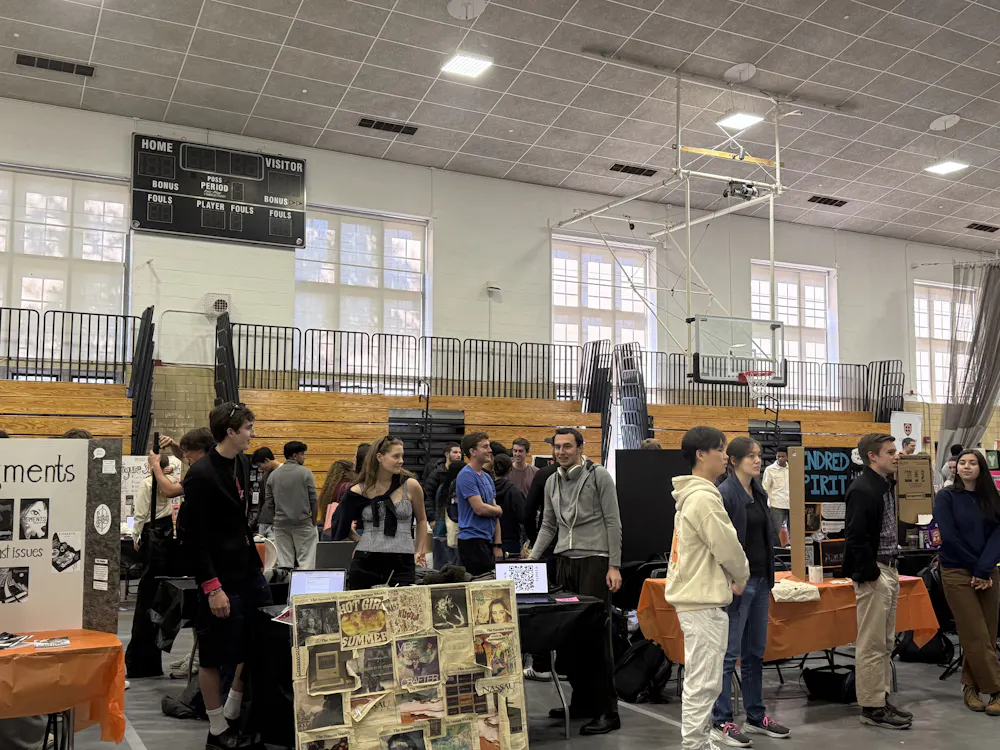
David EstradaThe University's student organization officers and treasurers returned to mandatory in-person training this fall after years of online sessions. Student reactions found parts of the training redundant or tedious, though most agreed the sessions were important.
The University's student organization officers and treasurers returned to mandatory in-person training this fall after years of online sessions. Student reactions found parts of the training redundant or tedious, though most agreed the sessions were important.