



Not far from Nassau Street, a vacant lot on Paul Robeson Place has been transformed over the summer into a "Writer's Block" — a garden of sculptures created by teams of local writers, architects and builders.
A project conceived of and implemented by a team of full-time volunteers from the Princeton area, the garden has 11 "follies," or structures that serve an aesthetic, rather than a practical, purpose.
Many of the writers are University professors.
Project Coordinator Peter Soderman describes the enterprise as a matter of seizing opportunity. "You've got a vacant lot that's sat vacant for 12, 14 years, and you've got more writers per capita and more architects per capita than almost any other town," he said. "It's pretty obvious that you should marry the two."
The result is part garden, part sculpture, part open-air museum where visitors wander from pavilion to pavilion among sunflowers and 15-foot corn stalks.
The lot, owned by Palmer Square and slated for housing construction later this fall, and was donated temporarily for the sculpture garden. Ground was broken for the garden on June 6, and it was completed by early August.
The resulting structures range from a rotating tool shed created by creative writing professor Paul Muldoon and architects Juliet Richardson and Richard Smith to Cornel West GS '80's circle of optical illusion designed by Sharon McHugh and John Nastasi.
Paul Krugman collaborated with Ron Berlin on a pyramid resembling the one on the back of the dollar bill. Peter Wasem designed a greenhouse structure inspired by Peter Singer's campaigns for animal rights.

Kevin Wilkes '83, an architect with Princeton Design Guild and site coordinator for Writer's Block, said the structures represent architects' response to writers' works as much as a response to their personalities.
"The architects did the bulk of the heavy lifting," Wilkes said. "The authors did their work a long time ago when they wrote what they wrote."
Wilkes, who oversaw much of the project, also designed James McPherson's pavilion, which entailed spending weekends reading the professor's Civil War books.
One of the first University professors to become involved was Paul Muldoon, a Howard Clark '21 Professor in the creative writing department. Muldoon said the project exemplified what he called, "a very good feeling between the town and the gown."
The idea for Muldoon's structure, a tool shed, came from playwright George Bernard Shaw, he said, who wrote many of his most famous works in a shed that he could rotate to face the sun.
Building a structure is just like writing a poem, Muldoon said. "We're talking about making things. The poem is a construct. It has to stand. It has to obey the laws of physics."

The team of volunteers that have created the garden emphasize its role in the community around it. Wilkes spoke of it as a means to share a vision of the potential for downtown Princeton.
"Peter [Soderman] and I wanted to quietly, by demonstration, make the case for beauty in downtown Princeton," said Wilkes. "It brings a lightheartedness, sense of humor, and wonderment to downtown."
Soderman also said the garden will provide refuge for those shopping downtown. "You have people staggering like woebegone wildebeests between P.J.'s Pancake House and Starbucks. Where's the mecca? The mecca is here," he said, gesturing to the garden around him.
"What gives this garden power is that it was built solely on the strength of volunteerism. That gives it sanctity, a quiet sense of pride," he said.
Construction of the garden was funded almost entirely out of pocket of the architects, builders and other community members who volunteered their time. The follies are to be auctioned off individually at the end of next month, and the money left over after each team recovers its investment will go to a cause of the team's choosing.
A welcoming party for University students and faculty will be held today from 4 p.m. to 6 p.m.
A party for the community, catered by the restaurant Mediterra, will be held on Sunday from 1 p.m. to 4 p.m. The garden also hosts various events open to the community, like pilates and Chinese tea ceremony classes. A schedule of events and more information about the garden can be found at www.princetonwritersblock.com.
Read More

Princeton University Orchestra and men’s ultimate frisbee team named in University’s latest hazing report
Andrew ArthurTwelve students in the Princeton University Orchestra and Men's Ultimate Frisbee team were found responsible for hazing violations in the University's latest Campus Hazing Transparency Report. Sanctions ranged from Dean's warnings to disciplinary probation.
Twelve students in the Princeton University Orchestra and Men's Ultimate Frisbee team were found responsible for hazing violations in the University's latest Campus Hazing Transparency Report. Sanctions ranged from Dean's warnings to disciplinary probation.

Murray-Dodge Café celebrates 50th Anniversary, drawing over 260 students
Hifza KaleemOn Wednesday, Murray Dodge Cafe celebrated its 50th anniversary, drawing more than 260 students to celebrate with free cookies and merchandise.
On Wednesday, Murray Dodge Cafe celebrated its 50th anniversary, drawing more than 260 students to celebrate with free cookies and merchandise.
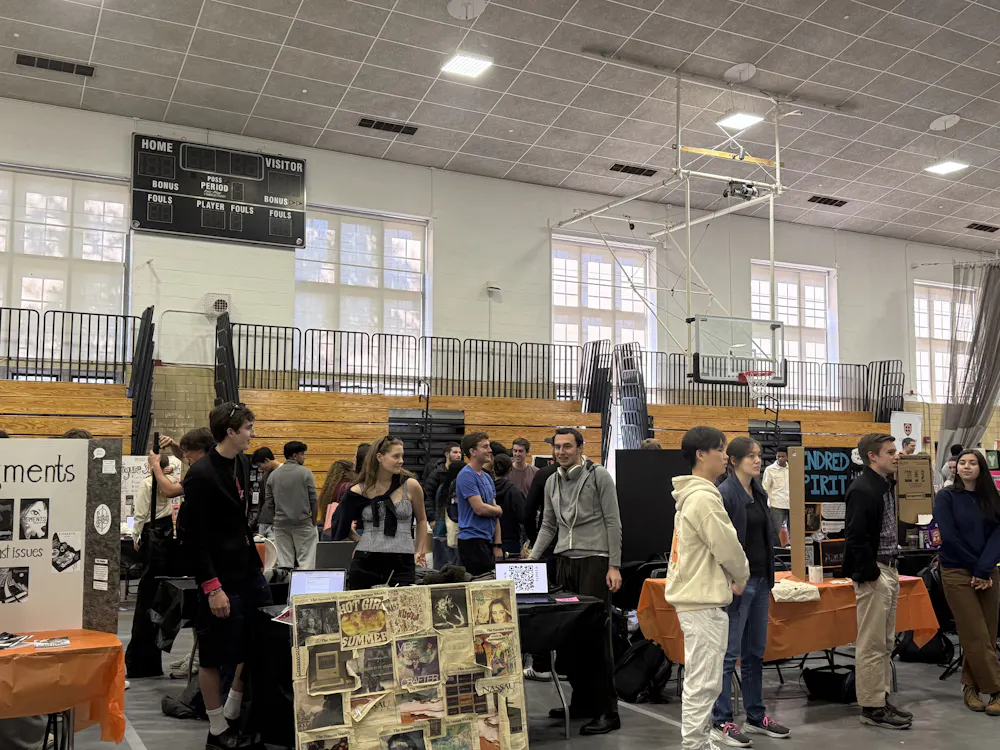
Students share mixed reactions as mandated officer and treasurer trainings return to in-person format
David EstradaThe University's student organization officers and treasurers returned to mandatory in-person training this fall after years of online sessions. Student reactions found parts of the training redundant or tedious, though most agreed the sessions were important.
The University's student organization officers and treasurers returned to mandatory in-person training this fall after years of online sessions. Student reactions found parts of the training redundant or tedious, though most agreed the sessions were important.