



Imagine, for a moment, explaining to a six-year-old boy — his name is Danny — what it means to be the provost of Princeton University.
You explain that it's "sort of like being the vice president of the University."
"So, what do you do?" he asks.
"Well, I help the president," you reply after a pause, trying to keep things simple as possible.
Danny looks at you, wide-eyed and smiling. He's got it.
"Like when she declares war?" comes the reply.
Sitting in his new Nassau Hall office, Christopher Eisgruber '83, the University's new provost, is laughing.
"So that explanation didn't work so well," he says, "and I tried to give him a better sense of what our president does since we don't have any plans to take over Yale — during this administration, at least."

Danny's still having a little trouble with the concept. He remains convinced that his daddy has some degree of responsibility for University security. That may be true, but Eisgruber, formerly the director of the Program in Law and Public Affairs, has a lot more on his plate now.
As the second-ranking officer of the University, the provost is responsible for Princeton's overall academic program and provides general oversight for many University operations. He also chairs the Priorities Committee and makes recommendations regarding the University budget to the President and the Board of Trustees. He succeeds Amy Gutmann, who left to take over as president of the University of Pennsylvania.
Eisgruber speaks of the many projects ahead of him, which include supervising the construction of the library along with the University's other major construction project: Whitman College.
"You know, generally, the provost's job is about recognizing things that are going on on campus, projects being implemented, and helping to make what people are doing successful," he says, pointing out developments in the School of Engineering and Applied Science, genomics institute and Wilson School, including the recruitment of new star faculty members and the development of new curricula.
His priorities include the recruitment of creative arts students — "students of any color hair whatsoever and green-haired students who can do whatever they want to do" — developing new opportunities for students and faculty in neuroscience and African-American studies, and the recruitment of minorities in all ranks of the University community.
Acknowledging the recent departures of several minority staff members, Eisgruber says, "if people are expressing their concerns, then we should take those concerns seriously and we should challenge ourselves to do better in every area."

In the aftermath of the Isenberg affair — in which an assistant professor in the history department was denied tenure, to the dismay of many students — Eisgruber says a review of the tenure process will be conducted, but not this year.
"Let me say at the outset it's a very complicated debate," he says. "On the one hand you can look at our faculty and say the rate of tenuring is low. On the other hand you can look at the composition of our faculty and say, well, the proportion of tenured faculty is high."
It's too soon to speculate what the review will entail, he adds, noting that the focus should be on "fairness" and a guarantee that professors who receive tenure are currently performing and will continue to perform "at the highest levels."
Despite the multitude of projects Eisgruber's office is coordinating, he is adjusting well.
"I'm feeling very comfortable these days," says Eisgruber. "For a long time, I would come into my office and the learning curve was extremely steep — it's still steep."
From physics to law
It's been an interesting journey for Eisgruber, though not as long a journey as one might imagine. At 42, he's one of the youngest of the president's top deputies.
Though he majored in physics as an undergraduate at the University, Eisgruber soon learned that he had another calling. It was during a 300-level theoretical physics course, Eisgruber recalls, when he understood it was time to shift direction.
"Theoretical physics was not meant for me," he says with a chuckle.
Though he completed his A.B. in the department, Eisgruber decided to focus on political theory as a grounding for later work in constitutional theory when he won a Rhodes Scholarship after graduation. He credits yet another Princeton course for that decision. "I took Constitutional Interpretation in my sophomore year from Walter Murphy," he says. "I knew that that's what I wanted to do in my life."
Eisgruber received his masters from Oxford and a law degree from the University of Chicago, where he served as editor-in-chief of the University of Chicago Law Review. He later clerked for a judge at the U.S. Court of Appeals and Justice John Paul Stevens at the Supreme Court. In 1990, he became an assistant professor at NYU Law and then moved to the Wilson School in Sept. 2000.
"Everything he does, he does well," said Andrew Bruck '05, one of the provost's three senior thesis advisees. Until he was named provost, Eisgruber served as a trustee of the American Whig-Cliosophic Society, including the period during which Bruck was president.
While all board members lead busy lives and often find it difficult to dedicate much time to Whig-Clio, Eisgruber never hesitated to get thoroughly involved.
But Eisgruber's skill doesn't end with administration and oversight. Bruck, who took a class with Eisgruber, counts him among the University's best professors. "I can't put my finger on it, but he's exactly what you'd want a Princeton professor to be," Bruck said. "He's accessible in exactly the way you'd envision a Princeton professor would be; he runs a class exactly how one should be run."
Research interests
Though Eisgruber won't be teaching for at least his first two years in office — he says he won't be able to give his students the attention they deserve while learning his new job — he will attempt to keep up with his research and scholarship.
"I will continue to write when I can, and I still hope to finish my next book by the end of this year," he says, noting that summers will offer him some extra time to pick up a pen or set his fingers to a keyboard.
Eisgruber, author of "Constitutional Self-Government," a book that defends judicial review and separation of powers as practical and necessary devices for implementing a non-majoritarian form of American democracy, takes his scholarship seriously.
He once wrote to his former boss, Justice Stevens, to criticize a decision made in a case in which Stevens lamented the demise of teaching in favor of scholarship in law schools across the country.
"While surveying the flood of law reviews that cross my desk, I have sometimes wondered whether law professors have any time to spend teaching their students about the law," Stevens wrote in his dissenting opinion in Central State University v. American Association of University Professors.
"That opinion was written up in The New York Times and Chris Eisgruber read it at breakfast on Sunday morning," Stevens said in an interview with The Daily Princetonian. "Because he is a very firm believer in the importance of scholarship by faculty members and he thought I was undermining his credo of the profession, he wrote me a long letter explaining how law review writing was a terribly important part of teaching."
Eisgruber laughs upon being reminded of the story, but stands ready to defend his beliefs. "If you want to really push intellect of the best young people that the world has to offer — which is what I think of our students — you can only do that by exposing them to the very best researchers — which is what I think of our faculty."
"One of the things I stressed to Justice Stevens was that the best teachers I knew were also engaged researchers," he continues, adding, with a chuckle, that, "he [Stevens] probably doesn't remember it the same way."
Despite the disagreement — albeit a cordial one — the two men still hold each other in the highest regard. "Chris is one of the finest students, one of the finest law clerks I've ever had," Stevens said.
Another of Eisgruber's former students testified to the new provost's potential. "I have a private bet [with one of my friends] over which of our advisors will make it big first," the student said. "Anne-Marie [Slaughter, Dean of the Wilson School] as secretary of state, or Chris as associate justice of the [Supreme Court]."
For now, Eisgruber is happy where he is. "I'm very happy in the job I have now," he says, reaffirming what he said after being named provost: he has no aspirations for becoming a university president. Indeed, there's plenty of work to do right now.
That's not to say there isn't time to relax. The provost can often be seen contently walking the grounds in front of Nassau Hall, ice cream from the Bent Spoon in hand.
"If I've been in meetings all day long, I'll usually go out and get ice cream," he says. "It just gets me out of the office. I'm looking out the window on a beautiful day like today and I've spent it inside. It's nice enough, but I could use a walk and get an energy boost."
People often refer to Eisgruber as the "nerd provost." The moniker comes as a surprise to him. He laughs and says, "If that's the worst thing I get called during my tenure, I'll be okay."
Read More

Princeton University Orchestra and men’s ultimate frisbee team named in University’s latest hazing report
Andrew ArthurTwelve students in the Princeton University Orchestra and Men's Ultimate Frisbee team were found responsible for hazing violations in the University's latest Campus Hazing Transparency Report. Sanctions ranged from Dean's warnings to disciplinary probation.
Twelve students in the Princeton University Orchestra and Men's Ultimate Frisbee team were found responsible for hazing violations in the University's latest Campus Hazing Transparency Report. Sanctions ranged from Dean's warnings to disciplinary probation.

Murray-Dodge Café celebrates 50th Anniversary, drawing over 260 students
Hifza KaleemOn Wednesday, Murray Dodge Cafe celebrated its 50th anniversary, drawing more than 260 students to celebrate with free cookies and merchandise.
On Wednesday, Murray Dodge Cafe celebrated its 50th anniversary, drawing more than 260 students to celebrate with free cookies and merchandise.
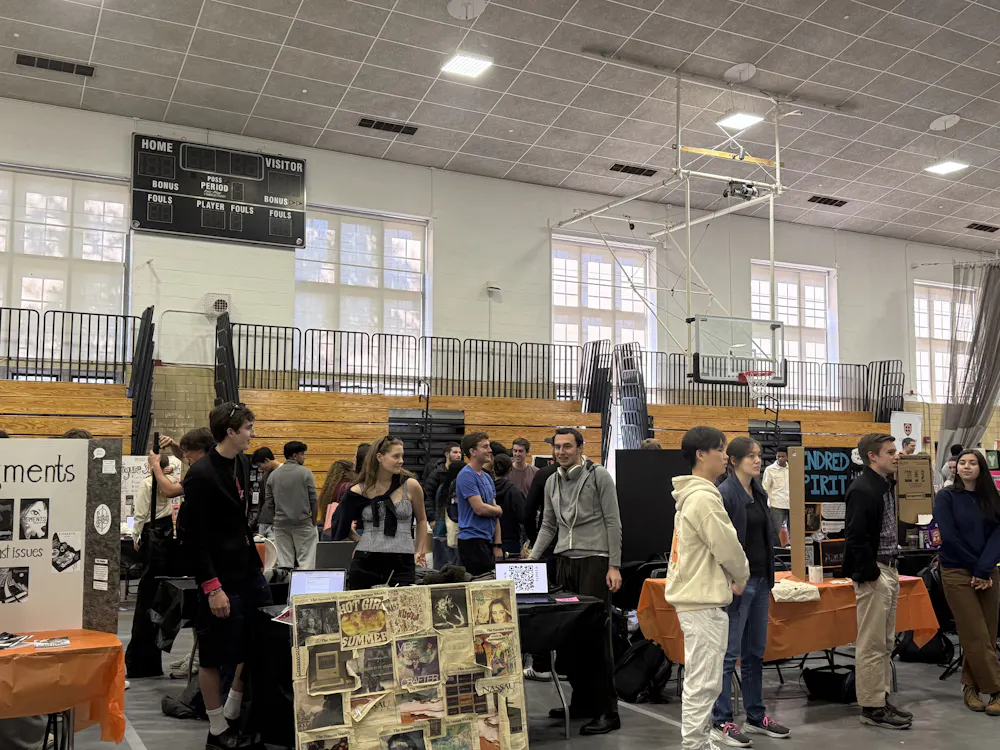
Students share mixed reactions as mandated officer and treasurer trainings return to in-person format
David EstradaThe University's student organization officers and treasurers returned to mandatory in-person training this fall after years of online sessions. Student reactions found parts of the training redundant or tedious, though most agreed the sessions were important.
The University's student organization officers and treasurers returned to mandatory in-person training this fall after years of online sessions. Student reactions found parts of the training redundant or tedious, though most agreed the sessions were important.