



The patrons of Ivy Inn don't flinch at the smoke that fills the bar and pool rooms, and wafts onto nearby tables.
"If some of these people couldn't smoke, they wouldn't be here," says a patron, who wished only to be identified as a longtime resident of Princeton. He sits down near the end of the counter and reaches for the white carton of cigarettes between his glass and a nearby ashtray, which is quickly filling up.
A friend sits down nearby. He carries a pack as well.
If the New Jersey State Senate bill S264, or the "Clean Indoor Air Act," passes, smoking will be banned in indoor public places like the Ivy Inn.
The law made it out of a state senate committee last session, only to be tabled before coming to a full vote. Legislators are looking to reintroduce it this session.
The act would ban smoking in "the common areas of all enclosed indoor places of public access."
This isn't the first time the area has faced a smoking ban. The Annex, Ivy Inn, Lahiere's and the National Smokers' Alliance successfully sued in 2000 to overturn a similar proposal by the Princeton Regional Health Commission for Princeton Borough and Township.
However, the pursuit of a smoking ban has remained high on the Commission's agenda.

"After 2000, we were looking for some kind of legislation that would give municipalities the right to ban smoking in certain places," Princeton Regional Health Officer David Henry said. "A state ban would be even better."
In fact, a commission member will attend a meeting about the reintroduction of S264.
Though community establishments may have to ban smoking, the proposed law exempts eating clubs — and other "building[s] owned and operated by a social, fraternal or religious organization."
Eating clubs were included in the 2000 ban until several successfully petitioned for exemption.
Public health concerns
Advocates of the proposed ban call secondhand smoke a leading health concern.
"[Decreasing exposure to secondhand smoke] is an important public health prevention step," Henry said. "The less exposure we have, the less health problems we'll have from that."

And Henry's concerns fall within a national context as well.
Massachusetts passed a smoking ban for restaurants and bars this past July.
California and Delaware have banned smoking in bars, while Idaho and others have banned smoking in restaurants.
Municipalities are currently the only New Jersey entities allowed to ban smoking, and only in case of fire hazards.
Local concerns
As in 2000, local businesses are concerned about how the act might affect them.
The proposal would be unnecessary regulation, according to Richard Carnevale, owner of the Annex and critic of the 2000 smoking ban.
"In New York it's hard to enforce the ban. But this town is so small that if a person sees smoke inside a bar, it's not too hard to make a stink about it and levy fines," Carnevale said. "I think government is overstepping its bounds."
Carnevale believes restaurants should be allowed to regulate themselves.
For example, the Annex has gradually expanded its nonsmoking accommodations to include all areas of the restaurant except the bar.
"Our solution was based on what our clientele wanted," Carnevale said. "The problem with this legislation is that it's not looking at human nature."
However, the act's timeline is uncertain. It has yet to be reintroduced to the floor this session and no vote is planned.
Read More

Princeton University Orchestra and men’s ultimate frisbee team named in University’s latest hazing report
Andrew ArthurTwelve students in the Princeton University Orchestra and Men's Ultimate Frisbee team were found responsible for hazing violations in the University's latest Campus Hazing Transparency Report. Sanctions ranged from Dean's warnings to disciplinary probation.
Twelve students in the Princeton University Orchestra and Men's Ultimate Frisbee team were found responsible for hazing violations in the University's latest Campus Hazing Transparency Report. Sanctions ranged from Dean's warnings to disciplinary probation.

Murray-Dodge Café celebrates 50th Anniversary, drawing over 260 students
Hifza KaleemOn Wednesday, Murray Dodge Cafe celebrated its 50th anniversary, drawing more than 260 students to celebrate with free cookies and merchandise.
On Wednesday, Murray Dodge Cafe celebrated its 50th anniversary, drawing more than 260 students to celebrate with free cookies and merchandise.
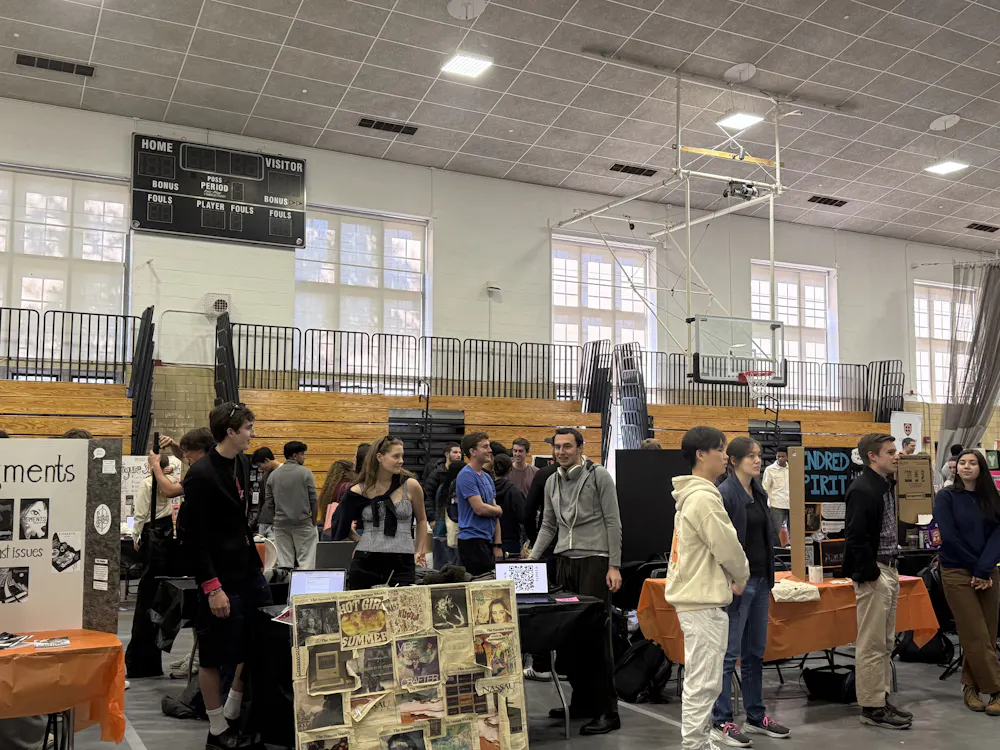
Students share mixed reactions as mandated officer and treasurer trainings return to in-person format
David EstradaThe University's student organization officers and treasurers returned to mandatory in-person training this fall after years of online sessions. Student reactions found parts of the training redundant or tedious, though most agreed the sessions were important.
The University's student organization officers and treasurers returned to mandatory in-person training this fall after years of online sessions. Student reactions found parts of the training redundant or tedious, though most agreed the sessions were important.